AI for Sales Prospecting The Smart Way
December 5, 2025
Think of AI for sales prospecting as a powerful assistant for your sales team. It's not about replacing people; it's about giving them superpowers. The core idea is to use intelligent software to automate the most grueling parts of finding, qualifying, and contacting potential customers so your reps can focus on what they do best: building relationships and closing deals.
What Is AI Sales Prospecting and Why It Matters
Remember the old way of prospecting? It was like trying to find a needle in a haystack. You'd spend hours digging through outdated lists, making endless cold calls, and blasting out generic emails, just hoping something would land. It was a numbers game, and frankly, it was exhausting and often demoralizing.
Now, imagine you had a tool that could instantly find every single "needle" in that haystack for you—every person who is a perfect fit for what you sell. That’s what AI for sales prospecting brings to the table. It turns the guesswork of sales into a sharp, data-driven strategy.
Instead of being a replacement for skilled salespeople, these AI tools act as their indispensable partners. They handle the repetitive, time-consuming tasks, freeing up reps to spend their time understanding customer problems, building genuine rapport, and closing bigger deals. For a deeper dive into how these intelligent systems identify potential clients, this AI-driven lead generation guide is an excellent resource.
From Manual Grind To Strategic Conversations
Let's be clear: this isn't just a fleeting trend. It's a fundamental shift in how successful sales teams get things done. In fact, 56% of sales professionals are already using AI tools in their daily work, and those who do are twice as likely to crush their sales targets. The reason is simple: AI replaces gut feelings and manual digging with real, actionable insights.
So, how does this actually work? AI-powered platforms can:
- Find Your Ideal Leads: They sift through millions of data points to pinpoint prospects who precisely match your ideal customer profile (ICP).
- Automate Deep Research: They instantly pull together critical information about a company and its decision-makers, saving your team from hours of manual searching.
- Personalize Your Outreach: They help you craft tailored messages based on a prospect's recent activities, challenges, and background, which dramatically increases response rates.
At its heart, AI for sales prospecting is about working smarter, not harder. It helps your team focus their energy where it matters most, leading to a healthier pipeline and faster growth.
This technology allows your team to finally move beyond generic, high-volume outreach. Instead, you can engage prospects with relevant, timely, and personalized communication from the very first touchpoint, building a stronger foundation for a lasting customer relationship.
Traditional Prospecting vs AI-Powered Prospecting
The difference between the old way and the new way is stark. This table breaks down exactly how the game has changed.
| Aspect | Traditional Prospecting | AI-Powered Prospecting |
|---|---|---|
| Lead Sourcing | Manual list building, purchased lists, cold research | Automated, data-driven discovery of ideal customer profiles |
| Efficiency | Low; time-intensive and repetitive | High; automates research and data entry, freeing up reps |
| Personalization | Generic, one-size-fits-all templates | Hyper-personalized outreach based on real-time data and triggers |
| Accuracy | High margin of error, often relies on outdated info | Highly accurate, with real-time data verification |
| Focus | Quantity over quality (high volume, low conversion) | Quality over quantity (targeted, high-intent prospects) |
| Strategy | Based on gut feelings and past experiences | Data-driven and predictive, based on success patterns |
| Outcomes | Inconsistent pipeline, long sales cycles, high burnout | Predictable pipeline, shorter sales cycles, higher morale |
Ultimately, while traditional prospecting casts a wide, hopeful net, AI-powered prospecting uses a precision-guided lure. The result is a more efficient, effective, and rewarding process for everyone involved.
How AI Tools Actually Supercharge Your Prospecting Workflow
To really get what AI for sales prospecting can do, you have to look under the hood. It’s not some magic button you push. Think of it more like a high-performance pit crew for your sales reps—a whole system of smart functions working together to make the entire prospecting process faster, sharper, and far more precise.
Let's break down the core capabilities that turn an SDR's daily grind into a strategic, high-impact operation. Each one builds on the last, creating a powerful cycle of finding, understanding, and engaging the right people at exactly the right time.
This image perfectly captures the shift from the old way of doing things—manually sifting through endless lists—to the intelligent, targeted approach that AI makes possible.
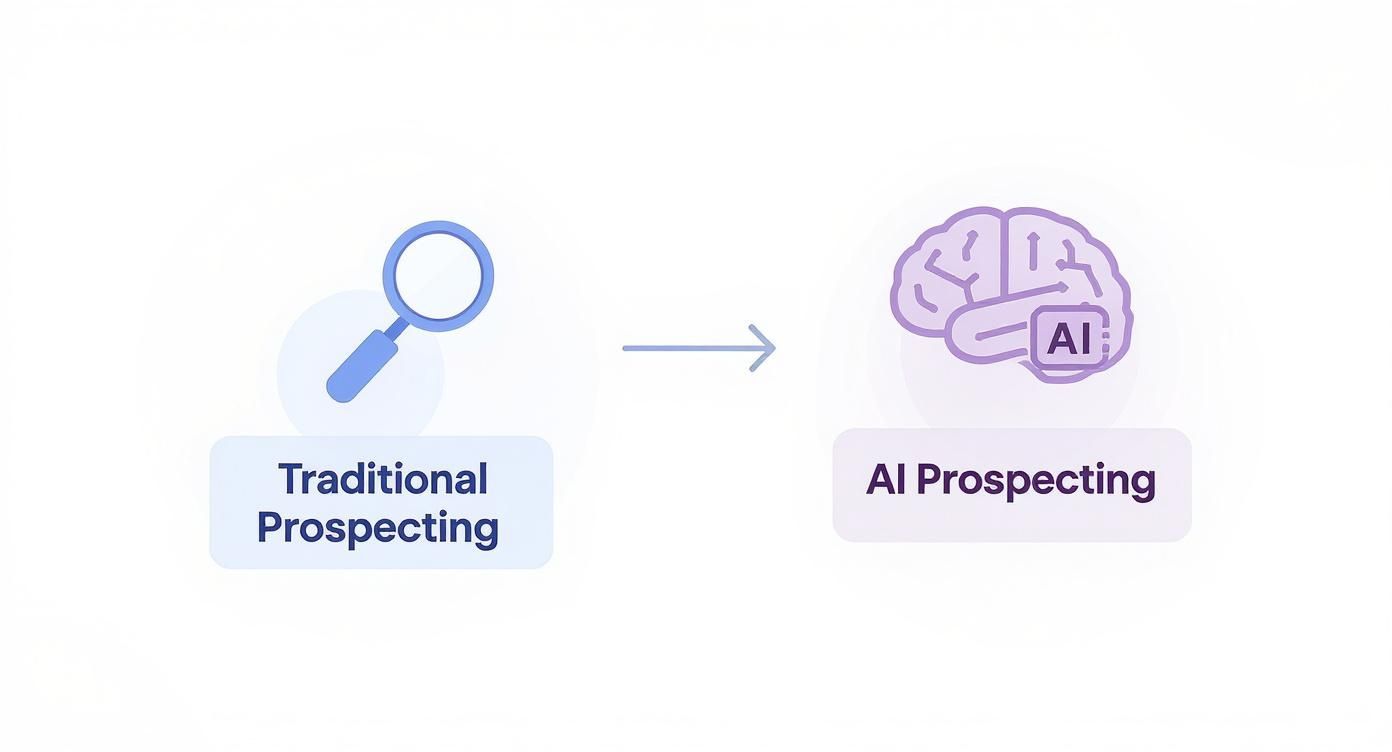
You can see how AI acts as both a filter and an amplifier. It helps you cut through the noise to focus your energy on high-value conversations that actually go somewhere.
Automated Lead Discovery and Scoring
First things first, an AI prospecting tool has to find your ideal customers in a massive ocean of data. Instead of wasting hours scrolling through LinkedIn or buying stale, outdated lists, these platforms comb through thousands of data points in real time. We're talking company websites, news articles, social media chatter, and even job postings to pinpoint prospects who perfectly match your Ideal Customer Profile (ICP).
But it goes much deeper than just matching keywords. A real game-changer is the platform’s ability to handle AI lead scoring, which helps you prioritize the absolute best opportunities. The system gets smarter over time, learning from your past wins and losses to spot the subtle patterns that signal a prospect isn't just a good fit, but is actually ready to have a conversation.
By analyzing behavioral signals, an AI can tell you which leads are actively showing buying intent. This lets your team focus its precious energy on conversations that are far more likely to turn into revenue.
This automated discovery and scoring process keeps your pipeline filled with quality, relevant leads. It takes the guesswork and grunt work out of the equation.
Intelligent Data Enrichment
Okay, so you've found a potential lead. Now what? The next headache is getting accurate information. We've all been there—spending hours hunting for the right email address, direct dial, and company details, only to come up empty or with bad data.
AI-driven enrichment fixes this in seconds. These tools automatically check multiple databases and online sources to find and verify contact information. But they don't stop there. They also enrich the lead's profile with crucial context, like:
- Technographic Data: What software and tools are they already using?
- Firmographic Details: How big is the company? What's their revenue and growth rate?
- Recent Trigger Events: Did they just get a round of funding, hire a new VP, or announce an expansion?
Having this level of detail gives your sales team a 360-degree view of the prospect before they even pick up the phone. It's the raw material for a genuinely personal and relevant conversation.
Hyper-Personalization at Scale
Everyone knows personalization is what breaks through the noise, but trying to do it for hundreds of prospects is a recipe for burnout. This is where AI really shines. It digs into all that enriched data to help you craft outreach that feels one-to-one, but without sacrificing scale.
For instance, an AI tool can scan a prospect's recent LinkedIn posts or company press releases to generate a custom opening line for an email. It might reference a new product launch or a shared connection, making your message feel researched and authentic. It’s no surprise that 54% of sales teams now use AI for customized outbound emails, and 45% use it to research their accounts.
This is a massive shift from the old spray-and-pray method. You can now create thousands of unique, relevant messages in the time it used to take a rep to painstakingly write just a few.
Smart Sequencing and Automation
Finally, AI takes over the relentless follow-up needed to actually book a meeting. Instead of your reps trying to manually track who to email and when, AI-powered sequencing tools manage the entire outreach cadence for them.
And these aren't your basic, time-based email drips. Modern AI platforms use intelligent automation that adapts to what your prospect does.
- If a prospect opens your email three times but doesn't reply, the AI can schedule a friendly nudge for the next day.
- If they click on a link to a case study, the system can follow up with a message that specifically addresses that topic.
- The moment they reply, they’re automatically pulled from the sequence so a real human can take over.
This ensures your follow-ups are always timely and relevant, keeping you top-of-mind without being annoying. It turns follow-up from a manual chore into a smart, automated system that nudges leads toward a conversation.
Measuring the Real-World Impact of AI Prospecting
The flashy features of an AI platform are one thing, but what really matters are the results. When you strip away the buzzwords, the real test for AI in sales prospecting is whether it delivers a measurable return on your investment. How does automating all that research and personalizing outreach actually beef up your bottom line?
It all comes down to tracking a few critical metrics that tell the whole story. When you let AI handle the mind-numbing manual work, you set off a powerful chain reaction. Your Sales Development Reps (SDRs) stop wasting their days digging for contact info and start spending their time in actual conversations with prospects who are genuinely a good fit.
That shift—from admin grunt work to strategic selling—is where the magic happens. Efficiency isn't just about speed; it's about re-investing your team's most precious resource, their time, into the activities that actually drive revenue.
Key Performance Indicators That AI Transforms
To see the real-world impact, you have to look beyond simple activity logs and focus on the key performance indicators (KPIs) that AI directly moves the needle on. These numbers give you a crystal-clear picture of how the tech is making your team not just more efficient, but far more effective.
Here are the big ones to watch:
- Increased SDR Productivity: This is the first thing you'll notice. By taking over research, data entry, and follow-ups, AI literally hands hours back to your team every single week.
- Improved Lead Quality: AI is brilliant at pinpointing prospects that perfectly match your Ideal Customer Profile (ICP) and are showing signs of buying intent. This means your pipeline gets filled with higher-quality opportunities, not just a higher volume of names.
- Higher Conversion Rates: It's a simple equation. When you have better leads and you reach out with highly personalized messages, you're going to get more positive replies, book more meetings, and—most importantly—close more deals.
The point of AI prospecting isn't to make your team busier; it's to make them more successful. A good platform connects every automated action to a tangible improvement in your pipeline health and revenue growth.
The proof is in the numbers. Teams that have really leaned into AI are seeing huge gains. Recent studies show sales teams using AI weekly report 78% shorter deal cycles, 70% larger deal sizes, and 76% improved win rates. On top of that, these reps report being 47% more productive, saving an average of 12 hours each week. You can dig into the full report on how AI is reshaping sales outcomes to see for yourself.
Calculating the ROI of Your AI Investment
Figuring out the potential ROI is the key to building a rock-solid business case for bringing in new tech. While every company’s numbers will look a little different, you can use a simple framework to get a pretty good estimate of the financial impact.
First, you need a baseline. How many hours does an SDR on your team currently burn on manual prospecting each week? What's your team's current meeting-booked rate?
Next, you can model what the future looks like with AI in the picture.
- Calculate Time Savings: If AI gives each SDR back 10 hours a week, multiply that by their hourly cost. That’s your immediate productivity ROI, right there.
- Estimate Increased Output: With those extra 10 hours, how many more qualified prospects can they realistically engage? Project the potential jump in meetings booked.
- Project Revenue Growth: Now, take your historical close rate and average deal size and apply them to those extra meetings. This gives you a clear, data-backed projection of the new revenue you can generate.
When you run these numbers, it becomes obvious that AI for sales prospecting isn't just another expense. It’s a revenue multiplier that fuels growth by freeing up your team to do what you hired them for: sell.
7 Steps to Choosing the Right AI Prospecting Platform
The market is absolutely flooded with tools promising to supercharge your sales process. But let's be honest, not all AI for sales prospecting platforms are built the same. Picking the right one isn’t about chasing the longest feature list; it’s about finding a true partner for your team's specific goals.
A bad choice burns through your budget, tanks team morale, and leads to abysmal adoption rates. The right platform, however, becomes the engine that drives your entire pipeline forward.
Think of it like hiring a key team member. You’d never bring someone on without checking their references, seeing how they’d fit your workflow, and making sure they have the skills to grow with you. The same logic applies here. You need a tool that's not just powerful, but also intuitive, trustworthy, and built for the long run.
Here’s what you need to focus on to cut through the marketing fluff and find a tool that delivers real, measurable results.
1. Dig Deep into Data Quality and Transparency
The heart of any AI prospecting tool is its data. If the data is garbage—inaccurate, old, or sourced unethically—the whole system is a waste of time. Your outreach will miss the mark, you could damage your brand's reputation, and you might even stumble into legal trouble.
This makes data quality the absolute, non-negotiable starting point.
When you're talking to vendors, don't be afraid to ask the tough questions:
- Where exactly do you get your data? You want to hear about multiple, reputable sources and a transparent process. Vague answers are a huge red flag.
- How often do you verify and update your information? The business world changes in a blink. A solid platform needs a continuous verification process to keep emails, job titles, and company details fresh.
- Are you compliant with privacy laws like GDPR and CCPA? This isn't just a nice-to-have; it's a must. The platform has to be built from the ground up with data privacy in mind to protect both your company and your prospects.
A platform that gets cagey about its data sources is telling you everything you need to know. A real partner will be proud of their data integrity and happy to walk you through their process.
2. Make Sure It Integrates Seamlessly with Your Workflow
The most powerful AI tool in the world is useless if your team won't use it. The number one killer of new software adoption is friction. If a platform forces reps to juggle tabs, manually copy and paste info, or abandon the CRM they live in all day, it's doomed to fail.
The goal is to find something that feels like a natural extension of your team’s current workflow, not another clunky system they have to learn.
A deep, two-way sync with your CRM is absolutely critical. This means data flows back and forth automatically, updating contact records, logging activities, and enriching profiles without anyone lifting a finger. For instance, a platform like Roger is built to slide right into your existing stack, meeting your sellers where they already work. This slashes the learning curve and gets your team to "aha!" much faster.
3. Plan for Scalability and Future Growth
The tool you pick today needs to support your team tomorrow. As your company grows, your prospecting needs will get more complex. You'll expand into new markets, hire more SDRs, and demand more sophisticated analytics. The tool that works for a team of three might completely buckle under the pressure of a team of thirty.
You need to ask how the platform scales across a few key areas:
- Volume: Can it handle a massive increase in lead searches, email sends, and active sequences without slowing down or breaking?
- Features: What’s on their roadmap? Are they planning to add advanced reporting, new integrations, or deeper personalization features that you might need in a year or two?
- Support: As your team gets bigger, will you get a dedicated customer success manager to help you refine your strategy, or will you be stuck in a generic support queue?
Choosing a scalable solution means your investment will keep paying off as your business expands. It helps you avoid the painful and expensive process of ripping out a tool and starting over right when you’re hitting your stride. You want an AI partner that grows with you, not one that holds you back.
To help you stay organized during your evaluation, use the checklist below. It covers the core features and critical questions to ask vendors to make an informed, side-by-side comparison.
AI Prospecting Platform Evaluation Checklist
| Evaluation Criteria | Key Questions to Ask | Ideal Answer/Feature |
|---|---|---|
| Data & Compliance | Where does your data come from? How often is it verified? Are you GDPR/CCPA compliant? | Multiple, reputable sources; daily/weekly verification; full compliance with clear documentation. |
| CRM Integration | Do you have a native, bidirectional integration with our CRM (e.g., Salesforce, HubSpot)? | Yes, a deep, native integration that automatically syncs contacts, activities, and data fields. |
| Core AI Features | Does your AI assist with ICP definition, lead discovery, and list building? | Yes, AI-powered ideal customer profile analysis and lookalike audience generation. |
| Personalization | Can the AI generate personalized email/LinkedIn copy based on prospect data? | AI writing assistant that uses prospect's title, company news, and LinkedIn activity for outreach. |
| Automation | Does the platform automate multi-channel sequences (email, LinkedIn, calls)? | Yes, with customizable steps, delays, and automated task creation for reps. |
| Usability | Can we get a team-wide trial? How intuitive is the user interface? | A "no-friction" UI and a free trial or pilot program to test adoption with real users. |
| Scalability & Support | What does your product roadmap look like? What support tiers are available? | A clear roadmap for new features and dedicated customer success managers for growing teams. |
| Analytics & ROI | What kind of reporting is available? How do you help us measure pipeline impact? | Dashboards tracking outreach metrics, meeting booked rates, and direct pipeline influence. |
This checklist isn't exhaustive, but it provides a strong foundation. By focusing on these core areas, you can confidently cut through the noise and select a platform that will truly empower your sales team and drive meaningful growth.
Your Step-by-Step Implementation Roadmap

So, you’ve invested in a powerful AI for sales prospecting tool. That’s the easy part. The real work is getting your team to actually use it in a way that moves the needle. Let's be honest, just dropping new software into your tech stack and hoping for the best is a recipe for a very expensive, very ignored line item in your budget.
A successful rollout isn't about the tech; it's about people and process. This roadmap will walk you through a structured rollout that avoids the common pitfalls. The goal is to make AI an indispensable part of your sales motion, not just another login your reps forget.
Phase 1: Define Success and Prepare Your Foundation
Before a single salesperson logs in, you need to know what winning looks like. Vague goals like "prospect better" won't cut it. You have to get specific and set the benchmarks that will prove this investment was worth it.
Set Clear, Measurable Goals: What, exactly, are you trying to accomplish? Define your KPIs with hard numbers. Are you aiming to increase qualified meetings booked per SDR by 20%? Or maybe you want to slash the time spent on account research by 50%? These metrics become your north star.
Audit and Cleanse Your Data: Here's a hard truth: your AI is only as good as the data you feed it. Garbage in, garbage out. Before you do anything else, conduct a serious audit of your CRM. Get rid of duplicates, standardize your data fields, and fill in the gaps on incomplete profiles. A clean dataset is non-negotiable if you want the AI to deliver accurate insights from day one.
Phase 2: Launch a Pilot Program
Don’t try to boil the ocean with a company-wide launch. Start small. A pilot program lets you work out the kinks, build an internal success story, and create a handful of evangelists who can vouch for the tool's value.
A motivated pilot group is your secret weapon. Pick a small team of your most tech-savvy, coachable reps—the ones who are always eager to try something new. Their feedback and success stories will be gold when it's time for the wider rollout.
During the pilot, zoom in on one or two high-impact use cases. For instance, you could focus on AI-powered lead scoring for the inbound team or have a small outbound group use it for automated email personalization. This tight focus makes it much easier to track results and show a clear, undeniable return.
Phase 3: Train for Workflow Transformation
Good training isn't about teaching people which buttons to click. It’s about fundamentally changing their daily habits. You need to focus on the why behind this new way of working, not just the what of the software.
Focus on Outcomes, Not Features: Nobody cares about a feature list. Frame the training around solving your team's biggest headaches. Show them how the AI directly reduces their manual research grind or helps them write outreach that actually gets replies—and leads to bigger commission checks.
Build Your First AI-Powered Playbooks: Work shoulder-to-shoulder with your pilot team to develop the first few prospecting sequences. Document exactly how they're using AI insights to personalize messages and spot buying signals. These initial playbooks become the proven template for the rest of your sales floor.
Integrate with Your Existing Tech Stack: Make sure the AI tool plays nicely with your CRM and other critical sales software. A clunky integration that forces reps to constantly switch between tabs is an adoption killer. The AI should feel like a natural, helpful extension of their current process.
Phase 4: Monitor, Optimize, and Scale
Implementation isn't a "set it and forget it" task. It's a continuous loop of learning and refinement. Keep a close eye on those KPIs you set back in Phase 1 to see what's working and what needs tweaking.
Schedule regular check-ins to get real feedback from the team. What do they love about the tool? Where are they getting stuck? Use what you learn to refine your playbooks and offer targeted coaching.
Once the pilot program is a proven success and you have a model that works, then you can confidently roll the platform out to the entire sales organization. Your pilot team will be your internal champions, driving excitement and showing everyone else what's possible.
Common Pitfalls in AI Prospecting (And How to Dodge Them)
Adopting AI for sales prospecting can feel like you’ve suddenly been handed a superpower. But like any powerful tool, if you don't know how to wield it properly, you can do more harm than good. It's easy to get caught up in the hype, but a few common missteps can quickly lead to wasted money, a demotivated team, and a tarnished brand.
The biggest mistake I see teams make? Thinking the AI can do everything on its own. It's a phenomenal co-pilot, not a replacement for a great salesperson. Let's walk through the most common traps and, more importantly, how to sidestep them.
The Danger of Over-Automation
It’s incredibly tempting to crank up the automation dial to eleven. The thought of reaching thousands of prospects while you sleep is alluring, but this is where things can go wrong—fast.
When you let the machine run completely wild, your outreach loses its soul. It starts to feel robotic, generic, and completely impersonal. Prospects are savvy. They can sniff out a mass-produced, copy-and-paste email from a mile away. Not only will your response rates tank, but you also risk getting your domain blacklisted as spam, which torpedoes your deliverability for everyone on the team.
The Solution: Think "human-in-the-loop." Let AI do 80% of the heavy lifting—the tedious research, the data crunching, the first draft. But always, always have a salesperson step in to review, tweak, and add that final human touch before hitting send, especially for your most important accounts.
Trusting Bad Data Blindly
There’s an old saying in tech: "garbage in, garbage out." With AI, this is truer than ever. Your AI platform is only as smart as the data you feed it. If your CRM is a chaotic mess of duplicate contacts, old phone numbers, and half-filled profiles, your AI will just amplify that chaos.
What does that look like in practice? Your team wastes time chasing down the wrong people, personalization tokens pull in hilariously incorrect information (like "Hi [FirstName] from [OldCompany]!"), and your entire strategy is built on a foundation of faulty analytics.
Treating data quality as a top priority is non-negotiable. Here’s how to get it right:
- Regular Audits: Block out time every quarter to actually clean up and standardize your CRM data.
- Data Governance: Create simple, clear rules for how new information gets into your system in the first place.
- Enrichment Tools: Invest in services that automatically verify and update contact details. This pays for itself almost immediately.
Ignoring Privacy and Compliance
In today's world of GDPR and CCPA, you can't just scrape data from anywhere and start blasting emails. How you collect and use prospect data is under a microscope. Ignoring these privacy regulations isn't just bad form—it’s a massive legal and financial gamble that can come with eye-watering fines.
A classic misstep is signing up with an AI vendor that’s cagey about where its data comes from or isn't fully compliant with global privacy laws. That puts all the risk squarely on your company's shoulders. You have to build your prospecting engine on a foundation of trust, and that starts with making sure every tool and process you use respects people's privacy and follows the law.
Got Questions About AI in Sales Prospecting? Let’s Clear Things Up.
Even with the best plan in hand, you're bound to have questions before you invest in an AI prospecting tool. It’s a big step. So, let's tackle the most common ones we hear from sales leaders who are right where you are.
How Much Do These AI Prospecting Tools Actually Cost?
The price tag on AI platforms can be all over the map, but you’ll typically run into a few common pricing structures. Many vendors charge on a per-user, per-month basis, which makes budgeting straightforward and predictable.
Others use a consumption-based model, where you pay for what you use—think cost per lead found or per email sent. You'll also see tiered packages, where a basic plan might give you lead discovery and some automation, while premium tiers unlock things like predictive analytics and white-glove support. The key is finding a plan that fits not just what you need today, but where you plan to be next year.
Is AI Going to Replace My Sales Reps?
This is probably the number one question we get, and the answer is a hard no. AI isn’t here to replace talented SDRs; it’s here to make them better. Think of it as the world’s best assistant, the one who takes all the tedious, soul-crushing tasks off their plate.
AI handles the grunt work—the manual research, the data entry, the endless follow-ups. This frees your team to do what humans do best: build real relationships, understand a prospect's tricky business problems, and have strategic conversations. It's about amplifying their skills, not making them obsolete.
How Fast Can I Realistically Expect to See a Return on Investment?
Every team is different, but most see a real ROI within the first few months. The first thing you'll notice is a huge jump in your team's productivity. When you give an SDR back hours of their week, they can spend that time talking to more qualified prospects. More conversations mean more meetings booked.
The full dollar-for-dollar ROI, the kind you measure in closed-won deals, usually starts to become obvious within two to three sales cycles. If you keep a close eye on your lead-to-meeting conversion rates and how quickly deals are moving through your pipeline, you'll have all the proof you need that the tool is directly boosting your revenue.
Ready to see how an AI co-pilot can transform your sales pipeline without all the complexity? Roger handles the entire outbound motion for you, from finding ideal customers to writing personalized outreach. Book more meetings while focusing on what you do best—closing deals.