Unlocking Growth With AI Lead Generation Software
January 8, 2026
Think of AI lead generation software as your team's smartest, fastest sales development rep—one that never sleeps. It's designed to automate the grunt work of finding, vetting, and reaching out to potential customers. This frees up your human reps to do what they do best: build relationships and close deals.
What Is AI Lead Generation Software?
Imagine you're at a massive conference, and your perfect customer is somewhere in the crowd. The old way of prospecting is like walking around, asking every single person what they do, hoping to get lucky. It's slow, exhausting, and mostly a waste of time.
Now, picture having a smart assistant that already knows who your ideal customer is. It scans the entire venue in seconds, hands you a list of the 50 best people to talk to, along with their names, titles, and even a few conversation starters. That's what AI lead generation software does for your sales process.
This isn't just another automation tool or a glorified contact database. It's a sophisticated system built to tackle the biggest bottleneck in sales: finding the right people and starting meaningful conversations with them, consistently and at scale.
From Manual Effort to Intelligent Automation
For years, sales development reps (SDRs) have been buried in low-value tasks. We're talking hours spent digging through LinkedIn, guessing email formats, and sending the same generic outreach message over and over. AI lead generation software completely flips that script.
Instead of manual drudgery, these platforms use intelligence to find your ideal prospects, confirm their contact information on the fly, and even help craft personalized messages that actually get a response. This is a game-changer for any team trying to build a reliable sales pipeline.
At its core, AI lead generation software replaces guesswork and manual labor with data-driven precision. It empowers sales teams to operate with an efficiency that was previously impossible, turning prospecting from a numbers game into a science.
Before we dive deeper, let's look at how this new approach stacks up against the old way of doing things. The difference is night and day.
Manual Prospecting vs. AI-Powered Lead Generation
| Activity | Manual Prospecting (The Old Way) | AI Lead Generation (The New Way) |
|---|---|---|
| Finding Leads | Reps manually search databases and social media. | AI automatically scans millions of data points to find ideal customer profiles. |
| Data Quality | Contact info is often outdated, leading to high bounce rates. | Real-time verification ensures data is accurate and up-to-date. |
| Personalization | Generic, one-size-fits-all templates. | AI generates personalized messages based on prospect's role, company, and activity. |
| Scale | Limited by the number of hours in a rep's day. | Can identify and engage thousands of prospects simultaneously. |
| Timing | Outreach is based on the rep's schedule. | Outreach is triggered by real-time buying signals (e.g., company news, tech changes). |
| Focus | 80% of time on research, 20% on selling. | 20% of time on research, 80% on selling. |
As you can see, the shift is dramatic. It's less about working harder and more about working smarter.
A Fundamental Shift in Sales Technology
The rapid adoption of these tools isn't just a trend; it's a fundamental change in how modern B2B sales teams are built. AI-powered lead generation has gone from a "nice-to-have" gadget to the engine driving pipeline growth for companies around the world.
The market for these tools is expected to jump from about $2 billion in 2025 to $7 billion by 2033, a growth rate that leaves the rest of the industry in the dust. You can explore the full research on AI lead generation market growth to see the data for yourself.
For B2B companies, this technology is no longer an optional upgrade—it’s becoming a requirement for staying competitive. It ensures you find every potential lead and make every conversation count, setting the stage for a stronger, more efficient sales cycle from the very first touch.
How AI Software Finds Your Next Customer
So, how does this AI software actually pinpoint your next customer? It's not some black box or magic trick. It's a smart, systematic process that sifts through mountains of raw data to find qualified meetings. Think of it as an intelligent assembly line for your sales pipeline, where each step adds another layer of precision and value.
This whole approach changes the game for sales teams by taking the most draining parts of prospecting off their plate. To really see how these platforms work their magic, it helps to have a solid grasp of existing B2B lead generation best practices—because the AI is built to supercharge and automate those very same principles.
Let’s pull back the curtain and look at how these systems work, stage by stage.
The diagram below gives you a bird's-eye view of the core workflow, from finding a prospect all the way to reaching out.
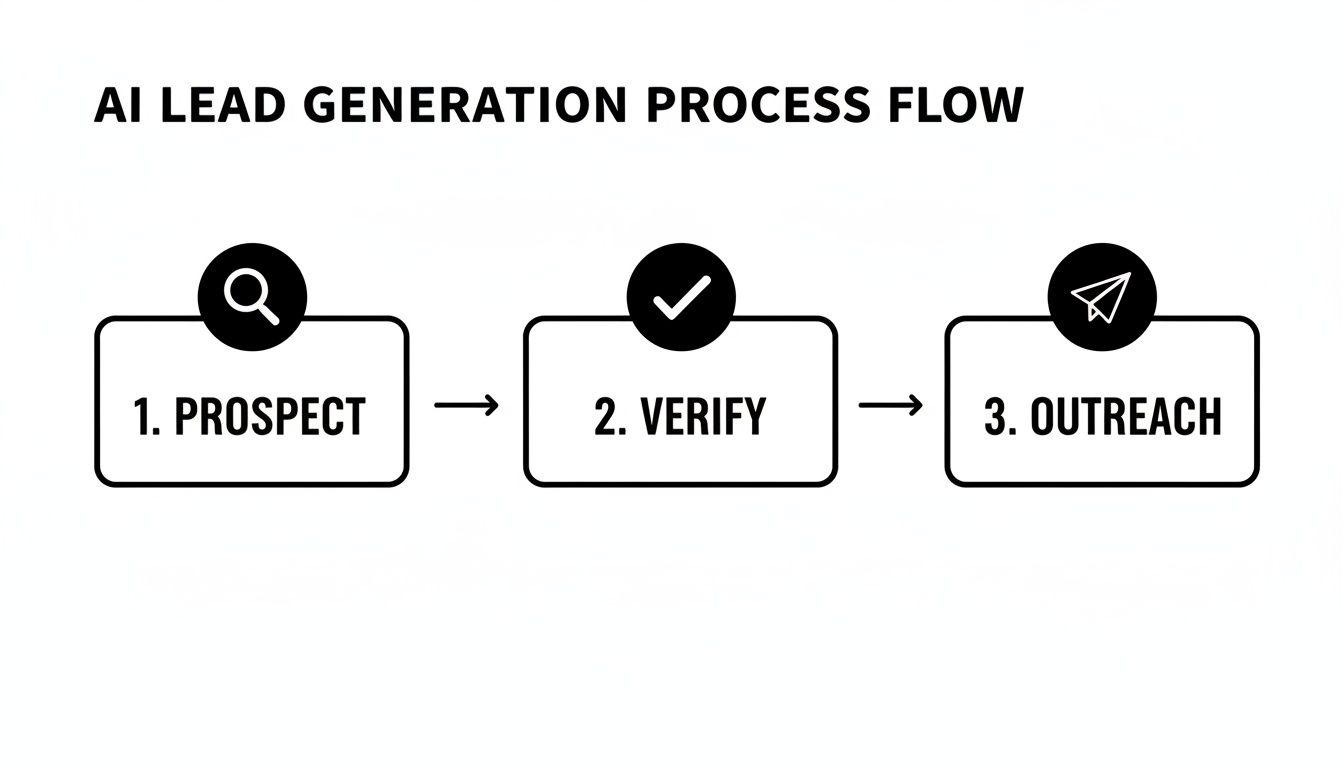
As you can see, the AI handles the entire flow: identifying the right people, making sure their info is correct, and then kicking off the conversation.
1. Intelligent Prospecting and Discovery
It all starts with intelligent prospecting. This is where the AI acts like a thousand researchers working around the clock just for you. First, you define your Ideal Customer Profile (ICP)—the exact industry, company size, job titles, and even the tech stack a company uses.
Once it has your marching orders, the AI gets to work, scanning millions of public data sources for anyone who fits the bill. These aren't random lists; the AI is pulling from dynamic sources like:
- Company Websites: To get a feel for their business, products, and mission.
- Professional Networks: Think LinkedIn, where it can pinpoint key decision-makers.
- News & Press Releases: To catch crucial buying signals like a new funding round, a recent expansion, or a leadership shake-up.
- Job Postings: A fantastic source for uncovering growth plans or technology gaps.
The AI cuts through all the noise to find the signals that actually matter. The result is a highly targeted list of accounts and contacts who are a perfect match. This is a massive upgrade from buying stale, outdated contact lists.
2. Automated Data Verification
Finding a potential lead is one thing; actually being able to reach them is another. Manually checking contact details is a soul-crushing task that’s often wrong anyway, leading to bounced emails that can wreck your domain’s reputation. This is where automated data verification is a lifesaver.
The AI lead generation software cross-references multiple data points in real time to make sure an email address is valid, a social profile is active, and even a phone number is correct. This one step alone can boost deliverability to over 95%, making sure every message you send actually has a chance to be read.
By cleaning and verifying data before you hit send, the AI protects your sender reputation and stops your sales team from wasting time on dead ends. It’s the quality control step that traditional prospecting has always been missing.
3. Hyper-Personalization at Scale
Let’s be honest: generic, one-size-fits-all emails are dead. Buyers today expect you to do your homework, but researching every single prospect by hand just isn't scalable. This is where AI truly flexes its muscles, enabling hyper-personalization for every single lead.
The system digs into a prospect’s recent activity—their LinkedIn posts, company news, professional background—and uses that intel to generate unique, human-sounding conversation starters. For example, it might craft a line congratulating them on a recent company award or mentioning a relevant article they shared. It creates an instant, authentic connection.
This is worlds away from just sticking a {{first_name}} and {{company_name}} in a template. It's about building contextually aware messages that show you’ve actually paid attention, which is why reply rates skyrocket.
4. Dynamic Outreach Sequencing
Finally, the AI plays conductor for the entire outreach campaign. Instead of firing off one email and hoping for the best, the software runs a dynamic outreach sequence across multiple channels, like email and LinkedIn.
It smartly times follow-ups based on whether a prospect is engaging, spreading the touchpoints over several days or weeks to stay on their radar without being annoying. If a lead opens your email but doesn't reply, the AI might schedule a LinkedIn connection request two days later.
This automated persistence is the key to breaking through the noise and booking meetings. It ensures no qualified lead ever slips through the cracks again.
What AI Actually Does for Your Bottom Line
It's one thing to understand the mechanics of how AI finds and engages potential customers. But let's be honest, the real question is about the bottom line. What tangible results can your business actually expect from bringing in AI lead generation software? The impact here isn't just about small efficiency gains; it's about fundamentally changing the economics of how you sell.
When you automate the most grueling parts of prospecting, you create a powerful ripple effect across your entire revenue team. The true value isn't just in doing tasks faster—it's about getting better results at every single step of your sales process.
Your Sales Team Gets a Productivity Supercharge
The first thing you'll notice is a huge jump in your team's productivity. Your sales development representatives (SDRs) are the engine of your pipeline, but old-school prospecting forces them to spend most of their day on tasks that have nothing to do with selling. Just think about all those hours wasted manually hunting for contacts, trying to guess email addresses, and logging everything.
AI takes over that soul-crushing admin work. It frees your reps from the drudgery of data entry and manual research. Imagine your team flipping the script from spending 80% of their day just looking for leads to investing that time in what really matters: running discovery calls, building relationships, and strategizing on key accounts. Suddenly, a small team can operate with the output of one twice its size.
The core benefit is focus. AI handles the repetitive, top-of-funnel grind, letting your skilled sales pros concentrate on what they do best: talking to people and closing deals.
Watch Your Customer Acquisition Costs Plummet
Winning new customers is expensive. Every minute your team spends chasing down a bad-fit lead drives that cost even higher. This is where AI delivers one of its biggest financial wins by drastically cutting your Customer Acquisition Cost (CAC).
How does that actually happen?
- Laser-Focused Targeting: AI ensures you're only spending time and money on prospects who perfectly match your Ideal Customer Profile (ICP). No more wasted effort on dead-end leads.
- Less Manual Labor: By automating the research, verification, and initial outreach, you slash the expensive human hours it takes to land a qualified meeting.
- Better Conversion: Higher-quality leads just convert better. It's that simple. You need fewer prospects at the top of the funnel to get a signed contract at the bottom.
These factors work together to build a much healthier, more sustainable growth engine. And we're not talking about small tweaks. Early adopters are seeing massive improvements in their pipeline economics. It's not uncommon for businesses using AI for lead generation to see a 50% increase in sales-ready leads while cutting their acquisition costs by up to 60%. You can dig into more of these powerful lead generation statistics and benchmarks to get the full picture.
Better Leads, Higher Conversion Rates
Ultimately, the whole point of lead generation is to create a predictable stream of revenue. AI lead generation software hits the two metrics that matter most for this: lead quality and conversion rates.
Because AI flags prospects based on real, data-driven buying signals—like a company hiring for a specific role or announcing a new round of funding—the leads are qualified from the get-go. These aren't just names scraped from a list; they are companies with a potential need and the budget to solve it.
This built-in quality gets a further boost from AI-driven personalization. Every person you reach out to gets a timely, relevant message that speaks to their specific situation. This drives more engagement, gets you more positive replies, and creates a much smoother path from that first "hello" to a booked meeting. When your sales team is consistently talking to high-intent, well-researched prospects, conversion rates just naturally go up, building a pipeline you can actually count on.
Essential Features Of Top AI Lead Generation Tools
Not all AI platforms are created equal. With so many options popping up, it’s easy to get lost trying to separate the genuinely powerful tools from the basic automation software. Think of it like buying a car—sure, most have four wheels and an engine, but the difference between a standard sedan and a high-performance vehicle is what’s under the hood. The right AI lead generation software comes with a specific set of non-negotiable features built to deliver a predictable sales pipeline.
This section is your practical buyer’s guide. We'll walk through the core features every serious platform needs, giving you a clear checklist to evaluate your options with confidence. To see how these features play out in the real world, you can also check out this breakdown of the top AI lead generation tools to compare different vendors.
Automated Lead Discovery And ICP Matching
The bedrock of any successful lead generation campaign is finding the right people to talk to. The best AI tools completely automate this discovery process. You should be able to define your Ideal Customer Profile (ICP) with pinpoint accuracy—drilling down into specifics like industry, company size, employee count, technologies they use, and exact job titles.
Once you’ve set your criteria, the AI gets to work, scanning millions of data points to find accounts and decision-makers who are a perfect match. This one feature alone frees your team from spending countless hours manually prospecting on LinkedIn or digging through stale databases. It's the difference between fishing with a single line and casting a smart net that only catches your target species.
A top-tier platform won’t just give you a one-time list; it actively surfaces new, qualified leads daily. It becomes a dynamic, always-on engine for opportunities, ensuring your pipeline never runs dry.
Multi-Channel Outreach Sequencing
In a world overflowing with digital noise, a single email is easily ignored. This is why any effective platform must support multi-channel outreach sequencing. This means the AI can coordinate a strategic series of touchpoints across different channels—primarily email and LinkedIn—to make sure you get noticed.
This feature lets you build smart, automated campaigns that could look something like this:
- Day 1: Send a personalized email.
- Day 3: Send a LinkedIn connection request.
- Day 5: Send a friendly follow-up email.
- Day 7: Like or comment on a prospect’s recent LinkedIn post.
The AI manages the entire sequence for you, intelligently spacing out each interaction to be persistent without being a pest. It’s the safety net that ensures every lead is properly nurtured and no opportunity slips through the cracks.
AI-Powered Message Personalization
This is arguably the feature that draws a sharp line between modern AI platforms and older automation tools. True AI lead generation software does much more than just plug {{first_name}} into a stale template. It uses AI to research every single prospect and generate unique, relevant, and human-sounding opening lines for your messages.
The system digs into a prospect's LinkedIn profile, recent activity, company news, and job description to craft personalized icebreakers. For example, it might reference a recent funding announcement, a point made in an article they shared, or a new company initiative. This level of detail shows you’ve done your homework and makes your reply rates skyrocket.
The point of AI personalization isn't to fake a human connection, but to create a genuine one much faster. It finds the relevant context needed to start a meaningful conversation, at scale.
Built-in Data Verification And Enrichment
Sending messages to bad email addresses is more than just a waste of time—it can seriously damage your domain's sender reputation. That’s why built-in, real-time data verification is a must-have. The software should automatically validate every email address before it even thinks about sending a message, ensuring your outreach actually hits the inbox.
Beyond just checking for validity, leading platforms also provide data enrichment. This means they can take a prospect's name and company and automatically fill in the blanks—finding their direct email, confirming their job title, and even grabbing their social profiles. This ensures your team is always working with accurate and complete contact information.
Finally, you need actionable analytics and seamless CRM integration. The platform should give you a clear, no-nonsense view of what's working (like reply rates and meetings booked) and automatically push all that valuable data into your CRM. This closes the loop, keeping your sales process perfectly in sync and creating a powerful feedback cycle that helps the AI learn and improve over time.
To make things even simpler, here's a checklist summarizing the core features you should look for when evaluating different AI lead generation platforms.
Core Feature Checklist for AI Lead Generation Software
| Feature Category | Must-Have Capabilities | Why It Matters |
|---|---|---|
| Lead Discovery & Sourcing | Granular ICP filtering (industry, size, tech stack, etc.), real-time lead sourcing, automated list building. | Eliminates manual prospecting and ensures a constant flow of high-quality, relevant leads. |
| Outreach Automation | Multi-channel sequencing (email + LinkedIn), customizable wait steps, automated follow-ups, A/B testing. | Nurtures leads effectively across platforms, maximizing engagement without manual effort. |
| AI Personalization | AI-generated icebreakers based on prospect's profile, company news, and online activity. | Dramatically increases reply rates by making outreach feel personal and relevant, not generic. |
| Data Health & Management | Real-time email verification, data enrichment (filling in missing contact details), duplicate detection. | Protects your sender reputation, improves deliverability, and ensures your team works with clean data. |
| Analytics & Integration | Performance dashboards (open/reply rates), meeting tracking, and native CRM sync (e.g., Salesforce, HubSpot). | Provides clear insight into campaign ROI and keeps your sales and marketing data unified. |
Using this checklist as your guide will help you cut through the marketing hype and focus on the capabilities that actually drive results for your sales team.
Setting Up Your Team For Success With AI Prospecting
Getting a powerful AI lead generation tool is just the start. The real magic happens when you weave it into your team's daily rhythm. A successful rollout isn't about flipping a switch and hoping for the best; it’s about creating a smart plan that helps your team tap into the tool's full potential from day one.
Think of it like this: you've just been handed the keys to a high-performance race car. It has incredible power, but to win, it needs the right fuel, a clear map of the track, and a skilled driver. This setup process is how you give your team everything they need to hit the ground running and get a real return on your investment.

Start With Your Ideal Customer Profile
Before you can let an AI find your next customer, you have to know exactly who you're looking for. The bedrock of any great AI-powered campaign is a laser-focused Ideal Customer Profile (ICP). This can't be a vague hunch; it needs to be a detailed blueprint the AI can follow.
The more specific your ICP, the better. Go beyond the basics and really drill down into the details of your best-fit customers.
- Industry: Which specific sectors have the most acute pain points you can solve?
- Company Size: Is there a sweet spot in terms of employee count or annual revenue?
- Geography: Are you targeting specific cities, states, or countries where you have the most traction?
- Technology Used: Do your best customers all use a particular CRM, like Salesforce, or marketing platform?
- Job Titles: Pinpoint the exact decision-makers and influencers you need to get in front of.
A well-crafted ICP is like giving your AI a compass. It ensures every single prospect it surfaces is a high-quality, relevant lead for your business.
Define Clear Goals And Messaging
Once your ICP is locked in, you need to figure out what winning looks like. Vague goals like "get more leads" won't cut it. You need to get specific and set tangible targets, like "booking 10 qualified meetings per rep per month."
Next up is your messaging. This isn't about writing stiff, robotic scripts. It’s about creating a solid foundation of templates that capture your brand's voice and unique value. The AI will use these as a starting point to create thousands of personalized variations.
The most effective strategy is to feed the AI your core talking points and your highest-performing email frameworks. The system learns your style, ensuring the outreach it generates sounds genuinely like it's coming from you.
This mix of a human-approved core message and AI-driven personalization is what makes modern prospecting work so well. It gives you consistency and scale without sacrificing that crucial human touch.
Establish Dashboards And Feedback Loops
Finally, to truly succeed, you need to build a tight feedback loop between your sales team and the AI platform itself. This is a critical step that’s easy to miss. Continuous monitoring and feedback are what make the AI smarter over time.
Start by setting up dashboards to track the metrics that matter: open rates, reply rates, and, most importantly, meetings booked. This gives you a live look at what's working and what needs tweaking.
Then, get your reps involved. Encourage them to regularly review the quality of the leads the AI is finding. If certain prospects are consistently turning into great conversations, that's valuable feedback you can use to refine your ICP. On the flip side, if some leads are a poor fit, that data helps the AI recalibrate its search. This cycle of feedback and refinement turns your AI lead generation software from a simple tool into a true learning system that gets better with every single campaign.
How To Measure The ROI Of Your AI Lead Generation
Investing in AI lead generation software is a big decision, and it’s only worth it if you can see a clear return. To prove its value—and justify the spend—you need to track the right Key Performance Indicators (KPIs). Forget vanity metrics like open rates; we need to get serious about measuring what truly impacts revenue.
The whole point is to draw a straight line from the AI’s automated work to actual sales outcomes. That means focusing on numbers that show real movement through your sales funnel, from the first email all the way to a closed deal. When you watch the right KPIs, the platform's ROI becomes crystal clear.
Core KPIs That Truly Matter
To get an honest picture of performance, you really only need to zero in on a few high-impact metrics. These KPIs tell you exactly how efficient and effective your AI-powered prospecting is.
Qualified Meetings Booked: This is the ultimate top-of-funnel metric. It’s the raw number of appointments the AI sets with prospects who actually fit your Ideal Customer Profile (ICP). This number is a direct reflection of the AI's ability to turn a cold list into warm conversations for your sales reps.
Lead-to-Opportunity Conversion Rate: This one tells you what percentage of AI-generated leads become real, legitimate sales opportunities in your CRM. A high rate here is a massive validator of lead quality. It proves the AI isn't just finding anybody—it's finding people with genuine interest and buying intent.
Honestly, these two metrics alone can build a powerful business case. They directly connect the software’s output to pipeline growth.
Validating Outreach and Efficiency
Beyond meetings and opportunities, it’s also smart to measure how well the AI's messaging is landing and how it’s affecting your sales cycle. These secondary KPIs round out the performance story.
Email Reply Rates are a direct report card on your messaging. Open rates can be smoke and mirrors, but getting a positive reply means the AI’s personalized outreach hit the mark. High reply rates show your messaging is compelling enough to get someone to actually engage.
Tracking the Sales Cycle Length for AI-sourced leads versus leads from other channels is incredibly revealing. It shows you the AI's impact on deal velocity. High-quality, well-timed outreach often speeds things up, shortening the time from first contact to a signed contract.
By keeping a close eye on these specific KPIs, you can build a clear, data-backed narrative around your AI’s performance. You’ll be able to confidently show stakeholders how the technology isn't just a time-saver—it's an engine for revenue, filling the pipeline with high-quality opportunities that close faster. It completely changes the conversation from a software cost to a strategic investment in predictable growth.
Got Questions? We’ve Got Answers.
Jumping into the world of AI-powered sales can bring up some practical questions. Let's tackle the most common ones head-on, so you know exactly what to expect when you bring this kind of tech into your workflow.
How Long Before I Actually See Results?
Every team is different, but you can usually spot early positive signs within the first 2-4 weeks. This often looks like a jump in your email reply rates as the AI gets a feel for your ideal customer and learns what messaging resonates with them.
When it comes to a more substantial impact on your pipeline—think a steady, predictable stream of booked meetings—you'll want to give it about 60-90 days. This gives the system enough time to gather the data it needs to really dial in your ICP and perfect your outreach for peak performance.
Is My Outreach Going to Sound Like a Robot Wrote It?
That’s a fair question and a common worry. The good news is that modern AI is designed to do the exact opposite. It actually learns from your writing—analyzing past emails to capture your unique voice and style.
It doesn't stop there. The software pulls real-time data from a prospect’s LinkedIn profile or recent company news to craft opening lines that are genuinely relevant and timely.
The point of AI lead generation isn't to fake a conversation; it's to start a real one. You're still in the driver's seat, setting the core message. The AI just handles the heavy lifting of research and personalization, making sure every email feels personal and relevant.
Is This Kind of Software a Good Fit for a Small Business?
Absolutely. In fact, AI tools can be a game-changer for smaller businesses. If you're a startup or SMB without a big sales development team, these platforms are an incredibly efficient way to build a solid outbound pipeline without breaking the bank.
Essentially, they give a small team the prospecting muscle of a much larger one. The key is to find a provider with flexible plans that can grow with you. This ensures you can compete with the big players by automating the grind of finding and engaging new customers, all while keeping costs in check.
Ready to stop prospecting and start selling? Roger handles your entire outbound motion, from finding ideal customers to booking qualified meetings directly on your calendar. See how Roger can build your pipeline for you.