AI Powered Lead Generation That Actually Converts
December 8, 2025

Imagine your sales team has a superpower: the ability to know exactly which prospects are ready to buy, what they care about, and the perfect way to start a conversation. That’s the reality of AI-powered lead generation. It's not just about doing things faster; it's about doing them smarter.
Think of it as the difference between fishing with a giant, indiscriminate net and using a high-tech sonar that pinpoints only the prize-winning fish. This technology uses data to make intelligent decisions, filtering your sales funnel so that only the most promising opportunities ever reach your team.
What Is AI Powered Lead Generation
Instead of casting a wide, generic net and hoping for the best, AI tools dive deep into massive pools of data. They analyze countless signals to find the specific individuals and companies that are a perfect match for your Ideal Customer Profile (ICP).
This isn't some far-off concept anymore; it's a fundamental shift in how modern B2B teams grow. It moves you from guesswork-heavy outreach to a precise, data-driven system. For a complete overview of this approach, be sure to check out our comprehensive guide to AI-powered lead generation.
Traditional Lead Generation vs AI Powered Lead Generation
The old way of finding leads was a grind. It relied on manual labor, intuition, and a whole lot of repetitive tasks. AI changes the game by adding a layer of intelligence that was never possible before.
The table below breaks down the key differences between the old-school approach and the new, AI-driven method.
| Aspect | Traditional Method | AI Powered Method |
|---|---|---|
| Data Analysis | Manual review of lists, based on basic firmographics (size, industry). | Automated analysis of thousands of data points, including intent signals and online behavior. |
| Lead Quality | Inconsistent; relies on guesswork and broad targeting. | High-quality, precisely targeted leads that match the Ideal Customer Profile (ICP). |
| Efficiency | Labor-intensive and slow; sales reps spend hours on manual research. | Highly efficient; automates research, qualification, and initial outreach. |
| Personalization | Generic, one-size-fits-all templates with low engagement. | Hyper-personalized messaging tailored to each prospect's role, pain points, and needs. |
| Scalability | Difficult to scale; requires hiring more people to do more manual work. | Infinitely scalable; AI systems can process massive volumes of data 24/7. |
Ultimately, AI doesn't just speed things up—it completely re-engineers the process to be more effective from the ground up, freeing your team to focus on what they do best: building relationships and closing deals.
The Real-World Impact on Performance
So, what does this actually mean for your bottom line? The results are compelling.
By intelligently filtering and prioritizing leads, AI ensures your sales team is only talking to people who are genuinely interested and a good fit. In fact, companies using AI for lead qualification see a remarkable 30% increase in lead conversion rates compared to traditional scoring methods.
This boost happens because AI is incredibly good at separating the signal from the noise, identifying real sales opportunities, and weeding out the contacts that would just waste your team's time.
The real magic of AI-powered lead generation is its ability to learn and adapt. The more data it processes, the smarter it gets at predicting who will become your next best customer. This creates a powerful cycle of continuous improvement for your entire sales pipeline.
How AI Rebuilds Your Lead Funnel from the Ground Up
Let's be honest, the traditional sales funnel is more of a leaky bucket than a well-oiled machine. You pour everything in at the top and hope a few good leads trickle out the bottom. AI changes that entirely. It doesn't just patch the leaks; it reconstructs the whole system into an intelligent, self-correcting engine for growth.
Think of it less like a funnel and more like a sophisticated refinery. Raw, unfiltered interest goes in, and AI meticulously analyzes, sorts, and enriches every single prospect at each stage. The result? Only the highest-quality, sales-ready opportunities land on your team's desk.
Finding Your Best-Fit Customers Before They Find You
The magic of AI-powered lead generation starts at the very top of the funnel. Forget about dusty old contact lists or broad, hit-or-miss demographic targeting. AI algorithms are constantly scanning billions of data points across the internet, actively looking for real-time buying signals.
These systems connect the dots between things like company growth trends, new technology adoption, and recent hiring patterns to build a living, breathing profile of your ideal customer. It’s not just about finding companies that fit your criteria today, but predicting which ones will be a perfect match tomorrow. It even uncovers "lookalike" audiences—businesses that share the subtle, hidden traits of your top customers, opening up entire markets you never knew existed.
This diagram breaks down how AI brings that intelligence to the core sales process.
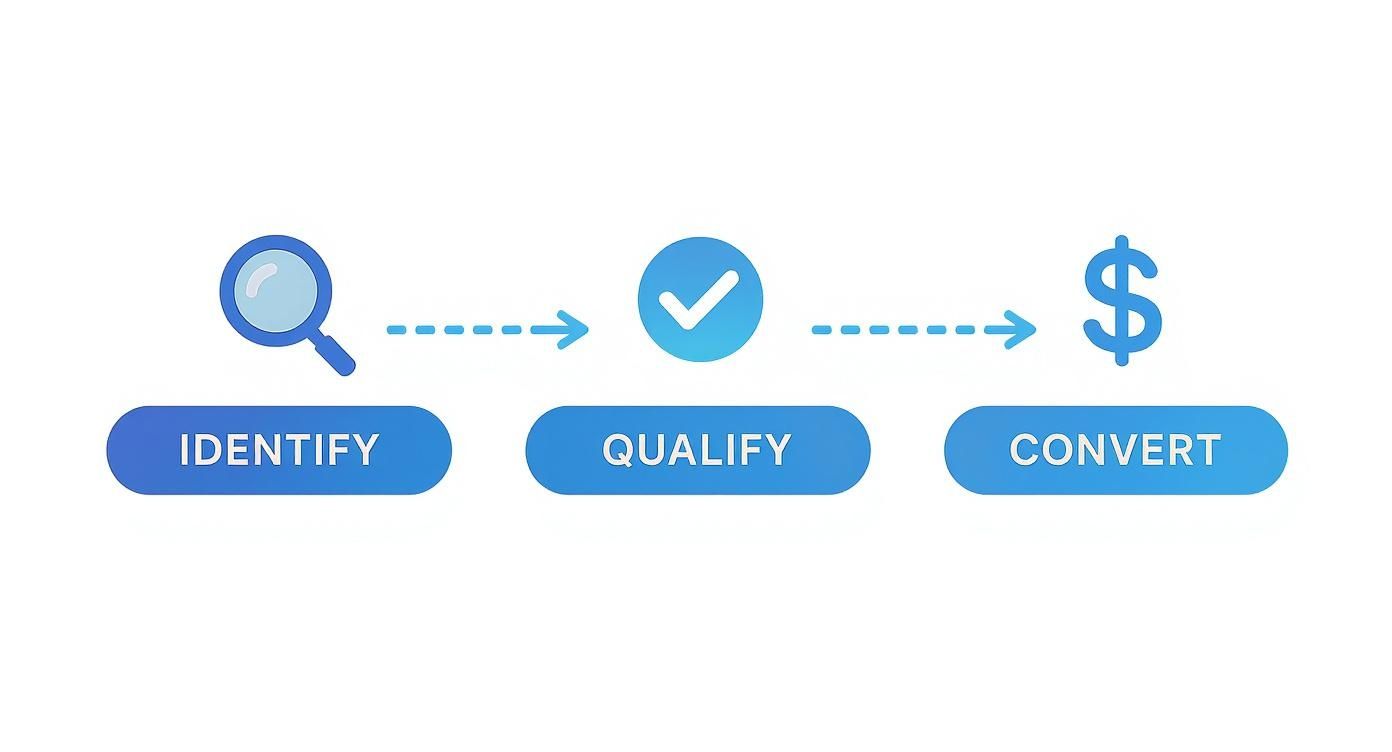
As you can see, AI injects precision into every step, making the entire journey from prospect to customer more efficient and, crucially, more predictable.
Engaging Prospects with Smarter Automation
Once you’ve identified the right people, the next challenge is getting their attention. This is where AI moves beyond simple automation and into intelligent, personalized engagement at scale. For instance, AI-powered chatbots can handle front-line conversations on your website 24/7, answering questions and qualifying interest without any human intervention.
When it comes to outbound, the game completely changes. AI scans a prospect's digital footprint—from their recent LinkedIn posts to articles they’ve published—to help you craft outreach that actually feels human and relevant. This isn’t about just slotting a {first_name} into a template.
- Contextual Messaging: Imagine an email that references a recent funding announcement or a new product launch at their company. That’s the kind of timely relevance AI can deliver.
- Optimal Timing: The system learns when an individual is most likely to open an email or engage on social media, then schedules touchpoints for maximum impact.
- Multi-Channel Coordination: AI can orchestrate a perfectly timed sequence of interactions across email and social media, ensuring persistent follow-up that never feels robotic.
Qualifying and Scoring Leads with Pinpoint Accuracy
Here’s where AI becomes your team’s most valuable player, acting like an always-on, data-obsessed sales development rep. It tracks every single interaction a prospect has with your brand—every email opened, link clicked, or pricing page visited—and uses that data to generate a dynamic lead score. This score isn't set in stone; it rises and falls in real-time based on their actions.
AI has truly transformed lead scoring. By analyzing everything from online behavior to engagement history, its algorithms can prioritize leads with an accuracy that humans simply can't match. This approach cuts through the noise and ensures your sales team invests their time only on prospects who are genuinely showing buying intent. For a deeper dive into the numbers, check out these AI and marketing data insights from Databox.
The bottom line is this: AI qualifies leads based on their actual behavior. By the time a prospect is handed off to sales, they aren’t just a contact—they're an educated buyer who has already signaled their interest.
Nurturing Leads Until They're Ready to Talk
Of course, not every interested lead is ready to buy today. For those prospects, AI automates the critical nurturing process. Based on a lead's specific interests and digital body language, the system can drip-feed them relevant content, like case studies that match their industry or blog posts that address their pain points.
This keeps your brand top of mind and continuously builds trust over time. Then, when the lead’s behavior signals they’re ready for a sales conversation—maybe they just spent five minutes on your pricing page—the AI instantly flags them for immediate follow-up. This intelligent handoff ensures no warm lead ever goes cold, maximizing the return on every lead you generate.
Measuring What Actually Matters

If you really want to understand the impact of AI-powered lead generation, you have to look under the hood. Old-school metrics like Cost Per Lead (CPL) are blunt instruments; they tell you the price of a name, but nothing about its potential. A modern, AI-driven strategy demands a smarter way of measuring what’s working, focusing on efficiency, quality, and the direct impact on your bottom line.
Think of it this way: you wouldn't judge a race car just by how much fuel it burns. You'd look at its lap times, its speed on the straightaways, and its cornering ability. We need to do the same for our lead generation engine—measure its performance, not just its fuel consumption.
This shift means we stop chasing vanity metrics and start tracking the KPIs that prove our AI is actually helping us close more deals, and faster.
Shifting Focus to Quality and Speed
First things first, you have to prioritize metrics that show the quality and velocity of your sales pipeline. Sticking to traditional volume goals often encourages the team to bring in a flood of low-quality leads, which just ends up wasting the sales team's time. The whole point of using AI is to cut through that noise, and your KPIs need to show that's happening.
Here are the metrics that really tell the story:
- Lead Qualification Rate: What percentage of leads from the AI system does your sales team actually accept as Sales Qualified Leads (SQLs)? A high rate here is concrete proof that the AI has a solid grasp on your Ideal Customer Profile.
- Speed to Lead: How long does it take for a sales rep to reach out after the AI flags a lead as qualified? Good AI tools should make this handoff almost instant, slashing your response times.
- AI-Influenced Pipeline: What's the total dollar value of all the sales opportunities in your pipeline that the AI either found or qualified? This KPI directly links the AI's daily work to potential revenue.
Tracking these numbers changes the conversation from "How many leads did we get?" to "How many of the right leads did we get, and how fast did we jump on them?"
Connecting AI Activity to Revenue
At the end of the day, the only way to truly justify your investment in AI is to tie it directly to closed deals. This means you need metrics that follow a lead from its first touchpoint all the way across the finish line.
A successful AI lead generation system doesn't just fill the top of the funnel; it accelerates the entire journey from prospect to paying customer. The goal isn't just more leads—it's more revenue.
To forge that undeniable link, you absolutely have to measure:
- AI-Influenced Revenue: This is the gold standard. It's the total contract value of all the deals you've won that started with or were qualified by your AI system. Nothing speaks louder to leadership than this number.
- Sales Cycle Length: Compare the average time it takes to close a deal from an AI-qualified lead versus a lead from any other source. The insights and pre-qualification from AI should be shortening this cycle significantly.
- Conversion Rate from SQL to Close: This metric is the ultimate test of lead quality. A higher conversion rate for AI-sourced leads shows they aren't just a good fit on paper—they're genuinely ready to buy.
When you track these outcome-focused metrics, you can build an airtight business case for your ai powered lead generation efforts. You stop talking about what the AI is doing and start proving the real business impact it's having.
Your Roadmap To Implementing AI Lead Generation
Getting an AI-powered lead generation program off the ground isn't about flipping a switch and hoping for the best. It’s a methodical process that requires a solid foundation and a clear plan. Think of it like building a house: you wouldn't dream of putting up walls without first pouring a concrete foundation and having a detailed blueprint in hand.
This roadmap will walk you through the essential stages, from getting your data in order to scaling your success across the whole company. By following these steps, you can sidestep common frustrations and make sure your AI initiative delivers real, measurable value to your B2B sales team.
Prepare Your Data Foundation
Before you even look at a single AI tool, you have to get your data house in order. Your customer relationship management (CRM) system is the absolute bedrock of this entire strategy. If it's a mess of outdated contacts, incomplete records, and inconsistent entries, your AI will churn out garbage results.
It’s the classic "garbage in, garbage out" scenario. An AI model is only as smart as the data it’s trained on, making a clean, integrated, and accurate dataset completely non-negotiable.
- Data Cleansing: Start by hunting down and merging duplicate entries, correcting outdated information, and standardizing data formats across your entire CRM.
- System Integration: Make sure your CRM talks seamlessly to your other critical systems, like your marketing automation platform and website analytics.
- Historical Accuracy: Double-check that your historical deal outcomes—won, lost, or disqualified—are all recorded correctly. This history is exactly what the AI will study to learn what a genuinely good lead looks like for your business.
Define Your Goals and Ideal Customer Profile
With a clean data foundation in place, it’s time to give the AI its marching orders. You have to be crystal clear about what a “win” looks like and precisely who you’re trying to sell to. Without that clarity, the AI is just flying blind, pulling in leads that don't actually fit your business.
Your Ideal Customer Profile (ICP) is the blueprint the AI will follow. It needs to be incredibly detailed, going way beyond basic firmographics like company size and industry.
Your AI’s success hinges on a well-defined Ideal Customer Profile. The more specific you are about the attributes of your best customers, the better the AI will be at finding more of them.
To really nail this part of the strategy, you can learn how to master ChatGPT for lead generation through guides that break down the practical applications. This helps you refine the specific prompts and instructions you'll feed your system.
Select Your Tools and Integrate Your Stack
Okay, now you're finally ready to pick your technology. The market is flooded with AI lead generation platforms, so it’s crucial to find one that fits your specific needs and plays nicely with the technology you already have. A tool that creates new data silos or requires a ton of manual workarounds completely defeats the purpose.
Look for a platform that connects easily with the tools your team lives in every day—your CRM, email client, and even communication hubs like Slack. The goal is a unified, seamless system, not a clunky collection of separate solutions.
Launch a Pilot Program
Instead of trying to boil the ocean with a massive, company-wide rollout, start small with a controlled pilot program. This approach lets you test your strategy, get real-world feedback, and make adjustments in a low-risk environment. Just pick a small, dedicated group of sales reps to get things started.
The whole point of a pilot is to learn and get better, fast.
- Test and Validate: Confirm that the AI is actually identifying and scoring leads that your sales team agrees are high-quality.
- Gather Feedback: Talk to the pilot team. Get their honest input on the new workflow, the quality of the leads, and how easy the tools are to use.
- Measure Early KPIs: Start tracking key metrics like Lead Qualification Rate and Speed to Lead to set an initial performance benchmark.
- Refine the Process: Use all that feedback and data to fine-tune your ICP, tweak the AI settings, and smooth out the handoff process from machine to human.
Scale and Optimize for Growth
Once your pilot program is a proven success and you’ve ironed out the kinks, it's time to scale. This means methodically rolling out the AI-powered lead generation system to the rest of your sales organization.
This phase is about more than just giving everyone a login. Proper training is absolutely critical for user adoption and consistency. You need to show the entire team how this new process makes their jobs easier and helps them hit their targets more efficiently.
But scaling isn't a one-and-done event; it's an ongoing process of optimization. Keep a close eye on your performance metrics and constantly ask for feedback from the team to find new ways to improve. As the AI ingests more data, it gets smarter, uncovering new patterns and becoming even more precise at pinpointing your next best customer.
Avoiding Common Pitfalls In AI Implementation
An AI project is only as strong as its foundation. While AI-powered lead generation has incredible potential, a few common but critical mistakes can completely derail your strategy before it even gets off the ground. Getting ahead of these challenges is key to turning your investment into a reliable growth engine.
Think of your AI system as a brilliant apprentice. It learns from the data you feed it and the environment you create. If you give it confusing instructions or junk materials, you can't expect it to produce a masterpiece. Real success starts with a thoughtful approach that sidesteps these frequent missteps.
The Garbage In, Garbage Out Problem
The single biggest reason AI lead generation projects fail is bad data. An AI model is only as smart as the information it learns from. If your CRM is a chaotic mess of duplicate contacts, incomplete records, and outdated deal info, the AI will learn all the wrong lessons.
It will start identifying and scoring leads based on flawed patterns, sending your sales team a flood of prospects that are a terrible fit. This doesn't just waste everyone's time; it kills their trust in the new system almost immediately. A clean, accurate, and well-maintained CRM isn’t just a "best practice"—it's a non-negotiable prerequisite for getting any value out of AI.
The rule of thumb is simple: if you wouldn't trust a human to make decisions with your current data, you absolutely can't expect an AI to do any better. Clean data is the fuel for your AI engine.
Over-Reliance on Pure Automation
Another major pitfall is treating AI as a "set it and forget it" magic button. The point of AI isn't to replace your sales team; it's to make them better, faster, and smarter. When you over-automate the process and cut out human oversight, you create a robotic, impersonal experience that alienates your prospects.
The sweet spot is finding the right balance between machine efficiency and the human touch.
- Let AI do the heavy lifting: It's brilliant at initial research, data analysis, finding ideal prospects, and scoring their intent.
- Let humans do what they do best: Focus on high-value activities that need empathy and strategy, like building genuine relationships, navigating complex conversations, and closing deals.
Forgetting this balance leads to generic outreach that turns buyers off and completely misses the subtle cues that only an experienced salesperson can pick up on.
Resisting the Black Box
Finally, teams often run into "black box anxiety." This is what happens when your sales reps don't understand or trust how the AI is making its recommendations. If a lead is suddenly scored as "hot," but the team has no idea why, they'll naturally be skeptical and will likely fall back on their old, manual habits.
The fix is to choose a platform that gives you transparency into the AI's logic. Your team should be able to see the specific signals—like a prospect visiting your pricing page or their company posting a relevant job opening—that contributed to a high lead score. This transparency builds confidence and drives adoption, turning the AI from a mysterious black box into a trusted co-pilot for your sales team.
Choosing The Right AI Lead Generation Platform
Picking the right technology partner is one of the most important calls you'll make when you decide to bring AI into your lead generation process. Get it right, and the platform acts as a force multiplier for your sales team. Get it wrong, and you’re left with data silos, frustrated reps, and a burned-out budget with nothing to show for it.
Think of it like hiring a key employee. You wouldn't just glance at a resume. You'd dig into their skills, see if they click with your team's culture, and make sure they have what they need to succeed. You need to apply that same deliberate, structured approach to find an AI platform that actually fits your business goals and sets your team up to win.
Core Integration Capabilities
Here's the thing: your AI platform can't live on an island. It has to talk to the rest of your tech stack, especially your CRM. A clunky integration that forces your team into manual data entry or requires constant IT workarounds completely misses the point of automation.
Look for a platform with native, deep integrations into the tools your team already lives in every day. This creates a smooth, two-way street for information. The AI can learn from your historical data, and just as important, it can push qualified leads right back into your existing sales workflow without creating a bunch of extra steps.
Model Transparency And Control
Be very wary of "black box" AI systems where you have no idea how the platform reaches its conclusions. If your sales team can't understand why the AI scored a lead as "hot," they simply won't trust it, and adoption will stall. This is a classic reason why so many promising AI projects end up failing.
A good platform pulls back the curtain, showing you the key signals and data points that influence its recommendations. Even better, it gives you the keys to fine-tune the algorithms yourself. This way, you can ensure the AI's logic matches up with your team's on-the-ground expertise and the unique nuances of your business.
The best AI lead generation tools act as a trusted co-pilot, not a mysterious oracle. Your team needs to see the "why" behind the "what" to build the confidence needed for full adoption and long-term success.
Evaluating Support And Scalability
Finally, don't forget about the people behind the software and your own plans for the future. As you roll out any new system, questions and hiccups are going to happen. You need responsive, knowledgeable customer support to get you through that learning curve and solve problems fast.
At the same time, look hard at the platform's pricing model and its ability to scale. Will it support you as your business grows, or will you be penalized for your success? A clear, transparent pricing structure that grows with your needs helps you avoid nasty surprises down the road. The right partner is one that can keep pace with you. When you find that fit, the impact can be huge; organizations using AI-driven systems see over a 50% increase in sales-ready leads and a 60% reduction in lead acquisition costs. You can explore more AI adoption statistics to get a sense of the full potential.
Ultimately, this isn't just a software purchase; it's a strategic decision. By focusing on these core criteria—integration, transparency, and support—you can make an informed choice that truly empowers your team and drives real, measurable growth.
Frequently Asked Questions
As teams start looking into AI-powered lead generation, some practical questions always pop up. Making the switch from old-school methods to an AI-first approach can feel like a big move. This section tackles the most common concerns we hear, giving you clear, straightforward answers to help you navigate the change with confidence.
How Much Data Do I Need to Get Started?
You might be surprised to learn you don't need a perfect, massive database to get going. Most modern AI platforms can start delivering value almost immediately just by plugging into your existing CRM and website analytics. A few thousand historical contacts with clear outcomes—think deals marked as "won" or "lost"—is often a great starting point.
The real key here is quality over quantity. The AI learns from your team's past wins and losses, so having clean, consistent data is far more valuable than just having a lot of it. As the system sees new interactions, its predictions get sharper and more accurate over time.
Will AI Replace My Sales Development Reps?
Absolutely not. Think of AI as a powerful assistant, not a replacement for your sales team. Its main job is to put your SDRs on steroids by automating the tedious, data-heavy work of finding and qualifying leads that are actually worth their time. This frees your team from spending hours on manual research and guesswork.
AI is the ultimate co-pilot. It handles the navigation and number-crunching, letting your human experts focus on what they do best: building relationships, having meaningful conversations, and closing more deals with better-fit prospects.
This shift doesn’t make your reps obsolete; it makes them dramatically more efficient and effective.
How Can I Trust the AI's Lead Scores Are Accurate?
Trust is built on two things: transparency and a constant feedback loop. An AI lead scoring model isn't just making wild guesses; it's learning directly from your team's on-the-ground experience. It starts by training on your historical sales data to figure out what a "good lead" actually looks like for your business.
Then, as it starts scoring new leads, your sales team provides the critical feedback by confirming which leads were genuinely qualified and which weren't. This input goes right back into the system, helping the model constantly fine-tune its accuracy. That's why it’s so important to choose platforms that offer model transparency, showing you the why behind each score. It lets you align the AI's logic with your team's expertise, creating a system you can actually rely on.
Ready to see how Roger can handle your prospecting and scheduling while your team focuses on closing? Book your demo today!