Automated Lead Generation A Guide to Scaling Your Pipeline
December 20, 2025
So, what exactly is automated lead generation? Think of it as a smart system that uses technology to find, qualify, and connect with potential customers automatically. It takes the repetitive, time-sucking tasks—like building contact lists and sending out cold emails—off your team's plate. This frees them up to focus on what they do best: having meaningful conversations with people who are actually interested.
The result? A sales pipeline that's not just full, but predictable and scalable.
Moving Beyond Manual Prospecting
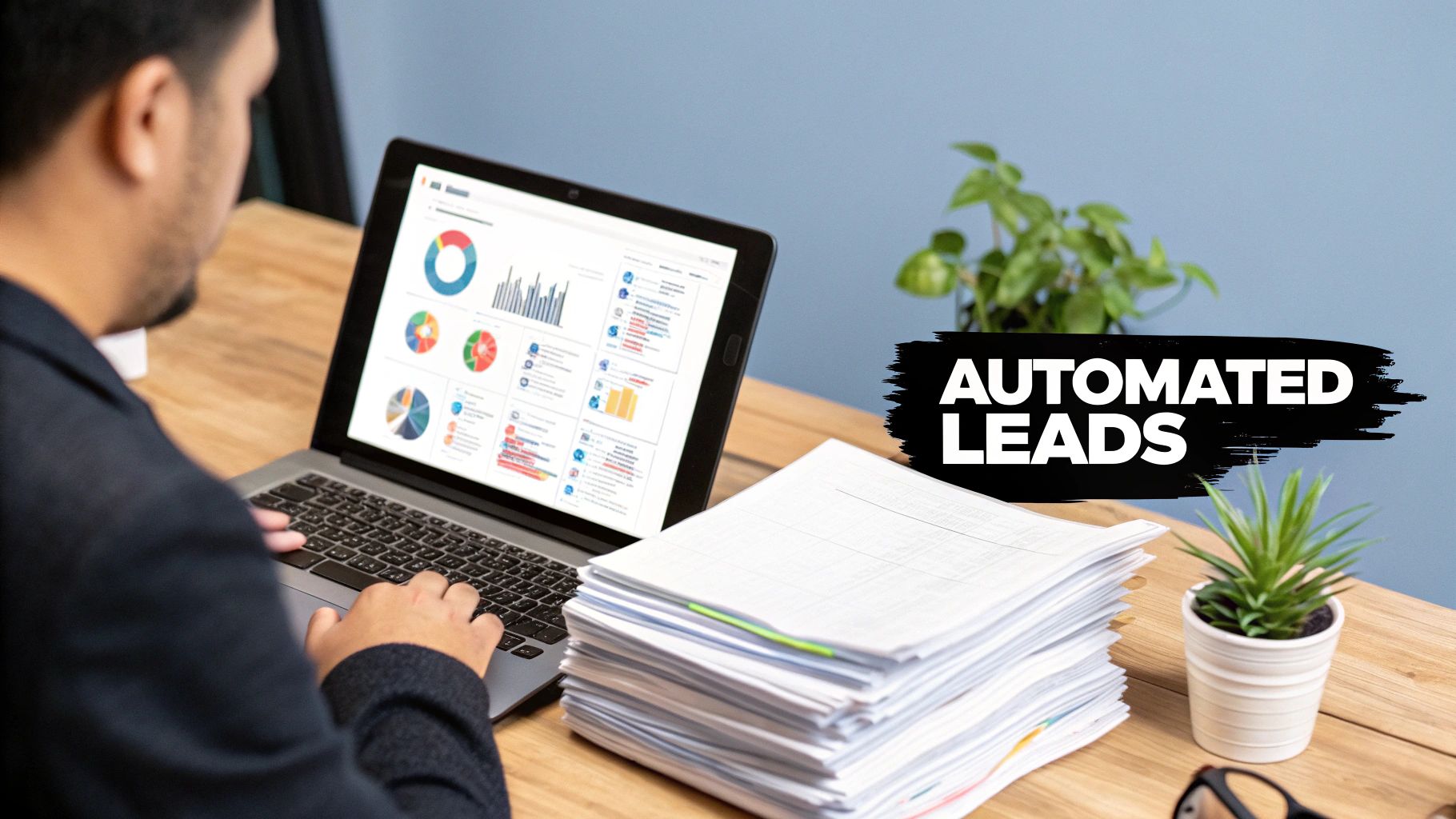
If you've ever stared at a massive spreadsheet of contacts, you know the feeling. Manual prospecting is a lot like trying to pan for gold by hand. It's slow, tedious, and the payoff is anything but guaranteed. Spending hours scouring LinkedIn, copying and pasting data, and sending one-off emails just doesn't cut it anymore. It's a recipe for burnout, not growth.
The biggest problem with the old way is just how inefficient it is. Every minute your sales reps spend on administrative grunt work is a minute they aren't building relationships or closing deals. This approach doesn't just exhaust your top talent; it creates a feast-or-famine pipeline where growth feels more like a lucky break than a deliberate strategy.
The Shift to a Strategic System
Automated lead generation, on the other hand, is like upgrading from a pan and shovel to a full-scale, high-tech mining operation. You’re no longer sifting through dirt at random. Instead, you're deploying a carefully designed system that uncovers, qualifies, and delivers high-value leads around the clock.
This isn't about blasting out more emails. It's a completely different mindset. This system works quietly in the background, constantly feeding your pipeline with prospects who fit your ideal customer profile perfectly. It does all the heavy lifting, so your team can step in at just the right moment for strategic, high-impact conversations.
An effective automated system doesn't replace your sales team. It empowers them by delivering a steady stream of qualified, engaged prospects, turning unpredictable prospecting into a reliable growth engine.
The Core Components of an Automated Engine
To build this kind of engine, you need a few key parts working in harmony. Think of it like a machine that needs the right fuel and regular tune-ups to perform at its peak. The essential components are:
- Data Sourcing and Enrichment: The system automatically finds potential leads who match your criteria and gathers the key information you need to connect with them.
- Intelligent Outreach Sequences: This involves creating and launching automated, multi-channel campaigns (think email and LinkedIn) that thoughtfully guide prospects through the initial stages of awareness.
- Personalization at Scale: Technology is used to tailor each message with specific, relevant details. This makes your outreach feel personal and human, not like it came from a robot.
- Lead Scoring and Qualification: The system tracks engagement and automatically identifies which leads are the warmest and most ready for a direct conversation with a sales rep.
Getting a handle on these core pieces is the first step toward building your own powerful automated lead generation engine. You’ll transform prospecting from a manual grind into a true strategic advantage, creating a clear, repeatable path to hitting your revenue goals. It’s all about working smarter, not harder.
The Anatomy of an Automated Lead Engine
To really understand automated lead generation, you have to look under the hood. A great system isn't just a single piece of software; it's more like a finely tuned engine where four essential parts work together perfectly. Thinking of it as a high-performance vehicle makes it easier to see how each component plays a critical role.
Imagine your data is the high-octane fuel, the technology is the powerful engine itself, your outreach sequences are the intelligent GPS, and lead scoring is the real-time dashboard. Every single one is non-negotiable. Bad fuel will make the engine sputter. A GPS without a destination is useless. Let's break this machine down, piece by piece.
Pillar 1: Data is the Fuel
It all starts with data. This is the raw material that powers every other part of your lead generation system. Low-quality data is like putting dirty fuel in a sports car—it’s going to clog the engine and you won’t get far, fast.
The goal is to gather accurate, relevant, and verified information about the people you want to talk to. This goes way beyond just a name and an email address. You need firmographic data (company size, industry), demographic details (job title, seniority), and even technographic insights (what software they’re already using). This level of detail is what makes your targeting razor-sharp from day one.
An automated lead generation engine running on bad data will only help you contact the wrong people faster. Prioritizing data quality is the single most important step in building a predictable pipeline.
This solid foundation lets you create meaningful segments. You can group potential customers by shared problems or specific roles, which sets the stage for outreach that actually feels personal and relevant, not like a generic blast.
Pillar 2: The Tech Stack is the Engine
Once you have high-quality fuel, you need a powerful engine to put it to work. Your technology stack—the collection of tools you use—is that engine. These platforms are the workhorses that handle all the repetitive, manual tasks, which frees up your team to focus on bigger-picture strategy and building real relationships.
A modern tech stack usually includes a few core components:
- Customer Relationship Management (CRM): Think of this as the central nervous system. It's the database where you store and track all lead information, conversations, and sales activities.
- Outreach Automation Tools: These are the platforms that send multi-step, multi-channel campaigns across email and social networks like LinkedIn.
- Data Enrichment and Verification Services: These tools are your data mechanics. They automatically clean your existing lists, fill in missing information, and confirm that contact details are still valid, which stops your emails from bouncing and wasting your effort.
A comprehensive platform like Roger brings these functions together, acting as a complete engine that handles everything from finding new leads to sending personalized messages, all from one place.
Pillar 3: Engagement Sequences are the GPS
Your engagement sequences are the roadmap that guides a prospect from being a stranger to a genuinely interested lead. This is your system’s GPS, mapping out the best route for each person based on who they are and how they interact with your messages. A good sequence is never a one-size-fits-all email blast.
Instead, it’s a carefully planned series of multi-channel touchpoints. This might look like an initial email, followed by a LinkedIn connection request two days later, and then another email that references a recent company milestone. The sequences are designed to be persistent without being annoying, delivering value at every step.
Pillar 4: Lead Scoring is the Dashboard
Finally, lead scoring acts as your dashboard, giving you instant feedback on what’s working and who’s most engaged. It’s an automated system that assigns points to leads based on their profile and their actions. For instance, a director at a target company will get more points than an intern, and a lead who opens three of your emails will score higher than someone who ignores them all.
This system is absolutely crucial for prioritizing follow-up. It shows your sales team exactly which leads are "hot" and ready for a human conversation, making sure they focus their valuable time on the opportunities most likely to close. By tracking behaviors like website visits or content downloads, lead scoring turns your automated lead generation from a simple outreach tool into an intelligent system that automatically surfaces sales-ready prospects.
Manual Prospecting vs. Automated Lead Generation
Making the switch from manual to automated lead generation isn't just about doing things faster; it's about fundamentally changing how you operate. The table below breaks down the key differences, showing why automation delivers such a clear and compelling return on investment.
| Activity | Manual Approach | Automated Approach |
|---|---|---|
| Lead Discovery | Time-consuming web scraping and list building. | AI-powered search across vast databases. |
| Data Quality | Prone to human error, quickly becomes outdated. | Continuous, automated verification and enrichment. |
| Outreach | One-off, inconsistent emails and messages. | Multi-step, multi-channel personalized sequences. |
| Scalability | Limited by individual rep's daily capacity. | Can engage thousands of prospects simultaneously. |
| Follow-Up | Relies on memory and manual reminders; inconsistent. | Trigger-based, timely, and persistent. |
| Lead Prioritization | Based on gut feeling or simple criteria. | Data-driven lead scoring based on fit and behavior. |
| Analytics | Hard to track and analyze results effectively. | Real-time dashboards showing what works and what doesn't. |
As you can see, the automated approach replaces guesswork and grinding with precision, scale, and intelligence. It allows your team to stop being data entry clerks and start being strategic advisors, focusing their energy where it matters most: on building relationships with your best potential customers.
Your Step-By-Step Implementation Roadmap
Building an automated lead generation machine can feel like a huge undertaking, but it’s really just a matter of following a structured process. If you break it down, you can move from a good idea on paper to a powerful system that actually drives revenue. Let's walk through how to assemble this engine, piece by piece.
The diagram below gives you a bird's-eye view of how the whole process flows, from finding raw data to qualifying leads who are ready to talk.
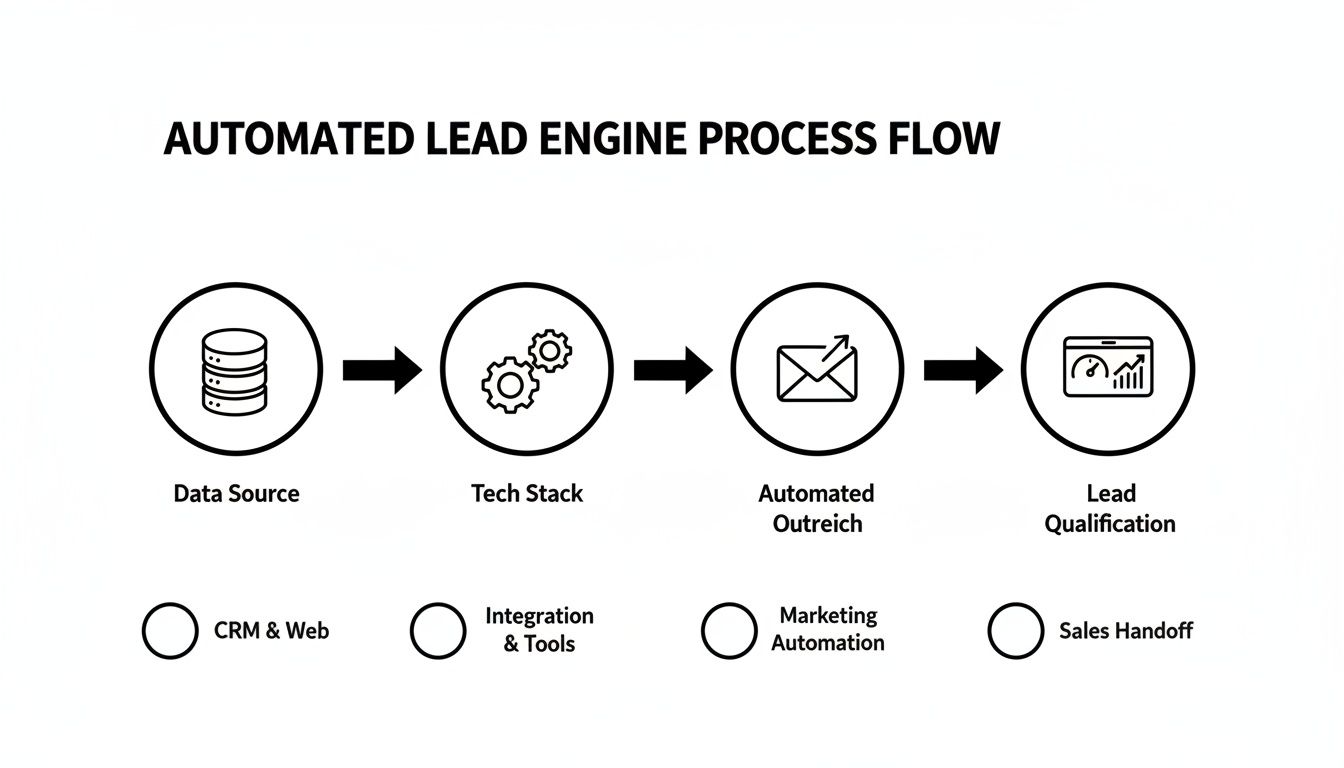
As you can see, each stage—Data, Tech Stack, Engagement, and Scoring—is a building block for the next. Get these right, and you'll have a pipeline that works for you 24/7.
Step 1: Define Your Ideal Customer Profile
Before you automate a single thing, you have to know exactly who you're talking to. Your Ideal Customer Profile (ICP) is a crystal-clear description of the company—not the person—that gets the most value from what you sell. If you skip this, you’ll just be automating noise and wondering why nothing is working.
The best place to start is with your happiest current customers. What do they have in common?
- Firmographics: What industry are they in? How big are they, in terms of revenue or employee count?
- Geography: Where are they based? Do you focus on certain cities, states, or countries?
- Pain Points: What specific business headaches do they have that you're uniquely good at solving?
Once you've nailed down the company profile, you can create buyer personas for the key people inside those companies. This level of clarity is the foundation for any effective automated lead generation because it ensures every single lead and message is aimed squarely at your business goals.
Step 2: Source High-Quality Lead Data
Okay, you know who you’re looking for. Now, where do you find them? This is the fuel for your engine. One of the quickest ways to kill your momentum is to use junk data—it leads to bounced emails, wasted effort, and a whole lot of frustration.
You essentially have two paths for sourcing data:
- Build Your Own Lists: This involves using tools to search professional networks and company databases based on the ICP you just created. You get total control, but it definitely takes more hands-on effort.
- Purchase from a Provider: You can buy curated lists from data companies that specialize in your niche. It's much faster, but you have to do your homework to make sure the provider is reputable and the data is accurate.
Platforms like Roger can actually automate this entire discovery process for you. They constantly find new decision-makers that fit your ICP and verify their contact info, so your outreach campaigns actually land in the right inboxes.
Step 3: Select the Right Technology Stack
Your tech stack is the machinery that brings your strategy to life. It's easy to get lost in a sea of software options, but you really only need a few core pieces to get started. The goal is a seamless stack that plays nicely together, not a Frankenstein's monster of disconnected tools.
A simple, effective stack usually includes:
| Tool Category | Purpose | Example |
|---|---|---|
| CRM | The source of truth for all your lead data and interactions. | HubSpot, Salesforce |
| Outreach Platform | Where you run your email and LinkedIn sequences. | Roger, Outreach |
| Data Verification | The tool that cleans your email lists to keep bounce rates low. | ZeroBounce, NeverBounce |
Of course, an all-in-one platform can make life a lot easier. A system that rolls lead discovery, verification, and multi-channel outreach into one place cuts down on complexity and keeps your data flowing smoothly from one step to the next.
Step 4: Design Your First Outreach Campaigns
It's time for the fun part: building the outreach sequences that will turn cold contacts into warm leads. This is where you blend automation with genuine personalization to create messages that feel human. Please, avoid the generic, "one-size-fits-all" templates. They don't work.
A multi-channel approach is usually best. Combining email with LinkedIn gives you a persistent but subtle presence.
A successful automated outreach strategy is not about sending more messages; it's about sending the right message to the right person at the right time, across multiple channels.
Here’s what a simple first campaign might look like:
- Day 1: Send a personalized email that mentions a specific challenge common in their role or industry.
- Day 3: Send a LinkedIn connection request. No sales pitch here—just a simple request to connect.
- Day 5: Follow up with a second email offering something genuinely useful, like a short case study or an insightful article.
- Day 7: Pop up on their LinkedIn feed by liking or commenting on one of their recent posts.
This approach gradually builds familiarity and trust, making your outreach feel less like an interruption and more like a helpful professional introduction.
Step 5: Implement a Lead Scoring System
Finally, you need a system to automatically spot who's interested and ready for a conversation. That's what lead scoring is for. It’s a simple set of rules that assigns points to leads based on who they are and how they interact with your outreach.
For instance, you could set up your scoring like this:
- +10 points if their job title is "VP of Sales" (one of your key personas).
- +5 points every time they open one of your emails.
- +15 points if they click a link in an email.
- +25 points if they actually reply.
Once a lead hits a certain score—let's say 50 points—they're automatically flagged as a Marketing Qualified Lead (MQL). The system then sends them straight to the sales team for a personal follow-up. This ensures your reps are only spending their valuable time on the hottest, most engaged prospects, which massively boosts their efficiency and close rates.
Real-World B2B Use Cases and Success Metrics

The theory behind automated lead generation is great, but seeing it in action is where the lightbulb really goes on. We're not just talking about sending emails faster; we're talking about building intelligent, scalable systems that have a direct line to your revenue.
Let's dig into a few real-world examples of how B2B companies are using this approach to gain a serious competitive edge. These use cases show how a well-oiled machine can engage the right people, with the right message, at exactly the right time. The outcome isn't just more leads—it's a pipeline full of better, more qualified opportunities that your sales team will be thrilled to work with.
Nurturing SaaS Free Trial Users into Customers
Picture a SaaS company offering a 14-day free trial. As sign-ups pour in, it’s completely impossible to manually track each person, send them personalized tips, and check in at just the right moments. This is a classic, perfect scenario for automated lead generation and nurturing.
The second a user signs up, an automated sequence springs to life. This isn't just a generic "welcome" email. It's a carefully planned series of messages designed to get them using the product and seeing its value.
- Day 1: An automated welcome email from a "customer success manager" immediately lands in their inbox, offering a quick-start guide or a link to a short video tutorial.
- Day 3: The system checks to see if the user has activated a key feature. If they haven't, it sends a targeted email highlighting the benefits of that feature and provides a direct link to it.
- Day 7: A mid-trial check-in email pops up, asking if they have questions and offering a link to book a quick 15-minute demo for some advanced tips.
- Day 12: With the trial winding down, an email showcases a case study of a similar company that saw a huge ROI after upgrading to a paid plan.
This whole process ensures every single trial user gets a consistent, helpful experience. It guides them toward that "aha!" moment that ultimately convinces them to become a paying customer. All of this works tirelessly in the background, converting sign-ups while your team focuses on building a better product.
An automated nurturing sequence acts like a dedicated guide for every new user, proactively addressing common questions and highlighting value, dramatically increasing the likelihood of conversion without any manual intervention.
Targeting C-Level Executives for a Consulting Firm
A high-ticket consulting firm needs to get in front of busy C-level executives. Cold calling is a dead end, and generic emails get deleted on sight. Their answer? A highly personalized, multi-channel automated campaign built around thought leadership.
First, the system identifies VPs and C-suite leaders at their ideal target companies using specific firmographic data. From there, it kicks off a slow-drip outreach sequence that's designed to build trust and credibility over time.
- Initial Touchpoint: A personalized email references a recent company announcement or a shared connection, offering a link to a relevant, high-value whitepaper on industry trends.
- LinkedIn Engagement: A couple of days later, the system sends a connection request on LinkedIn, followed by a brief, non-salesy message that mentions the whitepaper.
- Value-Added Follow-Up: About a week later, a second email follows up—not with a sales pitch, but with an invitation to an exclusive webinar hosted by an industry expert.
This sophisticated, patient approach positions the firm as a trusted advisor, not just another vendor trying to sell something. By the time a sales rep finally makes a direct call, the executive is already familiar with the brand and its expertise, making the conversation infinitely warmer and more productive.
Measuring the Success of Your Automation Engine
So, how do you know if your automated lead generation engine is actually working? You have to track the right metrics. It's time to forget vanity numbers like email open rates and focus on the data that connects directly to your pipeline and revenue.
Here are the key success metrics that matter:
- Cost Per Qualified Lead (CPQL): This tells you exactly how much you're spending to generate one lead that your sales team officially accepts. Automation slashes this number by cutting out manual labor and improving targeting.
- Lead Velocity Rate (LVR): This metric measures the month-over-month growth of your qualified leads. A rising LVR is a strong signal that your pipeline is expanding and your business is on a healthy growth path.
- Conversion Rate by Stage: Keep a close eye on how many leads move from one stage of your funnel to the next (e.g., from Marketing Qualified Lead to Sales Qualified Lead). This helps you spot and fix any bottlenecks in your process.
Companies that get this right see incredible results. Research shows that businesses using marketing automation can generate 50% more sales-ready leads at a 33% lower cost. Some even report a staggering 451% increase in qualified leads, with many seeing a tangible 10% revenue increase within the first 6-9 months. You can learn more about the impact of sales automation from Utmost Agency. This isn't just about efficiency—it's a proven driver of real business growth.
Common Mistakes That Derail Automation Efforts
Knowing what not to do is just as important as knowing what to do. Even the most powerful automated lead generation system can fall flat if it’s tripped up by a few common, avoidable mistakes. These pitfalls can turn a promising growth engine into a source of frustration that alienates prospects and burns through your budget.
Think of this as a troubleshooting manual for your strategy. Once you know where the landmines are, you can build a more resilient and effective system from the ground up—one that generates real results instead of just noise.
Ignoring the Importance of Data Quality
The single fastest way to kill your automation efforts is by feeding the machine bad data. Using outdated or inaccurate contact information is like trying to run a high-performance race car on watered-down gas. It doesn’t matter how incredible the engine is; it’s going to sputter and stall.
This one mistake leads directly to high email bounce rates, which can wreck your sender reputation and even get your domain blacklisted. But more importantly, it means your perfectly crafted messages never even make it to your ideal prospects. All that work, wasted.
A successful automated lead generation strategy is built on a foundation of clean, verified data. Without it, you’re just automating failure at scale—contacting the wrong people faster than ever before.
To get this right, you have to build a rigorous data hygiene process. That means regularly verifying email addresses, enriching contact profiles with up-to-date information, and clearing out old, irrelevant records. Platforms like Roger actually build this verification step right into their workflow, making sure your outreach is always based on solid data.
Over-Automating the Human Element
Another classic mistake is automating your outreach until it sounds cold and robotic. Prospects can spot a generic, mass-blasted email from a mile away, and when your messages lack any genuine personalization, they get deleted without a second thought.
This usually happens when teams get lazy, relying on a basic {{first_name}} merge tag and calling it a day. But real personalization goes deeper. It's about referencing a prospect’s specific industry, a recent company achievement, or a piece of content they just shared. The whole point of automation isn’t to remove the human touch, but to scale it.
Here are a few dead giveaways of over-automation:
- Generic Openers: Starting with "I hope this email finds you well" and nothing else.
- Irrelevant Pitches: Offering a solution that has zero to do with the prospect's actual job or company.
- No Custom Research: The message contains nothing specific about the person or their business.
Neglecting to Test and Optimize
Finally, one of the biggest blunders is adopting a "set it and forget it" mindset. Launching an automated lead generation campaign isn't the finish line; it’s the starting line. Failing to test and optimize is like driving a car without ever glancing at the dashboard—you have no idea if you’re heading in the right direction or about to run out of gas.
You should be constantly A/B testing different parts of your campaigns to see what truly connects with your audience. This means experimenting with things like:
- Subject Lines: Test different lengths, tones, and hooks.
- Calls-to-Action (CTAs): Compare a direct ask ("Book a demo") with a softer offer ("Read our case study").
- Messaging Angles: Try focusing on different pain points or highlighting different benefits.
By constantly digging into your performance data and making small, smart adjustments, you can turn a good campaign into a great one. This commitment to ongoing optimization is what separates a pipeline that dries up from one that drives sustainable, long-term growth.
Frequently Asked Questions
When you're on the brink of adopting a new strategy like this, the big, practical questions always start to surface. It's totally normal. Shifting to automated lead generation is a major move, so of course, you're thinking about the budget, the timeline, and what this all really means for your team's day-to-day work.
Let's tackle the most common questions we hear from teams who are right where you are. We'll give you straight answers to help you weigh these final details with confidence.
How Much Does It Really Cost to Get Started?
Honestly, the investment can be all over the map, and it really depends on your company's size and what you're trying to achieve. A small startup might get rolling with a few core tools for just a couple hundred dollars a month, zeroing in on essential email outreach and basic data verification. It's a fantastic, lean way to build momentum.
On the other hand, a mid-sized company aiming for more firepower—think multi-channel outreach, deep data enrichment, and slick CRM integration—could be looking at anywhere from $500 to several thousand dollars a month. The trick is to stop thinking of it as a cost and start seeing it as an investment. Good automation drives a serious ROI by cutting down on manual grunt work, making your sales team more efficient, and ultimately dropping your cost per lead.
Research shows that businesses using marketing automation can generate 50% more sales-ready leads at a 33% lower cost. A well-built system doesn't just save money; it makes money, often paying for itself surprisingly fast.
Will Our Outreach Sound Robotic and Impersonal?
This is probably the biggest fear we hear, but it's completely avoidable if you do it right. The point of modern automation isn't to blast out generic, one-size-fits-all messages. It's to scale personalization. It's about letting the machines handle the repetitive tasks so your team can pour their energy into the uniquely human side of selling.
The best platforms use dynamic tags and custom fields to personalize messages in ways that go far beyond just slotting in a first name. You can reference things specific to your prospect, like their:
- Industry: "I saw your work in the logistics space and..."
- Company News: "Congratulations on the recent funding round..."
- Recent Activity: "I noticed you shared an article on AI in manufacturing..."
When you nail this, your outreach feels helpful and relevant, not robotic. It makes prospects feel like you've done your homework, which is the exact opposite of being spammed.
What Is the Difference Between Marketing and Sales Automation?
It's a great question, because while they both use technology to streamline work, they operate in different parts of the customer journey. Getting this distinction right is key to building a growth engine that actually works.
Think of marketing automation as working at the top of the funnel. Its job is to attract and nurture a large audience through broad channels—think email newsletters, content downloads, and social media campaigns. The goal here is to sift through the crowd and identify Marketing Qualified Leads (MQLs), which are essentially people who've raised their hand to show some interest.
Sales automation, on the other hand, takes the baton at the bottom of the funnel. It gives sales reps the tools to manage their pipeline, send highly personalized outreach to those qualified prospects, and book meetings. The focus shifts to converting MQLs into Sales Qualified Leads (SQLs) and, ultimately, into paying customers. The real magic happens when you integrate both, creating a seamless handoff from marketing to sales.
How Long Until We See a Return on Investment?
You'll feel some immediate wins right away, like getting back hours previously lost to manual prospecting. But seeing a significant, measurable impact on your sales pipeline usually takes somewhere between three and six months. This runway is critical for getting everything set up, running tests, and gathering enough data to fine-tune your campaigns.
The first month is usually all about defining your ICP, building those initial lead lists, and launching your first outreach sequences. In months two and three, you’ll be digging into the data, A/B testing your messaging, and refining how you score leads.
Many businesses start seeing a tangible revenue bump of around 10% within six to nine months. Automated lead generation isn't a silver bullet; it's a long-term strategy that builds on itself over time, creating a predictable, scalable revenue machine that fuels real growth.
Ready to stop prospecting and start selling? Roger is the AI-powered platform that runs your entire outbound motion for you. From finding verified leads to writing personalized, research-driven outreach, Roger handles the heavy lifting so your team can focus on what they do best: closing deals.