How to Follow Up No Response Email: Simple Tactics to Get Replies
December 13, 2025
So, you sent an email and got... nothing. Radio silence. It’s a frustratingly common scenario, but the fix is often simpler than you think. The golden rule? Send a polite, value-driven follow-up 2-3 days after your first email. This simple timing adjustment can be the difference between being ignored and starting a conversation. It shows persistence without being a pest and often catches your prospect at a much better time.
Why Your Follow-Up Emails Aren't Getting Replies
It's easy to take a non-response personally. You spend time crafting the perfect message, hit send, and then... crickets. Your first instinct might be to assume they're just not interested. But that’s rarely the whole story.
Before you jump to conclusions, step into the shoes of a busy professional. Their inbox is a battlefield, and your email is just one of hundreds of combatants vying for attention. Silence usually isn't a hard "no"—it's a symptom of a much more common problem.
The truth is, your email is fighting an uphill battle against chaos. A lack of response often boils down to a few key reasons that have nothing to do with you or your offer.
- You Caught Them at a Bad Time: Your email landed smack in the middle of a frantic Monday morning, right before a major project deadline, or just as they were logging off for a long-overdue vacation.
- They're Drowning in Emails: The average professional gets over 120 emails a day. Yours might have been opened, mentally flagged for a later response, and then immediately buried under an avalanche of new messages.
- Your Ask Lacked Urgency: If your email doesn't solve a clear, pressing problem for them right now, it gets tossed onto the "I'll deal with this later" pile—a pile that almost no one ever gets back to.
The Technical Glitch You Might Be Missing
Beyond the human factors of timing and inbox clutter, there's a huge technical trap that trips up even seasoned pros: poor email deliverability. This is the silent killer of outreach campaigns. You could have the most compelling follow-up in the world, but it's worthless if it lands in the spam folder.
To keep your messages out of the abyss, you have to actively improve email deliverability by keeping an eye on your domain reputation and making sure all your authentication protocols are correctly set up.
Nailing Your Follow-Up Timing
Timing isn't just about getting lucky; it's a strategic lever you can pull to dramatically increase your odds. The data on this is crystal clear: there's a powerful link between your follow-up cadence and your reply rates.
Here's a quick cheat sheet to get you started.
Quick-Start Follow-Up Timing Strategy
This table breaks down the sweet spot for that first follow-up, giving your message the best possible chance of being seen and answered.
| Wait Time | Potential Reply Rate Impact | Reasoning |
|---|---|---|
| 2-3 Days | Up to a 31% boost | Gives the recipient enough time to act on the first email but keeps you top-of-mind. |
| 4-5 Days | Begins to decrease | The urgency from your initial email starts to fade, and your message gets buried deeper. |
| 5+ Days | Up to a 24% drop | Your message is now old news. They've likely forgotten your initial email entirely. |
As you can see, waiting just three days before sending that first nudge is the sweet spot. It gives a busy decision-maker time to get through their initial inbox rush while ensuring your name is still fresh in their mind.
The goal of a follow-up isn't to demand a response. It's to gently resurface your message, add a fresh piece of value, and make it ridiculously easy for them to reply.
Once you understand these underlying reasons, your entire mindset shifts from frustration to strategy. You stop seeing silence as rejection and start seeing it as a puzzle to solve. Was the timing off? Was the message too generic? Did I make it too hard for them to say yes? Answering these questions is the first real step toward writing follow-ups that finally get the replies you’re after.
Crafting a Follow-Up Sequence That Actually Gets Replies
Sending a single follow-up email is like taking one shot in the dark and hoping you hit the target. A well-planned sequence, on the other hand, is a strategic conversation. It’s built on the simple understanding that your prospect is busy, and it gives them multiple, easy opportunities to engage when the time is right.
Think about it: one-off messages rely almost entirely on luck and timing. A multi-step approach builds momentum. The data backs this up, too. While a single email might pull in a 16% response rate, simply adding a second follow-up can bump that number to 27%.
The key isn't just being persistent; it's being purposefully persistent. Every message in your sequence needs to have its own job to do and add a new piece of value. This is how you avoid sounding like just another "checking in" pest.
The Blueprint for a Winning Sequence
A solid follow-up sequence usually involves three to five messages, each with a specific role. Don't think of it as chasing someone down. Instead, see it as a series of helpful nudges designed to move the conversation forward. Each touchpoint is a chance to re-engage, offer a fresh angle, and make it incredibly simple for them to hit "reply."
Here’s a breakdown of a classic, effective three-part sequence that works time and again:
- Touch 1: The Gentle Nudge (Days 2-3): The goal here is simple: bring your original email back to the top of their inbox. Keep it light, friendly, and assume they were interested but got pulled into a meeting or another urgent task.
- Touch 2: The Value Add (Days 7-10): If the nudge didn't get a response, it's time to offer something new. This message needs to provide fresh, tangible value—a relevant case study, an article you think they'd find helpful, or a key insight—to reignite their interest.
- Touch 3: The Break-Up (Days 14-21): This is your final, professional "closing the loop" email. You respectfully state that you'll stop following up, which often creates just enough urgency to get a reply from people who were interested but kept putting it off.
The core idea behind a great sequence is to shift from a simple reminder to a value-driven conversation. Each email should answer the recipient's unspoken question: "Why should I care about this now?"
Real-World Scenarios and Templates You Can Actually Use
Generic, copy-paste templates fall flat because they have no soul. The best follow-ups are adapted to the specific situation. Following up after a product demo feels completely different from nudging a cold prospect who never engaged in the first place.
Let's look at how to apply this structure to a couple of common business scenarios.
The Post-Demo Follow-Up Sequence
After a demo, your prospect is warm, but they almost always need to talk it over with their team. Your job is to reinforce the value you showed them and clear any potential hurdles out of the way.
- Email 1 (Day 2): Subject: Next steps after our demo
"Hi [Name], thanks again for your time yesterday. For your convenience, I’ve attached the recording for your team to review. Was there anything we discussed that you’d like me to expand on?"
This is a simple, helpful check-in that makes their life easier. - Email 2 (Day 5): Subject: A case study you might find useful
"Hi [Name], while you’re reviewing things, I thought you might find this case study on how [Similar Company] solved [Similar Problem] helpful. It really brings to life the results we talked about. Happy to answer any questions that come up."
This adds social proof and connects the dots for them. - Email 3 (Day 10): Subject: Quick question about moving forward
"Hi [Name], just wanted to check if you have a timeline in mind for a decision. If now isn't the right time, no problem at all—just let me know, and I can close your file for now."
This is a gentle break-up that encourages a straight answer.
The Cold Outreach Follow-Up Sequence
With cold outreach, your goal is to build credibility and spark curiosity over time. For more inspiration, it's worth exploring resources that offer perfect follow-up email templates and best practices.
- Email 1 (Day 3): Subject: Re: [Original Subject]
"Hi [Name], just wanted to circle back on my note from last week about [Pain Point]. Is solving this on your radar at all right now?"
This is a low-pressure, easy-to-answer nudge. - Email 2 (Day 7): Subject: Saw your team is hiring for [Role]
"Hi [Name], noticed on LinkedIn that your team is expanding its [Department]—congratulations! I've seen that when teams scale like this, [Common Challenge] often becomes a top priority. We actually helped [Company] automate that process. Here's a quick look at how."
This connects your value to a timely, relevant trigger you researched. - Email 3 (Day 15): Subject: Permission to close your file?
"Hi [Name], I've reached out a few times without hearing back, so I'll assume improving [Business Area] isn't a priority right now and will stop my follow-ups. If I'm mistaken, just let me know."
This professional closing is respectful and very effective at getting a response.
By structuring your outreach into a logical sequence, you stop guessing and start guiding. Better yet, you can automate these cadences with a platform like Roger to ensure no lead ever falls through the cracks, letting you maintain consistent, valuable communication without all the manual effort.
Writing Subject Lines That Get Opened
Think of your subject line as the velvet rope outside an exclusive club. It's the one thing that decides whether your email gets in or gets ignored. If it doesn't immediately grab attention, the brilliant message you wrote inside doesn't stand a chance. And this isn't just a hunch—data shows that 47% of people open an email based on the subject line alone. It’s your first, and maybe only, shot.
A big question I always get is whether to reply to the original email or start a completely new thread. There’s a time and place for both, and getting it right depends entirely on how many times you’ve already reached out.
To Reply or Not to Reply?
For your first couple of follow-ups, hitting reply is your best bet. It’s simple, effective, and keeps everything in one neat little package. The "Re:" that gets added to the original subject line is an instant memory jog for your prospect, reminding them of the context without you having to spell it out. It's a gentle nudge, not an aggressive push.
But if you’ve sent two follow-ups in the same thread and all you’re hearing is crickets, it's time to switch things up. That original thread is likely dead and buried in their inbox. Starting a fresh email with a totally new, punchy subject line is like knocking on a different door. It signals that you're not just "checking in" again; you're back with something new to say.
Subject Line Formulas That Actually Work
First, let's agree to retire "Just checking in" and "Following up" forever. They scream "I have nothing new to offer!" and are the fastest way to get your email deleted. A good subject line acts as a tiny, powerful trailer for the value packed inside the email.
Here are a few angles that consistently get results:
- Spark Curiosity: "Quick question about [Their Company]" or "A thought on [Their Recent Project]"
- Lead with Value: "An idea for improving [Their Key Metric]" or "Your competitor just did something interesting"
- Get Personal: "Saw your post on LinkedIn about [Topic]" or "[Mutual Connection's Name]"
A great subject line makes a promise that the email body has to deliver on. It needs to be specific, relevant, and just intriguing enough to earn that click. The goal is to create curiosity, not clickbait that’ll get you flagged as spam.
As your follow-up sequence progresses, the tone and purpose of your emails will change. You'll move from a simple reminder to providing real value, and eventually, to a polite closing of the loop.
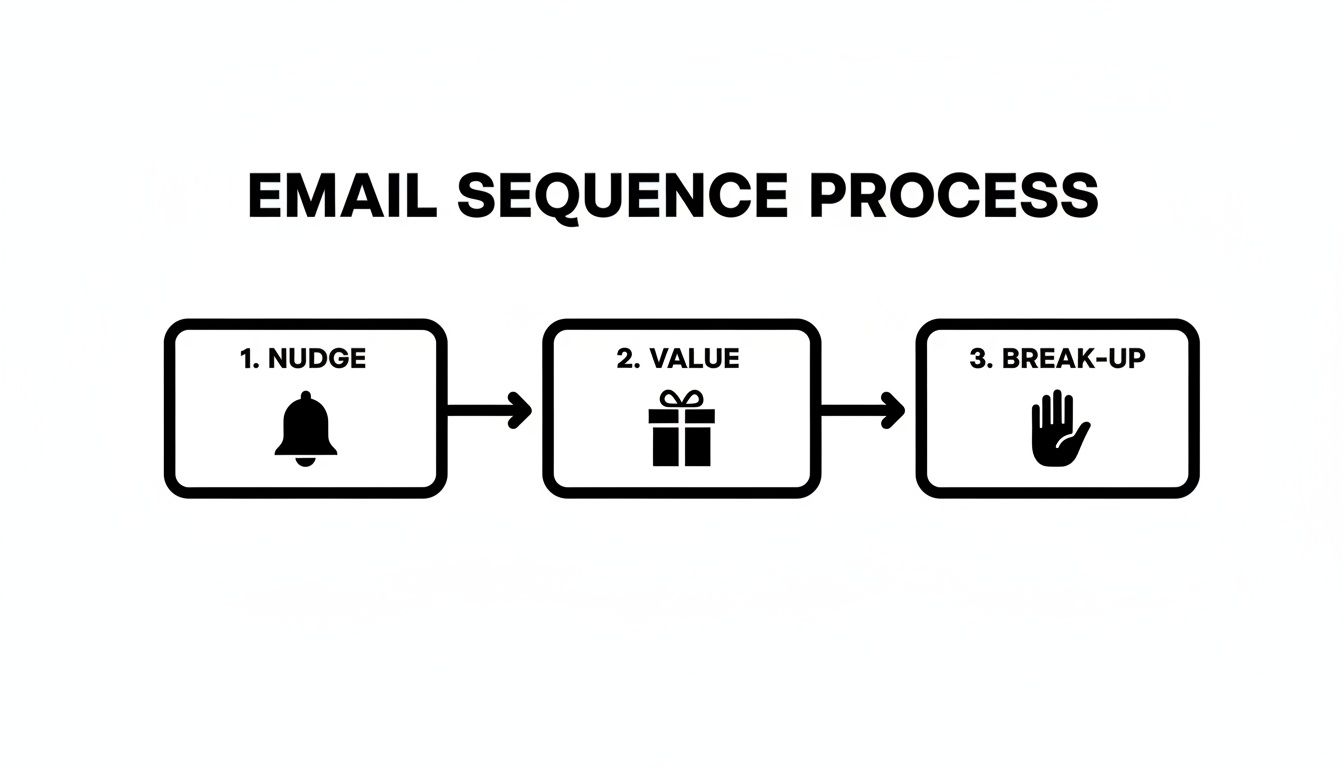
This flow shows how your outreach should evolve. Your subject lines need to evolve right along with it, reflecting the shift from a nudge to a value-add.
Crafting a Winning Subject Line
Let's break down the anatomy of a subject line that gets opened.
Keep It Short and Mobile-Friendly
More than 50% of all emails are now opened on a phone, where screen space is precious. Long subject lines get awkwardly cut off. I always aim for 6-7 words (under 50 characters) to make sure the entire thing is visible at a glance.
Use Personalization That Matters
Dropping a first name in the subject line is table stakes. Real personalization goes a layer deeper. Mention a recent company win, a post they shared, or a mutual connection you both respect. It instantly shows you've put in the effort.
- Weak: "Checking in"
- Better: "Checking in, John"
- Best: "John, saw [Company]'s news about the acquisition"
Avoid Spam Trigger Words Like the Plague
Words like "free," "sale," or "discount" are poison. So are ALL CAPS and a bunch of exclamation points!!! They’re a one-way ticket to the spam folder and make you look desperate. Focus on sounding like a helpful human, not a late-night infomercial.
Using Personalization to Stand Out
Let's be honest: generic follow-ups are the digital equivalent of junk mail. They’re predictable, impersonal, and get deleted on sight. When someone's inbox is a battlefield for their attention, a message that feels like a copy-paste job sent to a hundred other people is going to lose every time.
The antidote isn’t just sending more emails; it’s sending smarter emails. It’s about being thoughtful and genuinely personal.
And I don't mean just dropping in a {{first_name}} token. Real personalization shows you’ve actually done your homework. It proves you see them as an individual, not just another name on a list. This simple shift in mindset turns a self-serving "just checking in" nudge into a relevant, respectful conversation that actually earns a reply.
The data backs this up, too. Personalized emails can deliver 6x higher transaction rates, yet an astonishing 70% of brands don't bother to use them. That’s a massive missed opportunity.
The good news? This doesn't mean you need to write a full biography on every prospect. All you need is one specific, timely "hook" that you can weave into your message naturally. It’s about being observant, not obsessive.
Finding Your Personalization Hook
Before you write a single word of your follow-up, take five minutes to find one relevant piece of information. This is where you transform a cold outreach into a warm conversation starter.
Here are my go-to places to find a hook:
- LinkedIn Activity: This is a goldmine. Did they just share a great post, comment on a trending topic, or start a new job? Their activity tells you exactly what’s on their mind right now.
- Company News & Press Releases: A new funding round, a big product launch, or a key executive hire gives you the perfect excuse to reach out. It shows you're paying attention to their company's journey.
- Podcast or Webinar Appearances: If they've recently been a guest on a podcast or spoke at a virtual event, find a specific quote or idea they shared. Referencing it shows you respect their expertise and have done your research.
The goal is to find a trigger that allows you to connect what you offer to something they already care about. This flips the script, turning your email from an interruption into a timely and relevant conversation.
Weaving Personalization Into Your Follow Up Email
Once you've got your hook, the final piece of the puzzle is to work it into your email so it feels natural, not forced. It should act as a bridge that smoothly connects your observation to your reason for reaching out.
Ditch the generic "I saw your profile..." and get specific. I like to use a simple formula: Observation + Connection + Question.
Scenario 1: The LinkedIn Post Hook
You see your prospect, a VP of Marketing, just posted on LinkedIn about the struggle to measure the ROI of creative campaigns.
- Weak Follow-Up: "Hi Sarah, just wanted to follow up on my last email. Are you free to chat this week?"
- Personalized Follow-Up: "Hi Sarah, saw your post on measuring creative ROI and your point about vanity metrics really hit home. It's a huge challenge. We actually helped [Similar Company] connect their campaign spend directly to pipeline by automating their attribution. Is that something on your radar right now?"
Scenario 2: The Company News Hook
Your target company just put out a press release announcing a major expansion into the European market.
- Weak Follow-Up: "Hi Tom, circling back on my email. Let me know if you're interested."
- Personalized Follow-Up: "Hi Tom, congrats to the team on the European expansion—that's huge news! I imagine scaling your sales enablement for a new market is a top priority. My last note touched on how we help teams centralize their playbooks for global consistency. Would a quick 15-minute demo be a valuable use of time as you plan the rollout?"
By leading with a genuine, specific observation, you immediately stand out from the noise. It proves you've invested your time to understand their world before asking for a moment of theirs. More often than not, this simple act of research is what turns a no-response into a booked meeting.
Think Beyond the Inbox: Winning with Multi-Channel Follow-Ups
So you’ve sent a couple of thoughtful, well-researched emails and... crickets. It’s a frustrating spot to be in, but don’t assume it’s a dead end. The truth is, the inbox is just one part of the conversation. Sticking only to email is one of the biggest mistakes I see people make when a good prospect goes quiet.
Let's be clear: expanding your outreach to LinkedIn or even picking up the phone isn't about being pushy. It's about being professionally persistent. It’s about finding your prospect where they're most active and making a connection.
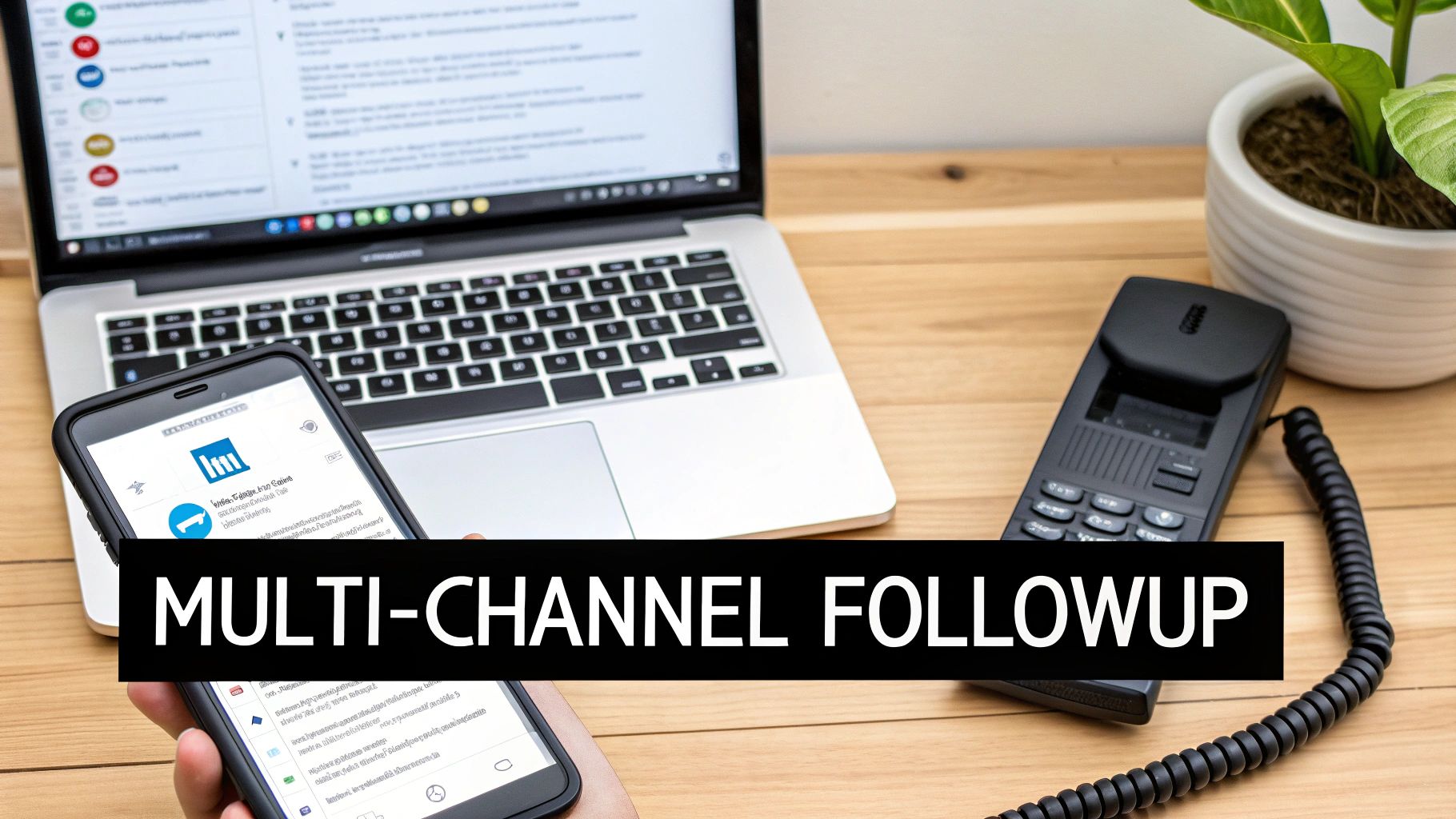
When done right, a multi-channel approach can boost contact rates by a whopping 161%. It signals that you're serious and resourceful. You're not just another automated email blast; you're a real person trying to start a real conversation. The trick is making every touchpoint feel connected and respectful.
Use LinkedIn the Smart Way
LinkedIn is the most natural next step when your emails aren't getting a response. It's a professional space, so reaching out there feels like a logical extension of your business communication. But you have to be smart about it.
Whatever you do, don't just fire off a blank connection request. That's the digital equivalent of shoving your business card in someone's face and walking off. It’s lazy and ineffective.
Instead, treat it as a strategic move in your sequence.
- View their profile first. This is a quiet, low-risk way to get on their radar. People are curious, and your profile view will often show up in their notifications—a subtle "hello" before you've even said a word.
- Engage with their activity. Before connecting, like or comment on a recent post. Make it a genuine, thoughtful comment that adds to the discussion. This shows you’re actually interested in their work, not just in selling them something.
- Personalize your connection request. Keep it brief and tie it back to your other outreach. Crucially, never pitch in the connection request.
Here’s a simple note I’ve used after a second email has gone unanswered:
Hi [Name], I sent over a couple of emails about [Topic] and figured it might be easier to connect here, too. Really enjoyed your recent post on [Relevant Topic].
This approach is low-pressure, adds a human touch, and makes them far more likely to accept your request and maybe even go find your original email.
Make a "Warm Call" That Actually Lands
I know, the idea of a phone call can be daunting. But this isn't a cold call out of the blue; it's a warm call. You're not a total stranger interrupting their day. You’re following up on something they’ve already received from you.
The goal here isn't to launch into a five-minute pitch. It's simply to make a human connection, confirm you've got the right person, and point them back to your emails. Timing is everything. A warm call works best after two or three emails have been ignored.
Here's a simple, non-salesy script that works wonders:
"Hi [Name], it's [Your Name] from [Your Company]. I know this call is unexpected, but I sent a couple of emails about [Pain Point] and just wanted to put a voice to the name. Is now an awful time for a 30-second chat?"
This little script is gold because it does three things perfectly:
- It acknowledges the interruption: This immediately shows respect for their time.
- It gives instant context: It links the call directly back to your emails.
- It asks for permission: "Is now an awful time?" gives them an easy out, which, paradoxically, makes them more likely to hear you out.
Even if you hit voicemail, you win. A quick, professional message is just another valuable touchpoint that might prompt them to search their inbox for your name.
Tying It All Together in a Cohesive Sequence
The real magic happens when you weave these channels into a single, logical game plan. Each step should build on the last, telling a story of professional persistence.
Here’s what a simple but powerful multi-channel follow-up cadence can look like:
| Touchpoint | Channel | Timing | Action |
|---|---|---|---|
| Email 1 | Day 1 | Your initial personalized outreach. | |
| Email 2 | Day 3 | A gentle nudge that adds a new piece of value. | |
| Connect | Day 5 | Send a personalized connection request referencing your email. | |
| Call | Phone | Day 8 | Make a quick warm call to connect and reference your previous outreach. |
| Email 3 | Day 10 | A final "break-up" email to close the loop professionally. |
By mixing up your channels, you create multiple on-ramps for a conversation without just hammering their inbox. This strategy shows you've done your homework, you respect their time, and you genuinely believe you have something important to discuss. That makes you much, much harder to ignore.
Your Top Follow-Up Questions, Answered
Following up can feel like a guessing game. How often is too often? Did I send that at the right time? And for goodness sake, should I start a new email thread or not?
These are the questions I get asked all the time. Let’s clear up the confusion with some straight answers based on what actually works.
How Many Follow-Up Emails Are Too Many?
There's no single magic number, but I've found that a sequence of three to five follow-ups over a few weeks is the sweet spot for most outreach. If you stop after one or two, you're almost certainly leaving money on the table. Go much beyond five without any engagement, and you risk looking like spam.
The trick is to bring something new to the table with every single message. Don't just "check in" or "bump" your last email. If you've made four or five solid attempts across a couple of channels (like email and a LinkedIn touchpoint) and still hear crickets, it’s time for a professional 'break-up' email. It’s a respectful way to close the loop, and you’d be surprised how often it gets a response.
The goal isn’t just persistence; it’s purposeful persistence. Each touchpoint should build on the last, offering a new reason to engage. When the value stops, the follow-ups should too.
What Is the Best Time of Day to Send a Follow-Up Email?
While this definitely depends on your audience, general data consistently points to a clear winner: mid-morning, around 10 AM on Tuesdays, Wednesdays, and Thursdays.
Why does this window work so well?
- You’re dodging the Monday morning inbox avalanche.
- You get in just before people head out for lunch.
- You avoid the Friday afternoon "I'm already checked out for the weekend" mindset.
But always think about your specific prospect. I’ve seen executives open emails at 7 AM while they have their coffee, whereas a software developer might not even look at their inbox until after their morning stand-up. Test a few different times, watch your open rates, and let the data tell you what your audience prefers.
Should I Reply to the Original Email or Start a New Thread?
This is a great strategic question. For your first one or two follow-ups, always reply to the original email. It’s just easier for your prospect. All the context is right there in one thread, and the "Re:" in the subject line is an immediate visual cue that this isn't a brand-new cold email.
But if you’ve sent a couple of follow-ups in the same thread and gotten nothing back, it's time to switch things up. That thread might be mentally (or literally) archived. By starting a new thread with a completely fresh and interesting subject line, you get a second chance to grab their attention and cut through the noise.
How Do I Automate Follow-Ups Without Sounding Robotic?
Automation is a must if you want to scale, but nobody wants to get an email that sounds like it was written by a machine. The secret is blending automated sequences with genuine human touches.
Of course, you’ll want to use a sales engagement platform to build your multi-step sequences. But don't just rely on {{first_name}}. Create custom fields for things like a recent company announcement, a project they worked on, or a specific pain point you found during your research.
The real game-changer is building manual steps right into your automated workflows. For example, your sequence could automatically create a task for you to "Find a personalization hook on the prospect's LinkedIn" or remind you to "Make a warm call" before the next email fires off. This hybrid approach gives you the best of both worlds: scale and a real human connection.
Ready to stop guessing and start getting replies? Roger runs your entire outbound motion for you. We find your ideal customers, personalize every message, and automate multi-channel follow-ups so you can focus on what you do best—closing deals. See how it works at https://hireroger.com.