How to Write a Cold Mail That Gets Opened and Answered
December 31, 2025
Crafting a cold email that actually gets a response is an art. It’s about personalizing your message, homing in on what your prospect actually needs, keeping it tight, and closing with a clear, easy-to-say-yes-to call to action. You’re not trying to close a deal in the first email; you're just trying to start a conversation. Get that right, and you'll immediately separate yourself from the noise in a crowded inbox.
Why Most Cold Emails Are Dead on Arrival
Let's be real for a second: the average B2B inbox is a war zone. Decision-makers are absolutely buried under a daily avalanche of generic, self-serving pitches that all blur together.
The result? The overwhelming majority of cold emails get deleted in seconds. The old "spray and pray" method is officially dead.
This isn't just a hunch; the numbers paint a pretty bleak picture. Think about sending out hundreds of emails only to get radio silence from 95 out of every 100 people. That's the reality for many, with cold email failure rates hitting a staggering 95%. Average response rates are often stuck between a measly 1% and 5%.
On the flip side, campaigns that go the extra mile with smart personalization—like mentioning a recent LinkedIn post or a piece of company news—can see reply rates jump as high as 18%, often doubling the typical outcome. You can dig deeper into these B2B email statistics to get the full story.
So, what’s behind this massive failure rate? It almost always comes down to a few critical, yet fixable, mistakes.
The Anatomy of a Failed Email
The road to the trash folder is paved with common errors. These aren't just small goofs; they're fundamental flaws that all but guarantee your message gets ignored.
Here’s why most outreach falls flat:
- Lazy Targeting: Pitching marketing automation software to a CFO? You've already lost. Sending an irrelevant message to the wrong person is the fastest way to get your email deleted.
- Generic Templates: Prospects can sniff out a copy-pasted template from a mile away. Lines like "I came across your profile and was impressed" are transparent and scream "I've done zero research."
- Zero Personalization: The email is all about you and your product, with no mention of their company, their role, or the specific challenges they're facing. It's a one-size-fits-all message that feels completely impersonal.
- Non-Existent Follow-ups: Giving up after just one email is leaving a huge opportunity on the table. A surprising number of replies come from the second, third, or even fourth message in a sequence.
Your email isn't just competing with other salespeople. It’s up against internal company messages, high-priority updates, and a dozen other daily distractions. Without being genuinely relevant, you simply don’t stand a chance.
To make things even tougher, the technical side of email has evolved. Providers like Google and Outlook are now incredibly good at spotting and filtering out mass, impersonal emails. Simply landing in the primary inbox is a win, let alone getting a reply.
Understanding these pitfalls is the first step. It forces you to shift your mindset from a numbers game to a precision game. The only way to win in the modern inbox is to earn your prospect's attention with outreach that is genuinely relevant and thoughtfully personalized.
Cold Email Performance Benchmarks at a Glance
Before you start writing, it helps to know what "good" looks like. Here's a quick look at some key industry benchmarks so you can set realistic goals for your own campaigns.
| Metric | Average Performance | Top Performer Goal |
|---|---|---|
| Open Rate | 30% - 50% | 60%+ |
| Click-Through Rate | 3% - 5% | 8%+ |
| Reply Rate | 1% - 5% | 10% - 20% |
| Bounce Rate | Under 5% | Under 2% |
These numbers give you a solid baseline. If your stats are falling short, it's a clear signal that something in your strategy—from your list quality to your messaging—needs a second look.
Writing an Email That Actually Gets a Response
Alright, let's get down to brass tacks. Moving from theory to practice means understanding that a great cold email is a finely tuned machine. It has four critical parts: the subject line, the opening hook, the body, and the call-to-action (CTA). If any one of these pieces fails, the whole thing falls flat.
This is your playbook for building an email that gets opened, read, and—most importantly—acted upon. Let's break down each element.
Winning the Open with Your Subject Line
Before anyone reads a single word of your pitch, they see the subject line. This is your first and, frankly, often your only chance to make an impression. Its job isn’t to sell anything; it's simply to earn that click.
Forget the clickbait or those overly clever phrases you think are brilliant. The best subject lines are the ones that are intriguing, personal, and feel like they came from a real person. They just need to spark enough curiosity to make someone pause and think, "Hmm, what's this about?"
Here are a few tactics I've seen work time and time again:
- Mention a mutual connection: "Intro from Jane Doe"
- Reference a recent event: "Congrats on the new funding round"
- Ask a quick, relevant question: "Question about your Q3 hiring goals"
- Keep it short and sweet: "Idea for [Company Name]"
Your goal is to sound like a colleague sending a quick note, not a marketing bot. Keep it lowercase, concise, and authentic.
Nailing That Critical Opening Line
Once you've earned the open, the clock starts ticking. You have about three seconds for your first sentence to prove your email is worth their time. This is where you have to immediately signal that you’ve done your homework.
A powerful opening line quickly connects the dots for the prospect, answering their unspoken question: "Why are you emailing me, and why should I care right now?"
Instead of the tired, generic "My name is..." or "I hope this email finds you well," lead with a hyper-personalized hook based on something you can find publicly.
My Pro Tip: Seriously, just spend five minutes on your prospect's LinkedIn profile or their company’s news page before you hit 'send'. That tiny bit of effort is what gives you the ammo to write an opener that stands out from the noise and shows you actually care.
For instance, you could reference:
- A recent LinkedIn post they shared or commented on.
- A new company initiative or a big product launch.
- Their recent appearance on a podcast or at an industry event.
- An article they wrote or were featured in.
This kind of immediate personalization builds instant rapport and buys you the attention you need to get to your core message.
Keeping the Body Short and Punchy
Okay, you've got their attention. Now for the body of the email. The single biggest mistake I see people make here is writing a novel. Decision-makers are busy. They don't read long emails from strangers; they scan them. Brevity is your best friend.
This is exactly why so many generic emails get ignored and sent straight to the trash folder.
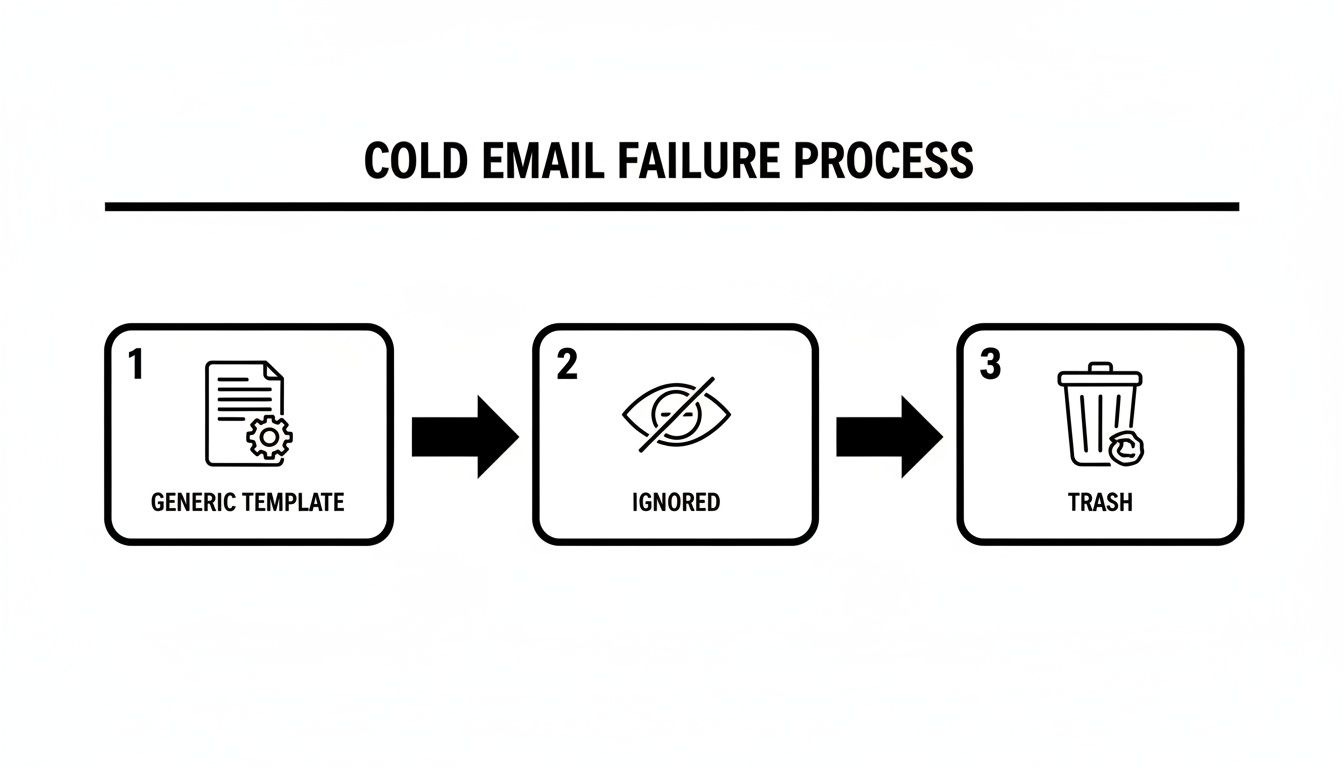
This visual pretty much sums it up. A generic, templated email has a one-way ticket to being ignored and deleted. You can avoid that fate by keeping things concise and personal.
In fact, the data backs this up. Short and sweet wins every time. Emails with just 6-8 sentences have been shown to get a 42.67% open rate and a 6.9% reply rate—easily beating out wordier messages. My own campaign data shows that emails under 200 words simply cut through the noise drowning most inboxes. To really nail this, you can learn more about how to write cold emails that get replies.
Your message should focus entirely on their world—their challenges, their goals, their pains. Frame what you do as a solution to a problem they are likely dealing with right now. Don't list features; hint at a better outcome.
A Simple Body Structure That Works
- Observation: "I saw your team is hiring several new account executives for the EMEA region."
- Problem/Insight: "Usually, when teams scale that fast, getting new reps onboarded and hitting quota becomes a major headache."
- Value Prop (The 'So What'): "We help sales leaders at companies like [Similar Company] cut their ramp time in half with on-demand sales coaching."
This structure connects a specific observation to a relevant problem and then offers a clear, compelling solution—all in just a few lines.
Mastering the Low-Friction Call-to-Action
Finally, every cold email needs a clear and simple call-to-action (CTA). This is where you tell them what to do next. But here's the catch: asking for too much, too soon is a classic mistake that kills all your momentum.
Asking for a "30-minute demo" is a huge commitment for a stranger. It means they have to find time, block off their calendar, and sit through a sales pitch. It's a very easy request to ignore.
Instead, go with a low-friction, interest-based CTA. Your goal isn't to book a meeting right away. It's just to get a simple "yes" and start a conversation.
CTA: Before and After
| High-Friction CTA (Avoid This) | Low-Friction CTA (Use This Instead) |
|---|---|
| "Are you free for a 30-min demo next week?" | "Open to learning more?" |
| "Can I send over a calendar invite?" | "Would a quick one-pager on this be helpful?" |
| "Let's schedule a call to discuss." | "Is this a priority for you right now?" |
These softer questions are way easier to answer and are designed to gauge interest without demanding their time. Once you get a positive signal, then you can move toward scheduling a proper call. Trust me, this two-step approach will dramatically increase your reply rates.
Building a Follow-Up Sequence That Converts
Sending a single, brilliant cold email and then stopping is like running 90% of a marathon and walking off the course. The real opportunity—the one that separates amateur outreach from a professional pipeline—is in the follow-up. Most people give up way too soon, leaving a massive opening for those who actually understand the power of persistence.
Your prospect is busy. Their inbox is overflowing, and your first email, no matter how well-crafted, might have just hit at the wrong time. A strategic follow-up sequence keeps you top-of-mind without being annoying, giving you multiple chances to break through the noise. This isn’t about pestering; it’s about providing genuine value over time.
Don't just take my word for it; the data tells a clear story. Follow-ups are the secret sauce, boosting cold email replies from a mere 3% on a single-shot email to 5.8% with three touches—that's a 93% uplift. Any more than that, and you start to see diminishing returns. You can dig into more cold outbound reply rate benchmarks to see how top-performing teams are crushing these numbers.
Designing a Value-Driven Sequence
The golden rule of following up is simple: every touchpoint must add new value. If your follow-up just says, "just checking in," or, "bumping this to the top of your inbox," you're wasting their time and your own. You’re signaling you have nothing else useful to offer.
Instead, think of each follow-up as a new, bite-sized opportunity to be helpful. This immediately repositions you from just another salesperson to a valuable resource.
Here are a few ways to add real value with each message:
- Share a Relevant Article: Found a great piece of content that speaks directly to a challenge in their industry? Send it over with a quick note like, "Saw this and thought of our conversation about X."
- Reference a Company Event: Did they just announce a new product or a big funding round? Send a quick congratulations and briefly connect it back to your initial point.
- Offer a Quick Insight: Provide a small, actionable tip or a surprising stat related to their role. For example, "I saw your team is hiring SDRs; here’s a tactic that’s really working for ramp-up time right now."
- Mention a Case Study: Briefly highlight a result you achieved for a similar company. Keep it punchy: "We recently helped [Similar Company] achieve [Specific Outcome]."
The goal of a follow-up isn't to repeat your first email. It's to offer a fresh angle, a new piece of information, or a different resource that builds on your initial message and reinforces your relevance.
Expanding Beyond the Inbox
A truly effective follow-up strategy doesn't live in email alone. Integrating other channels creates a more holistic and human outreach motion that’s much harder to ignore. Think of it as creating a surround-sound effect for your message.
This multi-channel approach makes your name familiar before your next email even lands. It shows you're a real person who is genuinely engaged in their professional world, not just an automated email address blasting out messages.
A Simple Multi-Channel Cadence
- Day 1: Send your initial personalized email.
- Day 2: View their LinkedIn profile. (They'll often get a notification).
- Day 4: Send your first follow-up email, offering that new piece of value.
- Day 6: Engage with their content on LinkedIn—like or, even better, leave a thoughtful comment on a recent post.
- Day 8: Send your final follow-up email. This can be a "break-up" email that politely closes the loop while leaving the door open for the future.
The timing and spacing of these touchpoints are critical. You need to give your prospect enough time to breathe between messages. A good rule of thumb is to wait 2-3 business days between each email. This cadence shows persistence without coming across as desperate or spammy, making it much more likely your effort will pay off with a conversation.
How to Avoid the Spam Folder
You can write the most brilliant, perfectly personalized cold email in the world, but it's completely useless if it never reaches the inbox. Landing in the spam folder is the digital equivalent of your message being shredded before it’s even opened.
This isn't just bad luck; it's about deliverability—a technical but absolutely critical piece of any cold outreach puzzle. Email providers like Google and Outlook are incredibly sophisticated, using a complex set of signals to decide if you're a legitimate sender or just another spammer. Getting this right from the start is non-negotiable.
Authenticate Your Domain Like a Pro
First things first: you need to prove to the internet that you are who you say you are. This is done by setting up a few key technical records for your domain. Think of them as your official ID card for sending emails.
Setting these up is essential for building trust with email providers:
- SPF (Sender Policy Framework): This record lists all the mail servers that are authorized to send email on behalf of your domain. It’s like telling Google, "If an email from my domain comes from one of these approved servers, it's legit."
- DKIM (DomainKeys Identified Mail): This adds a digital signature to your emails, which the receiving server can then verify. It proves that the email hasn't been messed with on its way to the recipient.
- DMARC (Domain-based Message Authentication, Reporting & Conformance): This is the final piece of the puzzle. DMARC tells servers what to do if an email fails the SPF or DKIM checks (like sending it to spam or rejecting it outright). It’s your last line of defense against someone trying to impersonate your domain.
Getting these records in place signals that you're a responsible sender, which is a massive step toward staying out of the spam filter.
Warm Up Your Account Before You Sprint
You can't just fire up a brand-new email account and start blasting out hundreds of emails a day. That's a massive red flag for providers and a one-way ticket to the junk folder. You need to "warm up" your account to build a positive sender reputation.
The warm-up process involves gradually increasing your sending volume over several weeks. You start small—maybe 10-20 emails a day—and slowly ramp it up. It’s also incredibly important to engage in natural email behavior, like replying to messages you receive, which shows providers you're a real human being.
Building a good sender reputation is like building credit. It takes time, consistency, and good behavior. Rushing the process will only hurt you in the long run.
A proper warm-up period is one of the most overlooked yet vital parts of a successful cold email strategy. Don't skip it.
Keep Your List Clean and Your Content Cleaner
Your sender reputation is also directly tied to the quality of your email list and the content of your messages. A high bounce rate—the percentage of emails that couldn't be delivered—is a major warning sign. Always, always verify your email lists before starting a campaign to scrub out invalid addresses. You should be aiming for a bounce rate below 3%.
Beyond list hygiene, the content of your email can easily trigger spam filters.
Be mindful of these common spam triggers in your copy:
- Too many links: More than two or three links can look suspicious to filters.
- Spammy keywords: Words like "free," "winner," or "urgent offer" are classic red flags that have been abused for years.
- Heavy images: Emails with large images and very little text are a known spam tactic.
- ALL CAPS and excessive punctuation!!!: This just makes you look unprofessional and, frankly, like a spammer from the early 2000s.
Mastering these technical details ensures all the hard work you put into writing a great cold email actually pays off. For a deeper dive, check out this in-depth guide on email deliverability.
Scaling Your Outreach with Intelligence
Writing a handful of killer cold emails is one thing. Building a predictable, scalable machine that consistently generates meetings? That's a whole different ballgame.
This is where you graduate from one-off manual efforts to a system-driven approach. You stop being just a writer and become the architect of a growth engine. The focus shifts to data, optimization, and smart automation that does the heavy lifting, freeing you up to actually talk to interested prospects.
You Can't Scale What You Don't Measure
To build a reliable pipeline, you have to treat your outreach like a science experiment. Gut feelings are great for brainstorming, but hard data is what builds predictable revenue. Forget what you think works and start measuring what actually works.
First things first, you need to define your core metrics. These are the vital signs of your outreach health.
The Cold Email KPIs That Matter
- Open Rate: The percentage of people who opened your email. This is your first hurdle and tells you if your subject line is doing its job.
- Reply Rate: The percentage of recipients who actually replied. This is the real measure of engagement—it proves your message hit the mark.
- Meetings Booked: The bottom-line result. This is what it's all about. How many positive replies turn into actual conversations on the calendar?
- Bounce Rate: The percentage of emails that couldn't be delivered. If this creeps over 5%, it's a red flag. It damages your sender reputation and means your contact list is stale.
Once you have a baseline for these KPIs, you can start optimizing with A/B testing. The key is to change only one variable at a time. Change the subject line, but keep the body the same. Change the CTA, but keep the subject line the same. That's the only way you'll know for sure what moved the needle.
An A/B test isn't just about finding one winning subject line. It's about building a library of insights that compounds over time, making every future campaign smarter than the last.
Start by testing the elements with the biggest potential impact. A tiny tweak to a subject line can double your open rate overnight. For example, you could test a question-based CTA like, "Open to seeing how it works?" against a more direct one like, "Do you have 15 minutes on Tuesday?" The data will give you a clear winner.
Let Automation Do the Heavy Lifting
Let’s be honest: manually researching every prospect, digging for verified emails, writing personalized intros, and scheduling follow-ups is a massive time-suck. It’s simply not a model that can scale.
This is where technology becomes your unfair advantage.
Modern sales automation platforms are built to handle the repetitive, mind-numbing tasks that hold sales teams back. But the real game-changer is adding a layer of artificial intelligence to the mix.
AI-powered tools like Roger can take this a huge step further. They don't just automate tasks; they perform them with an intelligence that was impossible to achieve at scale just a few years ago.
Here’s how this completely changes your process:
- Intelligent Prospecting: Instead of you manually searching LinkedIn, AI algorithms can constantly scan the web, identifying decision-makers who are a perfect fit for your ideal customer profile based on real-time signals.
- Automated Verification: The system automatically validates contact information on the fly, keeping your lists clean, your bounce rate near zero, and your domain reputation protected.
- Hyper-Personalization at Scale: This is where the magic happens. The AI can analyze a prospect's recent LinkedIn posts, company news, or podcast appearances and draft a genuinely relevant opening line. It can even learn your unique writing style from your sent folder, so the outreach sounds like it came directly from you.
By plugging a platform like Roger into your workflow, you’re basically giving every rep on your team a dedicated AI research assistant. This assistant handles the grunt work of research and copywriting, allowing your team to focus their energy on high-value conversations with warm, qualified leads.
This is how you turn outreach from a manual grind into a powerful, predictable, and scalable growth engine.
Got Questions About Cold Email? Let's Clear Things Up.
Even with the best playbook, you'll run into questions when you're actually writing and sending cold emails. I get it. Let’s walk through some of the most common ones I hear from teams trying to nail their outreach.
What’s the Best Day to Send a Cold Email?
While there’s no single magic bullet, years of data point to the middle of the week as your best bet. Tuesdays, Wednesdays, and Thursdays consistently pull the highest open and reply rates.
Think about your own work week. Mondays are for catching up and putting out fires. Fridays? Everyone's mentally checked out and planning their weekend. Hitting them mid-week means you land in their inbox when they're most focused and productive.
How Long Should a Cold Email Be?
Short. Really short. You're aiming for a sweet spot between 50 and 125 words.
Here’s why: Busy execs don't read emails from strangers; they scan them. Your message needs to be digestible in under a minute, especially on a phone. Anything longer is just begging to be deleted or ignored.
The point of that first email isn't to close the deal. It's just to get a foot in the door and start a conversation. Brevity is your best friend here.
Does Cold Email Still Even Work?
It absolutely does, but the game has changed. The old "spray and pray" approach of blasting a generic template to thousands of people is dead. Good riddance.
Today, successful cold outreach is all about quality, not quantity. It works when you get these pieces right:
- Real Personalization: You have to prove you’ve done your homework on the person and their company.
- A-List Contacts: Make sure you're talking to the right person who actually has the problem you solve.
- Value-First Messaging: Stop talking about your features. Focus on their world and their challenges.
- Smart Follow-ups: Be persistent without being a pest. It often takes a few tries to get noticed.
Nail these elements, and cold email is still one of the most direct and powerful ways to build a B2B pipeline from scratch.
Should I Put Attachments in a Cold Email?
Hard no. Please don't. Sending an unsolicited attachment is one of the fastest ways to get your email flagged as spam, killing your deliverability.
Put yourself in their shoes—would you open a random file from a complete stranger? Probably not. It’s a huge security risk. If you have a case study or a one-pager to share, host it online and simply include a link. It’s safer for them and keeps your email clean and professional.
Ready to stop the manual grind and start booking more meetings? Roger uses AI to handle your entire outbound process—from finding decision-makers and verifying emails to writing hyper-personalized outreach that sounds just like you. Let our platform build your pipeline while you focus on closing deals. Get started with Roger today.