How to Write Cold Emails That Get Real Replies
January 4, 2026
If you want to write cold emails that actually get a response, you need to internalize one simple truth: stop selling and start a conversation. The goal isn't to blast your product features. It's to send a short, sharp, and relevant message to the right person, focusing entirely on their world, not yours. This single shift in perspective is what separates a deleted email from a new opportunity.
Why Your Cold Emails Are Being Ignored
Let's get real for a moment. Most cold emails are dead on arrival, deleted without a second thought. If you feel like your outreach campaigns are just shouting into the void, you're not alone. The old playbook—blasting generic templates to a massive, untargeted list—is officially broken.
It’s not just a string of bad luck; it’s a systemic problem. Today’s inboxes are guarded by smarter spam filters, and decision-makers have zero tolerance for impersonal sales pitches. The numbers tell a pretty grim story.
Cold Email Performance: The Hard Numbers
The statistics on cold outreach can be a real wake-up call. Here's a quick look at key statistics that highlight the challenges and opportunities in cold emailing.
| Metric | Industry Average | High-Performer Benchmark |
|---|---|---|
| Open Rate | 27.7% | 40%+ |
| Reply Rate | 5.1% | 10-20% |
| Failure Rate (No Reply) | 95% | < 80% |
These numbers aren't meant to discourage you; they're meant to ground you in reality. An average open rate of just 27.7% in 2025 (a sharp drop from 36% the year before) means nearly three out of four emails are never even opened. The 5.1% reply rate is even more telling. Without a sharp strategy, you're looking at a response rate that barely breaks 1-5%.
One of the biggest hurdles is simply getting the email opened in the first place. For a deeper look at that specific challenge, check out these strategies on How to Improve Email Open Rates.
The inbox is a battlefield for attention. Generic, self-centered emails are the first casualties because they trigger an immediate, subconscious reaction from the recipient: "This isn't for me."
The Psychology of the Delete Button
The decision to archive or delete an email happens in a split second. It’s an instinctive, almost subconscious, reaction. Most failed cold emails trigger the same psychological alarms.
- It's all about you. Your prospect doesn’t care about your company name, your latest funding round, or your product's shiny features. They care about their own headaches and goals. Any email that opens with "My name is..." or "I'm reaching out from..." is immediately screaming "sales pitch" and gets tossed.
- It feels canned. People can smell a generic template from a mile away. Vague pleasantries like "I came across your profile..." or "I was impressed by your company..." are just empty calories. They signal a lack of genuine effort and respect for the recipient's time.
- The ask is too big. Asking for a 30-minute demo in the very first email is like proposing on a first date. It’s a huge, high-friction request from a complete stranger. This immediately puts the other person on the defensive and makes it incredibly easy to just hit delete and move on.
Before we can build a playbook that actually works, we have to accept why the old one fails so spectacularly. Understanding these common mistakes is the first step toward crafting outreach that feels less like spam and more like the start of a valuable conversation.
Finding the Right People to Email
Let’s be honest: a brilliant email sent to the wrong person is just spam. Before you write a single word of your email, your real work begins with figuring out exactly who you should be talking to. Blasting a generic list is the fastest way to get your domain blacklisted and burn through your best leads.

The entire foundation of a winning cold email campaign is a hyper-targeted list. This goes way beyond basic info like company size or industry. You need to build a detailed Ideal Customer Profile (ICP) that reads less like a data sheet and more like a biography of your perfect customer.
Building Your Ideal Customer Profile
Think of your ICP as the north star for all your prospecting efforts. It's a living document that defines not just the company you're targeting, but the specific person inside that company who is feeling the exact pain your solution solves.
Go deeper than just job titles. Sure, you might be targeting a "VP of Sales," but what you’re really looking for is the VP of Sales at a Series B SaaS company who just complained on LinkedIn about their struggle to scale their SDR team. That's where the magic happens.
To flesh out your ICP, start by digging into these questions:
- What are their key responsibilities? What numbers are they on the hook for? (Think pipeline generation, reducing churn, or boosting team efficiency).
- What are their daily frustrations? What are the "hair on fire" problems keeping them up at night? (Maybe it's inaccurate sales forecasts, high SDR turnover, or constantly losing deals to the competition).
- What are their professional goals? Where do they want to be in the next year? (They’re probably focused on hitting their annual quota, gunning for a promotion, or building a world-class sales org).
- What triggers a buying decision? What event pushes them to actually look for a new tool? (This could be a new funding round, a key executive hire, or a string of bad quarterly results).
Answering these questions completely changes the game. Your outreach stops being a generic pitch and becomes a genuinely relevant conversation. You’re no longer just selling a product; you’re offering a solution to a specific, urgent problem.
You're not just looking for a title; you're looking for a situation. A well-defined ICP helps you identify prospects who are actively feeling the pain your product solves, making your outreach an act of assistance, not an interruption.
Uncovering Prospects with Buying Intent
Once you’ve got your ICP locked in, it's time to find these people out in the wild. This is where a little strategic research separates the top performers from everyone else. Your mission is to find buying signals—clues that show a prospect has a real, immediate need for what you’re selling.
This isn't about exporting a massive list from a database. It's about becoming a digital detective to build a small, high-quality list where every single contact is a fantastic fit.
Practical Research Tactics
Here are a few real-world ways I build hyper-targeted prospect lists:
Go deep with LinkedIn Sales Navigator: Don't just search for titles. Use the advanced filters to find companies with recent headcount growth, people who have recently changed jobs, or specific keywords in their profiles. A manager who just started a new role is almost always looking to make a quick impact and is far more open to new tools.
Monitor company news and job postings: I love setting up alerts for funding announcements, new office openings, or major executive hires. For instance, a company that just posted five new "Sales Development Representative" roles is screaming that they need to scale their outbound—a perfect trigger for your outreach.
Hang out where your prospects are: Find out where your ICP spends their time online. Are they in certain Slack communities, subreddits, or niche industry forums? Pay close attention to the questions they ask and the problems they complain about. This is an absolute goldmine for understanding their real pain points.
With this focused approach, you might only send 50-100 emails in your first campaign. But the key is that every single one will be grounded in genuine relevance. The goal here isn't volume; it’s precision. When you ensure every email lands in the inbox of someone with a clear and present need, personalization becomes second nature, and your chances of starting a valuable conversation go through the roof.
Anatomy of a Cold Email That Converts
Let's get down to brass tacks. A cold email that actually gets a reply isn't a beautiful piece of prose; it’s a tool built for a specific job. Think of it less like a work of art and more like a precision-engineered machine. Every single part, from the subject line to your sign-off, has a critical role to play.
We're going to break down the four key components of an email that starts conversations. If you can nail these four parts, you’ll be well on your way to booking meetings instead of just cluttering up inboxes.
Crafting a Subject Line That Earns the Open
Your subject line is the gatekeeper. It has one job and one job only: get them to click. Forget about being clever or using clickbait—that stuff gets flagged as spam in a heartbeat. In my experience, clarity and relevance beat cleverness every single time.
The best subject lines are short, specific, and feel like they came from a real person, not a marketing automaton. They should almost look like an internal email.
Here are a few approaches that consistently work:
- Benefit-Oriented: Hint at a valuable outcome without giving everything away. Think "Idea for [Their Goal]" or "Quick question re: SDR team scaling."
- Referral-Based: This one is gold. If you have a mutual connection, lead with it. "Jane Smith suggested I reach out" is almost guaranteed to get an open.
- Question-Based: A simple, direct question can pique curiosity. Something like "[Their Company] + [Your Company]?" or "Question about [Recent Project]" works wonders.
Your subject line has to earn the open. Don't blow it with generic fluff. Keep it under five words, make it look human, and make sure it aligns with what's inside the email.
The Critical First Sentence: Your Opening Hook
Once they’ve opened your email, the clock is ticking. You have maybe three seconds to prove this message is worth their attention. Your opening line has to immediately signal that you've done your homework and this email is for them. This is where personalization is your superpower.
And I'm not just saying that. Good personalization can literally double your reply rates. I've seen campaigns referencing a prospect's recent LinkedIn post or a quote from a podcast jump to 20% reply rates or even higher. The data backs this up, too—personalized subject lines are 26% more likely to be opened.
The key is to make your hook genuine and specific. "I was impressed by your work at [Company]" is a compliment so generic it's meaningless. Go deeper.
Example Hook 1 (Referencing Content): "Hi Sarah, just read your article on building a remote sales culture. Your point about asynchronous check-ins really resonated—we've been tackling that same challenge."
Example Hook 2 (Referencing a Company Trigger): "Hi Mark, saw the news about your Series B funding and plans to expand the sales team. Congrats on the milestone."
This instantly tells them you're not a spammer. You invested a minute of your time to understand their world before asking for a minute of theirs.
The Body Copy: Problem First and Keep It Concise
Okay, you have their attention. Now, get to the point. The body of your email needs to be ruthlessly efficient. Your one and only job here is to connect their problem to your solution in as few words as possible. Seriously, keep the entire email under 150 words. If you can get it closer to 100, even better.
A simple Problem-Agitate-Solve (PAS) framework works great, but keep it tight:
- Problem: State a challenge you know their role or company is facing. "Many scaling SaaS companies struggle to maintain lead quality as their SDR team grows."
- Agitate: Briefly poke the bruise. "This often leads to wasted sales cycles and missed revenue targets."
- Solve (Subtly): Position your solution as the way out. "We help companies like [Competitor] solve this by [One-Liner Value Prop]."
Notice how the focus stays on them? No one cares about your company's founding story. Instead, drop in a relevant customer name or a specific result to build instant credibility. If you want to see how this looks in practice, you can find a ton of great cold email templates for sales that put these principles into action.
The CTA: Redefining the Ask
This is it. The final piece of the puzzle and where so many cold emails fall flat on their face. Asking for a "30-minute demo" is a massive ask from a stranger. It’s a high-friction request that screams "I'm going to sell to you," and it requires a significant time commitment.
Your goal isn't to book a meeting from the first email. It's simply to get a reply and start a real conversation. To do that, switch to a low-commitment, interest-based CTA.
Bad CTA (High Friction): "Do you have 30 minutes to chat next week?" Good CTA (Low Friction): "Is solving [The Problem] a priority for you right now?"
This simple yes/no question is easy to answer and doesn't require them to open their calendar. It gauges interest without pressure, which makes it far more likely you'll get that all-important first response. Once they reply, then you can work on building the relationship and scheduling a proper call.
Mastering the Follow-Up to Get a Response
Your first email is just the opening act. Let's be honest, the real conversations—the ones that actually turn into deals—are almost always won in the follow-up.
So many people send one email and just give up. That's great news for you, because it means professional persistence is your biggest advantage. This isn't about being annoying; it's about being strategic and staying on their radar.
A well-planned follow-up sequence shows you’re serious and gives your prospect multiple chances to engage when the time is right for them. A single cold email can easily get buried on a busy Monday morning, but a thoughtful sequence helps you cut through that noise. The data doesn't lie: one email alone averages a dismal 3% reply rate, but adding just two more follow-ups can bump that to 5.8%. You can explore more data on how send times and sequences impact replies to really dial in your timing.
Think of every email you send, whether it's the first one or the fourth, as having four core building blocks.
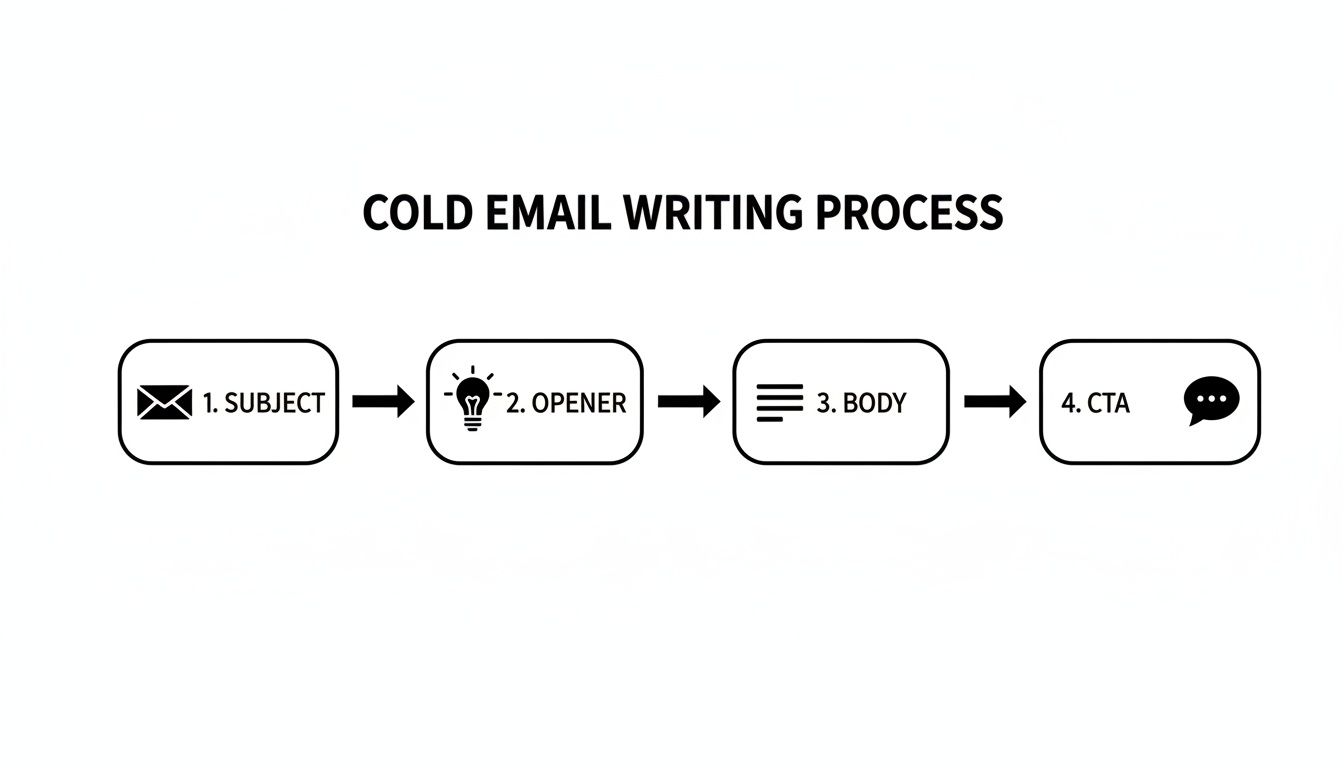
You have to rethink each of these components—Subject, Opener, Body, and CTA—for every single follow-up to make sure you're providing fresh, distinct value.
Designing Your Follow-Up Cadence
A winning follow-up sequence isn't just sending the same message over and over again with "bumping this up" in the subject line. Please don't do that. Each touchpoint needs to offer a fresh angle or a new piece of value, making it easy for the recipient to see why you're back in their inbox.
For most campaigns, a 3-to-5 step sequence spread over about two weeks is a fantastic starting point. The goal is to create a rhythm that feels helpful, not harassing. You're trying to balance persistence with a genuine respect for their time and inbox.
A great follow-up is a continuation of the conversation you tried to start, not just a "bump" of your original email. Every message should stand on its own as a valuable, relevant piece of communication.
Here’s a practical, multi-channel cadence you can adapt. It combines email with a lighter touch on a professional social platform like LinkedIn to create a more well-rounded outreach effort that doesn't feel one-dimensional.
Sample 3-Step Follow-Up Sequence
This is a simple but effective template that combines email with a quick social touch to keep you top-of-mind without being pushy.
| Day | Channel | Action & Message Focus |
|---|---|---|
| Day 1 | Send the initial personalized cold email. Focus entirely on their problem. | |
| Day 3 | Reply in the same thread with a new, valuable insight. Share a relevant article or a surprising statistic related to their industry. | |
| Day 5 | Send a connection request with a brief, personalized note. Something simple like, "Hi [Name], enjoyed your recent post on [Topic]. Following your work." |
This simple three-step process is a solid foundation, but don't be afraid to build on it. You could easily add another email on Day 8 that reframes their problem from a different angle or a final "breakup" email on Day 12 that politely closes the loop.
Crafting Messages That Add Value
The golden rule of following up is simple: never, ever send a "just checking in" email. Each message must provide a new reason for the prospect to reply. You’re not just asking for their time; you're demonstrating your expertise and your commitment to helping them solve a real problem.
Here are a few ways to vary your angle with each touchpoint:
- Share a Relevant Resource: Find a blog post, case study, or webinar that directly addresses a pain point you mentioned in your first email. Frame it as, "Thought you might find this useful."
- Offer a Quick Insight: Give them a bite-sized piece of advice or a statistic that’s immediately valuable. For example, "I saw you're hiring for SDRs—many teams find that [X strategy] can shorten ramp-up time by 20%."
- Reference a Different Pain Point: Your initial email might have focused on one specific challenge. Your follow-up can tackle a related, but different, one. This gives you another shot at hitting on something that's a top priority for them right now.
By mixing your channels and constantly adding new value, you transform your follow-up from a nuisance into a welcome resource. This is how you demonstrate professional persistence, earn respect, and, ultimately, get the response you’re looking for.
How to Scale Your Outreach Without Sounding Like a Robot
Look, writing deeply personalized cold emails one-by-one is a fantastic way to get replies. But let's be honest, it doesn't scale. Your team hits a wall, and you can only send so many before the day is over. This is the exact moment where a smart automation strategy isn't just a nice-to-have; it's essential for building a predictable outbound machine.
The real goal here isn't just about blasting out more emails. The challenge is scaling your efforts without sounding like a generic robot. That's where modern tools come in. Platforms like ours at Roger are built to handle the grunt work, freeing up your team to do what they do best—build relationships and close deals.
Moving Beyond Manual Prospecting
The first major roadblock in any outbound campaign is building a solid lead list. If your team is spending hours manually digging through LinkedIn and company websites, that's a massive waste of their talent and time. Automation gives you your first big win right here.
Instead of all that manual searching, AI-driven platforms can constantly surface decision-makers who fit your Ideal Customer Profile. They scan social profiles, track job changes, and monitor company news to pick up on buying signals as they happen. This means your team is liberated from the drudgery of prospecting and you get a steady stream of high-quality leads flowing into the pipeline.
Automation should empower your strategy, not replace it. The best tools handle the robotic parts of prospecting and research, freeing up human creativity to craft messaging that connects. This is how you achieve personalization at scale.
Working with an automated discovery process means your list is always fresh and relevant. Your team can then pour their energy into tailoring the message for specific segments instead of just hunting for names and email addresses.
Automating Research and Personalization
Okay, you have the list. Now you need the details that make your outreach actually connect with someone. This is usually the most time-consuming part of writing a great cold email. Again, this is where a good automation platform can be a complete game-changer, doing deep prospect research for you.
These tools can scan a prospect’s recent LinkedIn activity, find articles they’ve written, or even flag their company’s latest funding announcement. The system then pulls out the key insights you can use to write a killer opening line or a relevant talking point.
Here's how that might play out in the real world:
- Lead Discovery: The system flags a new VP of Marketing at a target company who just posted on LinkedIn about a new integration they launched.
- Automated Research: The platform tags this specific post as a key "personalization point."
- Drafting Copy: When you go to write the email, it might suggest an opening line like, "Saw your post about the new XYZ integration—great to see you're expanding the tech stack."
This approach lets you keep that high-touch, personalized feel across hundreds or even thousands of emails. The platform does the heavy lifting of finding the "why you, why now," and your team just has to approve or tweak the AI-generated copy to fit your brand’s voice perfectly.
Building Intelligent Multi-Channel Sequences
Finally, to truly scale your outbound, you need smart follow-up sequences that run on autopilot. And I'm talking about much more than just a drip campaign of pre-scheduled emails.
Modern automation platforms can build out multi-channel sequences that weave together email and LinkedIn touchpoints. For instance, if an email doesn't get a reply after a few days, the system can automatically send a LinkedIn connection request or a short message. It manages the entire cadence for you, making sure you stay top-of-mind without any manual babysitting.
This setup means your sales team only steps in when a prospect signals interest—they reply, open an email multiple times, or accept that connection request. They stop wasting their days sending manual follow-ups and start focusing their time on warm conversations and booking meetings. That’s how you make the leap from manual outreach to a systematic, scalable, and seriously effective outbound machine.
Your Top Cold Email Questions, Answered
Even with the best playbook, you're bound to have questions. Cold emailing can feel like a bit of an art and a science, so let's clear up some of the most common sticking points I see people run into.
How Long Should My Cold Emails Be?
Think short. Then think shorter. Your goal should be somewhere in the ballpark of 50 to 150 words.
We're not writing a novel here. This is a quick, sharp message designed to grab attention and get a response. I always tell people to aim for 5-7 sentences, tops. Use plenty of white space—break your thoughts into tiny, one or two-sentence paragraphs. This makes it a breeze to scan on a phone, which is where most people will first see your email.
Trust me, long walls of text are the fastest way to get your email ignored. Respect their time, and you'll earn a moment of theirs.
How Many Times Should I Follow Up?
You absolutely have to follow up. Sending one email and hoping for the best is a rookie mistake; the reply rates are just too low. The sweet spot is a sequence of 3 to 5 touches, usually spread out over a couple of weeks. Just adding a few follow-ups can literally double your response rate.
But don't overdo it. Pushing past five or six emails in a short window starts to feel like spam, and that's a quick way to hurt your domain reputation.
The real secret to follow-ups? Add value every single time. Don't just send a lazy "just checking in" message. Bring a new idea to the table, share a different resource, or ask a different question. Give them a new reason to reply.
What Are the Biggest Mistakes to Avoid?
Most cold emails that fall flat make one of three classic blunders. If you can steer clear of these, you're already way ahead of the game.
- Making it all about you. Nobody cares about your company's long history or your "amazing" features. They care about their own problems. Your email needs to be framed entirely around their world and what's in it for them.
- Using a generic template. If your email screams "I sent this to 1,000 other people," it's getting deleted. Even one small, specific detail—mentioning a recent podcast they were on or a post they shared on LinkedIn—shows you did your homework and makes all the difference.
- Asking for too much, too soon. A call to action like "Book a 30-minute demo" is a massive ask from a total stranger. Start small. Ask a simple, low-friction question to see if there's any interest before you go for the big meeting.
How Do I Keep My Emails Out of the Spam Folder?
This is non-negotiable. If your emails don't hit the inbox, everything else is a waste of time. Deliverability is the foundation of your entire cold email strategy.
Here’s your checklist to stay out of the spam filter:
- Authenticate your domain. Make sure your SPF, DKIM, and DMARC records are set up. These are technical signals that prove to email providers you're a legitimate sender, not a spammer.
- Warm up new email accounts. Never start blasting hundreds of emails from a brand-new address. You have to build a reputation. Start slow, send a few emails a day, and gradually ramp up the volume over a few weeks.
- Verify your email list. Always run your list through an email verification tool before you hit send. This cleans out the dead and invalid addresses. A bounce rate over 3% is a major red flag to email providers.
- Avoid spam trigger words. You know the ones: "free," "guarantee," "sale." Also, avoid using all caps, a ton of exclamation points, or stuffing your email with too many links.
Nailing these technical details and content best practices is what gives your carefully crafted emails a fighting chance to actually be seen.
Ready to build an outbound machine that handles the prospecting, personalization, and follow-ups for you? Roger uses AI to run your entire motion, from finding the right leads to writing outreach that gets replies, so your team can focus on one thing: closing deals. Book more meetings with Roger today.