A Modern Playbook for lead generation for saas
December 29, 2025
In the cutthroat world of software, pinning your hopes on a single source for new business is a recipe for disaster. It’s like trying to build a skyscraper on one pillar—it's just not going to hold up. Real, effective lead generation for SaaS isn’t about finding that one magic channel. It’s about building a robust, multi-channel engine that reliably brings in qualified prospects. The best strategies blend proactive outbound tactics with valuable inbound marketing to create a predictable path to growth.
Why a Multi-Channel Approach to SaaS Leads is Non-Negotiable
If you're only focused on SEO or paid ads, your lead pipeline is at the mercy of every algorithm update and the ever-rising cost of clicks. On the flip side, a pure outbound strategy can quickly exhaust your team and your market if you aren't also building a brand people recognize and trust. The modern playbook for SaaS growth demands a diversified, interconnected approach.
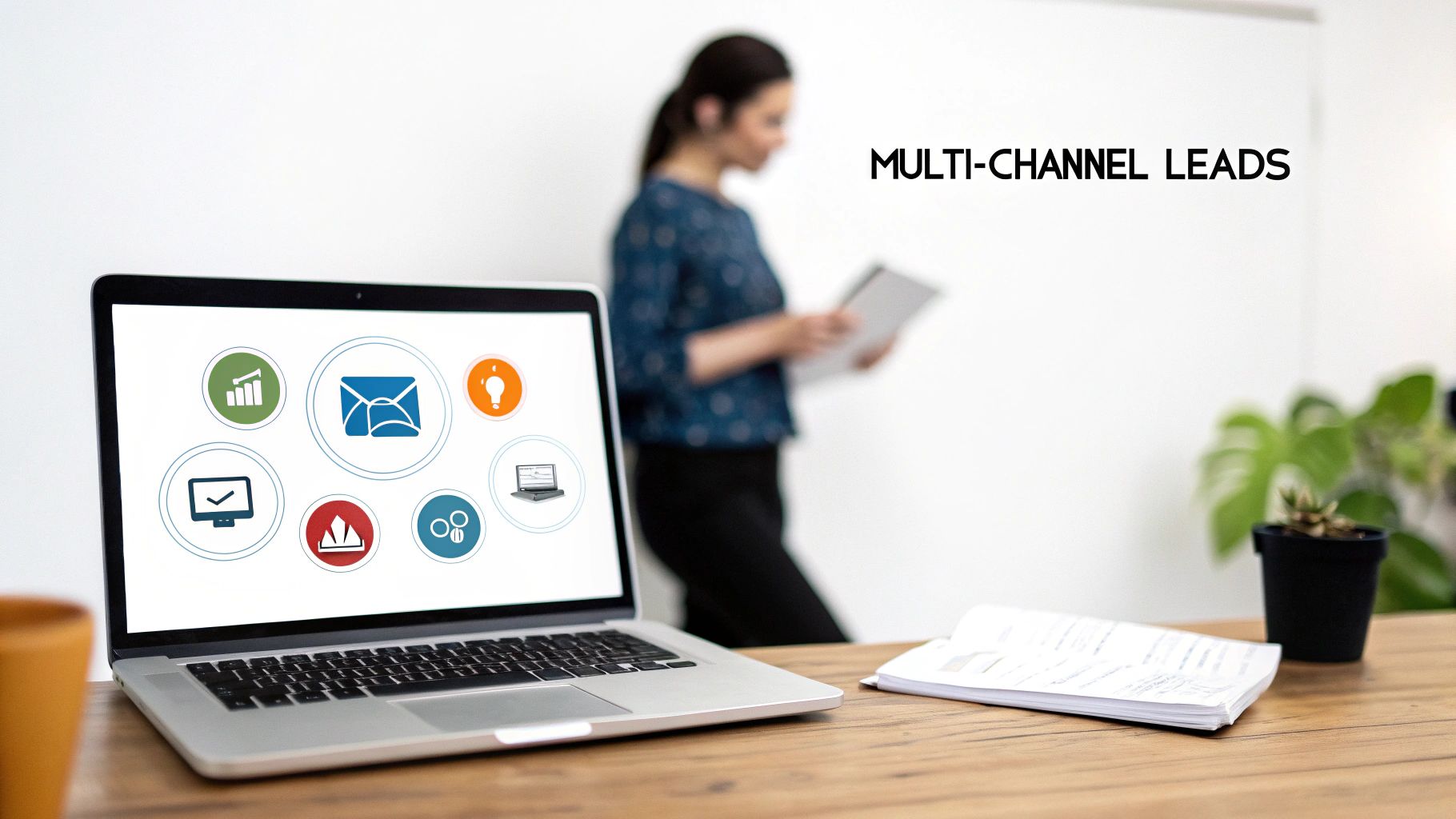
This isn't just about doing more for the sake of being busy; it’s about being smarter. It means showing up where your Ideal Customer Profile (ICP) already hangs out—whether that’s their inbox, their LinkedIn feed, or a niche industry Slack channel. When you do it right, each channel strengthens the others, creating a powerful flywheel effect.
The Power of Channel Synergy
When you combine channels, you create something much more powerful than the sum of its parts. Think about it: a prospect sees your founder’s post on LinkedIn, gets a personalized email a day later that references that same post, and then sees a retargeting ad with a relevant case study. This sequence of touchpoints builds familiarity and trust way faster than any single channel ever could on its own.
The data backs this up. In B2B SaaS, email marketing is still a beast, delivering an ROI of $36-42 for every dollar spent. And LinkedIn is essential, with 97% of B2B firms using it to generate leads. But here’s the kicker: when you weave them together into multi-channel sequences, win rates can jump by 17%, and average deal sizes can increase by 42%.
Building a Resilient Growth Engine
A multi-channel strategy is your best defense against market volatility and sky-high customer acquisition costs (CAC). If one channel suddenly becomes too expensive or stops performing, the others can pick up the slack, keeping your lead flow steady. That kind of resilience is what separates the companies that last from those that don't.
The goal is to build a system where your marketing and sales efforts aren't just isolated campaigns but interconnected gears in a well-oiled machine. Each channel feeds and amplifies the others, turning sporadic leads into a predictable revenue stream.
To give you a clearer picture of how these different channels fit into a modern SaaS playbook, here's a quick breakdown.
Modern SaaS Lead Generation Channels at a Glance
| Channel | Primary Use Case | Key Metric | Best For |
|---|---|---|---|
| Email Outreach | Direct, personalized communication to a targeted list. | Reply Rate | Reaching specific decision-makers with a tailored message. |
| Building professional networks and engaging prospects with content. | Connection Rate | B2B prospecting, social selling, and brand building. | |
| Content/SEO | Attracting prospects by solving their problems with valuable content. | Organic Traffic, MQLs | Building long-term authority and capturing buyer intent. |
| Paid Ads (PPC) | Driving targeted traffic to landing pages for immediate lead capture. | Cost Per Lead (CPL) | Testing messaging quickly and scaling top-of-funnel traffic. |
| Partnerships | Tapping into another company's audience for referrals. | Partner-Sourced Leads | Accessing a warm, trusted audience for high-quality leads. |
Each of these channels plays a unique role, but their true power is unlocked when they work together.
For a dose of real-world inspiration, check out these inspiring multi-channel marketing campaign examples. Next up, we'll get into the nitty-gritty of defining your ICP and actually building out the outbound and inbound components of this growth machine.
Building Your Foundation: The Data-Driven ICP
Every successful lead gen effort I've ever seen, whether outbound or inbound, starts with one thing: knowing exactly who you're talking to. If you skip this step, you're basically just shouting into the void and hoping someone hears you. This critical foundation is your Ideal Customer Profile (ICP).
Think of your ICP not as a static persona document but as a living, breathing guide that defines the absolute perfect-fit company for your SaaS. It’s the blueprint for everything that follows.
Forget vague descriptions and educated guesses. A powerful ICP is built on hard data, not gut feelings. It’s the difference between a campaign that feels like a shot in the dark and one that hits the bullseye every time. When you know precisely who your best customers are, finding more of them stops being a game of chance and becomes a repeatable process.
Moving Beyond Basic Demographics
A rookie mistake I see all the time is an ICP that says something like, "We target marketing managers at tech companies." That's not a profile; it's a starting point. A truly data-driven ICP digs way deeper to find the specific signals that scream "high-value customer."
The best place to start is with your current champions—the customers who use your product the most, stick around the longest, and sing your praises. They're your gold mine of data. Look for the common threads that tie them all together.
- Firmographics: What are the non-negotiable company traits? Get specific here. Instead of "Finance," drill down to "B2B FinTech." Pinpoint company size not just by employee count but by annual revenue, too. Where are they located?
- Technographics: What’s in their tech stack? If all your best customers use Salesforce, Marketo, and Slack, that tells you a lot. It reveals potential integration plays and signals their level of operational maturity.
- Behavioral Signals: How do they act? Look for patterns in their hiring—are they bulking up their sales team? Did they just close a new funding round? What keywords are they using in their job descriptions? These are powerful buying signals.
When you do this work, you might discover your sweet spot isn't just "tech companies." It's Series B FinTech companies with 50-200 employees that recently hired a VP of Sales and run on HubSpot. Now that's a target you can build a killer campaign around.
Your best customers leave a trail of clues. Your job is to follow that trail, gather the evidence, and build a profile so detailed that you can spot another perfect-fit customer from a mile away.
Uncovering the "Why Now?" Buying Signals
Once you’ve got the “who” figured out, the next layer is understanding the why. What pain point got so bad or what event happened that made them finally start looking for a solution like yours? This is where you connect what your product does to the real-world business challenges they face.
The best way to get these answers is to talk to people. Interview your top customers and grill your sales team. You need to know:
- What was the core problem they needed to solve? "Improving efficiency" is too fluffy. You want to hear things like, "Our SDRs were wasting 10 hours a week on manual data entry, and it was killing our pipeline."
- What was the trigger event? Was it a missed revenue target that got leadership's attention? A new exec hire who wanted to shake things up? Did a competitor’s big win light a fire under them?
- What were they using before? Knowing if they were struggling with a direct competitor, a clunky spreadsheet, or a homegrown mess gives you incredible context for your messaging.
- What concrete results did they get? Always push for numbers. "We increased meeting bookings by 35% in the first quarter" is a story your sales team can tell over and over again.
Make Your ICP the Single Source of Truth
All this research needs to live somewhere. Pull it together into a simple, one-page document that becomes the go-to resource for your entire company. When marketing, sales, and product are all working from the same playbook, magic happens.
And remember, this isn't a one-and-done task. Your market evolves, your product changes, and so should your ICP. Revisit and refine it every six months. This document isn't just a marketing exercise; it's the very blueprint for your entire lead generation for SaaS strategy.
Mastering Outbound with Automated Multi-Channel Sequences
Once you have your data-driven ICP locked in, it's time to get your hands dirty. This is where we move from theory to action and start building a powerful, automated outreach system that actually books meetings with your ideal customers.
Modern outbound isn't about blasting a thousand generic emails and praying for a reply. It's about orchestrating a thoughtful, multi-channel sequence that feels personal, adds real value, and keeps you on a prospect's radar without being a nuisance.
Getting this balance right is everything for effective lead generation for SaaS. Let's break down a sequence that layers LinkedIn, email, and smart follow-ups to start a conversation, not just throw a pitch.
Designing a Sequence That Gets Responses
The backbone of any high-performing outbound sequence is its structure—the cadence, the channels, and the content of each touchpoint. A huge mistake I see all the time is making every single message a hard sell. Don't do that. Instead, think of your sequence as a series of gentle nudges that build familiarity and trust over time.
A solid starting point for a B2B SaaS sequence usually looks something like this:
- Day 1 (LinkedIn): Keep it simple. View their profile and send a personalized connection request. The goal is just to pop up on their screen. No pitch yet.
- Day 3 (Email 1): Now you send the first email. This needs to be highly personalized, referencing something specific you found in your research.
- Day 5 (LinkedIn): If they’ve accepted your connection request, engage with their content. A thoughtful comment or a like goes a long way.
- Day 7 (Email 2): Follow up on your first email, but come at it from a different angle. Offer a different value prop or a piece of relevant content, like a case study.
- Day 10 (Email 3): This is often a good spot for a lighthearted "breakup" email to close the loop while leaving the door open for the future.
Of course, this is just a template. The real magic happens when you test different timings, messages, and touchpoints to see what actually resonates with your specific ICP.
The Art of Hyper-Personalization at Scale
Generic templates are the fastest way to get your domain blacklisted. Personalization is what makes outbound work, but doing it manually for hundreds of prospects is a recipe for burnout. The solution is to automate the discovery of personal details and then weave them into your messaging.
For example, you can instantly level up from a generic opener like, "I saw you're the VP of Sales at [Company]."
The Generic Way:
"Hi [Name], I noticed you work at [Company] and thought our sales automation tool could help your team."
The Hyper-Personalized Way:
"Hi [Name], I saw the recent news about [Company]'s expansion into the APAC region—congrats on the growth. As you scale the new sales team, I imagine keeping the pipeline full without burning out your reps is a top priority."
See the difference? The second example shows you’ve done your homework. It builds instant rapport and frames your solution inside the context of their current business goals. This is exactly the kind of detail that modern automation tools can uncover and insert into your sequences, making true personalization possible at scale.
The goal of personalization isn't just to use a prospect's name. It's to prove you understand their world and their challenges before you ever ask for their time. That's how you earn a reply.
This visual shows how nailing your targeting is the crucial first step before you ever hit "send."
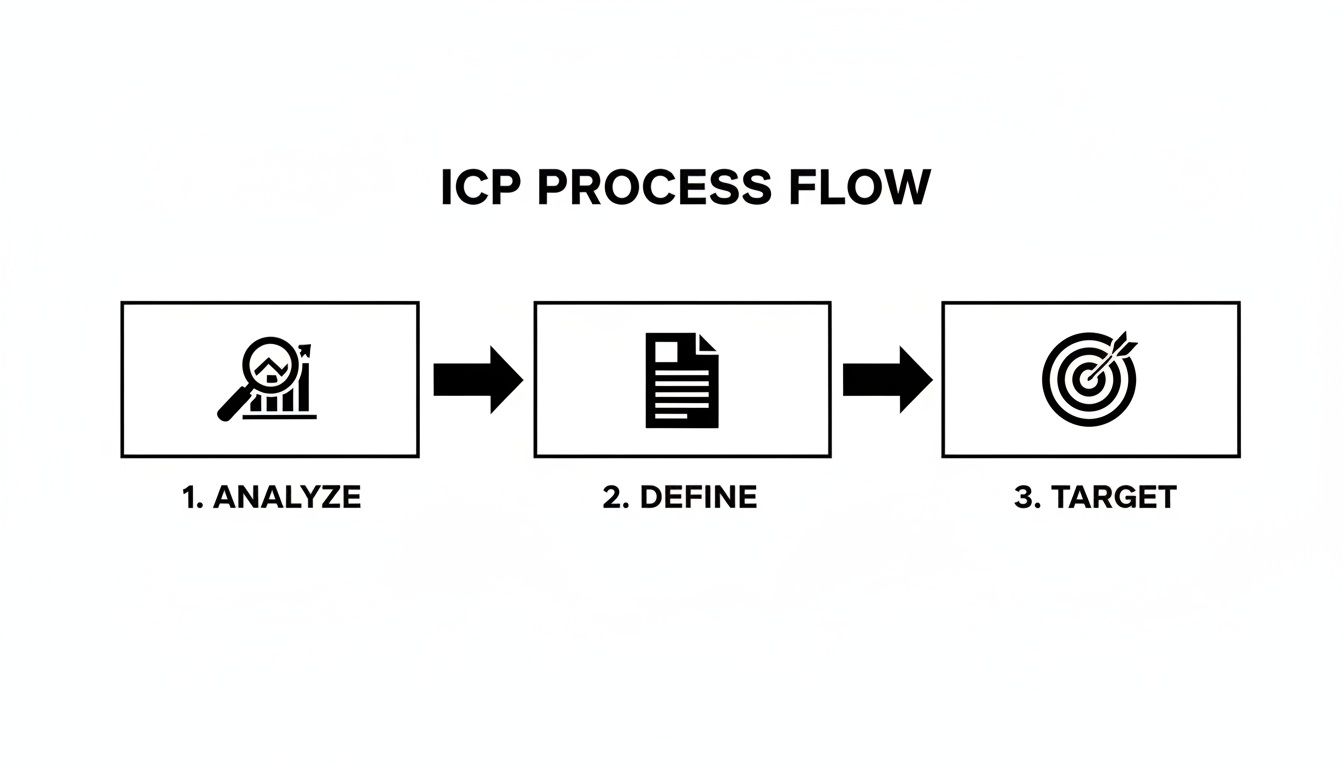
This process—analyzing your best customers, defining what they have in common, and then targeting lookalikes—is the engine that powers every effective, personalized outreach campaign.
Crafting Messages That Add Value
Every single follow-up needs a reason to exist beyond just "checking in." Each message is a fresh opportunity to provide a new piece of value, educate the prospect, or offer a different perspective on their problem.
Here are a few simple ways to add value in your follow-ups:
- Share a Relevant Case Study: Send a link to a short case study showing how you helped a company just like theirs. Make it painfully easy for them to see themselves in the story.
- Offer a Helpful Resource: Found a great blog post, webinar recording, or whitepaper that addresses a common pain point for their role? Send it over.
- Reference a Shared Connection: Mentioning a mutual connection on LinkedIn is one of the most powerful ways to build trust and boost your chances of getting a response.
- Provide a Quick Insight: Share a surprising statistic or a key industry trend that reinforces the very problem your software solves.
Here’s how that might look in a real-world follow-up email.
Follow-Up Email Example (Value-Driven)
Subject: A quick thought on [Prospect's Pain Point]
Hi [Name],
Following up on my last email.
I was thinking about your team's expansion and remembered a great article on scaling sales teams internationally. Thought you might find it useful.
We actually helped [Similar Company] cut their ramp-up time for new reps by 30% when they faced a similar challenge.
Would it be worth a quick chat next week to see if we could do the same for you?
This approach positions you as a helpful expert, not just another salesperson trying to hit quota. It’s a fundamental shift that dramatically improves reply rates and is a cornerstone of successful lead generation for SaaS. When you combine a smart multi-channel sequence with hyper-personalization and value-driven messaging, you create an outbound machine that consistently books meetings with your ideal customers.
Scaling Your Engine with Inbound and Paid Acquisition
While your outbound team is actively hunting for new business, you need another engine working in the background. This is where inbound marketing comes in. It’s less about chasing and more about becoming a magnet—a long-term asset that naturally pulls qualified prospects toward you simply by being the best answer to their most urgent questions.
You're essentially shifting from interrupting a prospect's day to becoming a valued resource they seek out.
Think of inbound as the perfect partner to your outbound efforts. It’s a flywheel. Your outbound sequences can drive curious prospects to your valuable content, and that same content warms up cold audiences, making them far more receptive when your sales team finally reaches out. This synergy is how modern lead generation for SaaS really works.
Capturing Buyer Intent with SEO
The bedrock of any solid inbound strategy is Search Engine Optimization (SEO). It’s all about showing up the moment your ideal customer is actively looking for a solution you provide. The real trick here is to focus on keywords that scream high buyer intent.
Forget about broad, top-of-funnel terms like "sales tips." You need to get way more specific and target the long-tail keywords people use when they're close to making a buying decision.
- Comparison Keywords: "best sales automation software for startups"
- Alternative Keywords: "[competitor name] alternative"
- Use-Case Keywords: "how to scale cold outreach without hiring"
- Integration Keywords: "salesforce integration for lead enrichment"
These are the kinds of searches that lead directly to demo requests. By creating genuinely helpful, practical content around these topics—think in-depth guides, honest comparison pages, and detailed use cases—you intercept prospects at the most critical point in their journey.
Inbound marketing isn’t about creating content for everyone. It’s about creating the perfect content for your ICP, answering the exact questions they’re typing into Google right before they’re ready to buy.
Before we dive into paid strategies, let's quickly compare how these two approaches—outbound and inbound—stack up. They serve different purposes and operate on different timelines, so understanding their unique roles is key to building a balanced lead generation machine.
Comparing Outbound vs Inbound Lead Generation Tactics
| Tactic | Time to Results | Typical Cost | Scalability |
|---|---|---|---|
| Outbound (Cold Email/LinkedIn) | Fast (Days to Weeks) | Low to Medium | High, but can face deliverability and response rate challenges at scale. |
| Inbound (SEO & Content) | Slow (Months to a Year+) | Medium to High (upfront) | Very high. A single piece of content can generate leads for years. |
| Paid Ads (Google/LinkedIn) | Immediate (Hours to Days) | High (Pay-per-click) | High, but directly tied to budget. Can get expensive quickly. |
| Partnerships/Referrals | Varies (Weeks to Months) | Low | Can be inconsistent and harder to scale predictably. |
As you can see, there's no single "best" method. A powerful strategy blends the immediate impact of outbound and paid with the long-term, compounding value of inbound SEO.
Fueling Growth with Paid Acquisition
Sometimes you just need to generate leads right now. That’s the job of paid acquisition. Channels like LinkedIn Ads and Google Ads let you inject fuel directly into your lead gen engine, test messaging on the fly, and target your ICP with pinpoint accuracy.
While SEO is a long-term investment that builds momentum over time, paid campaigns can start delivering results almost immediately. But let's be clear: this isn't about just driving clicks. It’s about driving the right clicks from the right people.
Smart Paid Campaigns for SaaS
Throwing money at generic ad campaigns is the fastest way to drain your marketing budget. For SaaS, success with paid acquisition is all about surgical targeting and a compelling offer.
Here are a few high-impact campaign ideas I’ve seen work wonders:
- Retarget Your Demo Page Visitors: Someone checked out your demo page but didn't book a call. They're practically waving a flag that says "I'm interested!" Hit them with a simple retargeting ad on LinkedIn featuring a customer testimonial or a short product video to give them that final nudge.
- Target Specific Job Titles with a Relevant Case Study: Use LinkedIn’s incredible targeting to put a powerful case study right in front of your ICP. An ad that says, "See how a VP of Sales just like you increased their team's meeting bookings by 45%" hits a lot harder than a generic list of features.
- Promote a High-Value Gated Asset: Offer something genuinely useful that solves a major pain point for your audience—a deep-dive guide, a data-rich report, or a webinar recording. This captures contact info from interested prospects you can then nurture with targeted email sequences.
Marketing automation has completely changed this game; today, 55% of B2B SaaS companies use it to generate, score, and nurture leads automatically. While SEO often produces the highest quality leads, the cost can vary. The ultimate goal is a healthy LTV:CAC ratio of at least 3:1—that’s the sign of a truly sustainable growth model. As the SaaS market expands, the most successful firms are those that weave multiple channels together. You can find more great examples of how SaaS companies are winning with automation.
By blending the long-term asset building of inbound with the speed and precision of paid ads, you create a balanced, resilient system that keeps your pipeline full—not just today, but for years to come.
Unlocking Exponential Growth Through Partnerships

Let's be honest, some of your best potential leads are already being courted by other companies. The trick is to realize those companies aren't always competitors. By building strategic partnerships and referral channels, you can tap into pre-built, trusting audiences—a surefire way to generate high-quality lead generation for SaaS with a much lower customer acquisition cost.
The secret is finding non-competitive businesses that serve your exact ICP. Think about it: if you sell sales automation software, who else is talking to VPs of Sales? A company offering CRM implementation services is a perfect fit. You're both solving problems for the same person, but your products complement each other beautifully.
How to Find and Approach the Right Partners
Start by getting inside your customer's head. Map out their entire workflow and the tech stack they use every single day. What other tools, platforms, and services are essential to their job? This simple exercise will give you a fantastic list of potential integration partners, co-marketing allies, and referral sources.
Once you have a shortlist, remember that this is a two-way street. Your outreach can't just be a one-sided ask. You need to approach them with a concrete idea that benefits both of you.
Here are a few collaboration ideas I've seen work time and time again:
- Co-hosted Webinars: Pitch a joint webinar on a topic that serves both audiences. Something like, "The Ultimate Tech Stack for Scaling Sales in 2025" lets both of you shine as experts.
- Content Swaps: Offer to write a genuinely helpful guest post for their blog, with a natural mention of your solution. In return, you can feature their expertise on your site.
- Integration Partnerships: This is the gold standard. If your products can connect via an API, that integration becomes a powerful, ongoing lead source for both companies as you cross-promote it.
A true partnership isn't just about swapping leads. It's a strategic alliance built on the shared goal of delivering more value to a mutual customer base. When you genuinely focus on helping their audience, they'll be more than happy to introduce you.
Building a Referral Program That Actually Works
While partnerships fill the top of your funnel, a solid customer referral program can turn your happiest users into your most effective sales team. These are, without a doubt, the warmest leads you'll ever get because they arrive with a stamp of approval from a trusted peer.
The key is to make referring dead simple and the incentive genuinely compelling. A clunky, complicated referral system will gather dust, no matter how great the reward is.
To get started, consider these simple but effective incentive structures:
- The Double-Sided Reward: Give both the referrer and the new customer a reward, like a $100 gift card or a month free. This gives everyone a reason to take action.
- Tiered Incentives: Amp up the rewards as a customer refers more people. This encourages your biggest champions to keep sending new business your way.
- Feature Upgrades: Offer exclusive access to a premium feature or an extended trial for successful referrals. This is a great way to reward them within your product's ecosystem.
By building out these two pillars—strategic alliances and customer advocacy—you're creating a powerful, self-sustaining growth engine. You stop chasing individual leads and start gaining access to entire communities at once.
Making Sense of It All: Measuring and Optimizing Your Funnel
You can build the most sophisticated lead generation engine in the world, but if you can’t tell what’s actually working, you’re just flying blind. It's time to look past vanity metrics like email open rates or social media likes. Those might feel good, but they don't pay the bills.
Real, sustainable growth comes from obsessing over the key performance indicators (KPIs) that have a direct line to your revenue. This doesn't require some overly complex dashboard. In fact, it’s much better to have a simple, clear view of a few core numbers that tell the real story.
The Metrics That Truly Matter
To get a clear picture of what's happening, you need to zero in on the numbers that reveal the economic truth of your campaigns. These are the metrics that form the foundation of a data-driven strategy for lead generation for SaaS.
Cost per Lead (CPL): This is your bottom line for acquisition. How much does it cost, on average, to get one lead through a specific channel? Knowing this helps you pour your budget into the channels that are actually efficient.
Lead-to-Meeting Conversion Rate: Of all the leads that come in the door, how many actually become a real, qualified sales meeting? This is a huge indicator of lead quality. A high number here means your targeting and messaging are spot-on.
LTV-to-CAC Ratio: This is the holy grail for any SaaS business. Your Customer Lifetime Value (LTV) absolutely must be at least 3x your Customer Acquisition Cost (CAC). If it is, you have a profitable, sustainable growth model.
The goal isn't just to get leads; it's to acquire profitable customers. If your LTV-to-CAC ratio is teetering below 3:1, you're probably burning cash to acquire customers who churn before you can make that money back.
The Real Work: Continuous Testing and Optimization
Once you've established your baseline metrics, the fun part begins. Now you can start making smart, informed tweaks to actually improve performance. The best way I've found to do this is through disciplined A/B testing—changing one thing at a time to see what really moves the needle.
For instance, you could test two completely different email subject lines. Maybe one is super direct and benefit-focused, while the other is more casual and intriguing. Send each to a segment of your audience and see which one drives a higher lead-to-meeting rate, not just a better open rate.
The same idea works for your calls-to-action (CTAs). Pit "Book a Demo" against a softer CTA like "See a 5-Min Walkthrough." You'd be surprised how small shifts in language can have a massive impact on your conversion rates.
This is the cycle that separates the good from the great: measure, test, iterate, and repeat. It’s what turns a decent lead generation system into a truly unstoppable one.
SaaS Lead Generation FAQs
Kicking off a new lead generation strategy always brings up a ton of questions. Let’s tackle some of the most common ones I hear from founders so you can set the right expectations from day one.
How Long Until I Actually See Results?
This is the million-dollar question, and the honest answer is: it completely depends on your channels. There's no single timeline.
- Outbound: If you’ve nailed your ICP and messaging, you can start seeing replies and booking meetings within the first 1-2 weeks. It’s the fastest way to get direct market feedback.
- Paid Ads: You'll see traffic and leads coming in almost right away. The real work is in the weeks that follow as you tweak campaigns to actually get a positive return on your ad spend.
- Inbound/SEO: This is the long game. You’re building an asset, and that takes patience. Realistically, you’re looking at 3-6 months before you build enough momentum to see a steady stream of organic leads.
What’s a Good Lead Conversion Rate for B2B SaaS?
Benchmarks can be tricky since they vary so much by industry, deal size, and sales cycle. But for a well-run outbound campaign, shooting for a 2-5% lead-to-meeting conversion rate is a solid goal.
For inbound leads, especially high-intent ones like a demo request, that number should be way higher—often north of 20%. The most critical thing is to establish your own baseline and then relentlessly work to improve it month over month.
For a deeper dive into the core principles behind building a solid sales pipeline, you can explore what lead generation marketing truly entails from a founder's point of view.
Should My SaaS Start with Outbound or Inbound?
For most early-stage SaaS companies, outbound is the quickest path to cash. It puts you in control, letting you go directly to your ideal customers to get feedback, land those first few logos, and validate your offer. You aren't sitting around waiting for them to find you.
My advice: Start with a sharp, focused outbound strategy to get your first customers in the door and generate that crucial initial revenue. As you start getting traction, funnel those profits back into a long-term inbound play (like content and SEO) to build a powerful, passive lead source. A healthy mix of both is the end game.
Ready to stop prospecting and start closing? Roger handles your entire outbound motion, from finding decision-makers to writing personalized outreach and scheduling meetings.