A Modern Playbook for Lead Generation Outbound
December 30, 2025
Outbound lead generation is all about proactively finding and talking to potential customers for your business. It's the opposite of inbound, where you wait for people to come to you. With outbound, you're the one starting the conversation through personalized emails, LinkedIn messages, and even strategic cold calls to create a reliable flow of sales opportunities.
Building Your Foundation for Outbound Success
A winning outbound strategy doesn't kick off with writing a cold email. It starts with a rock-solid foundation. Blasting messages to the wrong audience is like sailing without a map—you'll just waste time and money and get nowhere fast. Real success comes from having crystal-clear focus on who you're targeting and using high-quality data to reach them. This initial legwork is what separates the top-performing teams from everyone else just making noise.
To really get your head around the process of proactively reaching out to potential customers, this guide on what outbound lead generation entails is a great place to start. Having that context is key before you start building your targeting framework.
Defining Your Ideal Customer Profile
Your Ideal Customer Profile (ICP) is the absolute blueprint for your entire outbound operation. It’s a detailed description of the perfect company for your product, making sure your sales team is aiming its firepower at accounts that are most likely to convert and become happy customers. I can't stress this enough: a vague or poorly defined ICP is the number one reason outbound campaigns fail.
You have to go deeper than just the basics like industry and company size. The most powerful ICPs combine several layers of data to paint a very specific, actionable picture.
- Firmographics: This is your starting point. Nail down the company size (by employee count or revenue), the specific industry (like B2B SaaS or E-commerce), and the geography (countries or regions) where your best customers are located.
- Technographics: What tools are they already using? Knowing a prospect uses a competitor's software, a complementary platform, or even a specific CRM can be a massive advantage and a perfect conversation starter.
- Buying Triggers: These are real-time events that signal a company might be ready to buy. Think about things like a recent round of funding, a new executive hire (like a VP of Sales), or major team expansion announced on LinkedIn.
A great ICP is a filter, not a net. Its job is to exclude 99% of the market so you can pour all your energy into the 1% most likely to buy from you right now.
Sourcing and Verifying Prospect Data
Once you've got a razor-sharp ICP, it's time to build a list of people to contact. This is where so many teams stumble, buying cheap, old lists that just lead to bounced emails and a trashed domain reputation. Keeping your data clean isn't just a "best practice"—it's absolutely essential for any outbound effort that you want to scale.
Here’s how the pros handle this crucial step:
Source with Precision: Use reliable tools to find contacts that actually fit your ICP. LinkedIn Sales Navigator is the gold standard for pinpointing the right people in your target companies. From there, data providers like ZoomInfo or Apollo.io can add the direct contact info you need.
Verify Everything: Never, ever trust a list without checking it first. Use an email verification tool to make sure the addresses are real and active. Services like NeverBounce or ZeroBounce are your best friends here. Your goal should be to keep your bounce rate under 3-5%.
Automate Enrichment: You can't manually research every single prospect if you want to scale. Use automation to pull in personalized details for your contacts, like their recent LinkedIn activity, mentions in the news, or people you both know. This is the raw material for the killer personalized outreach we'll get into next.
Crafting Outreach That Actually Gets Replies
Alright, you’ve got your perfectly defined ICP and a clean, verified list of contacts. Now for the fun part—actually talking to them. This is where most outbound efforts fall apart. In a world where every decision-maker's inbox is a warzone, your generic, one-size-fits-all email template is dead on arrival.
Let's be clear: the goal isn't just to send messages. It's to earn replies. This means ditching the old "spray and pray" playbook for good and focusing on a thoughtful, multi-channel approach that adds value from the very first touch.
This entire process hinges on a solid foundation. You have to define who you're talking to, build a list of those exact people, and then make sure their contact info is actually correct.
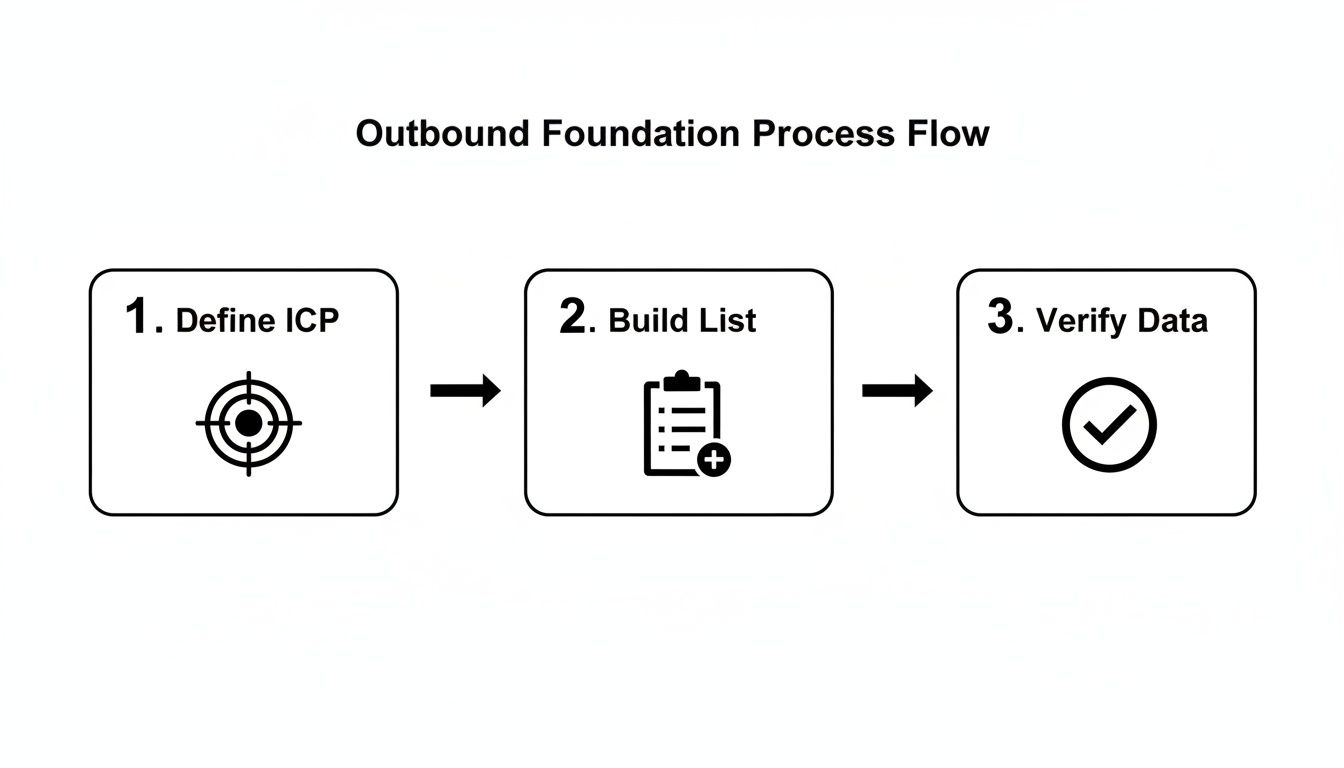
Get these three steps right, and every message you write has a fighting chance of landing with the right person and making an impact.
The Power of Multi-Channel Sequences
Relying only on email is a classic rookie mistake. Your buyers are on LinkedIn, they might answer their phones, and they're definitely seeing your emails. Your outreach needs to show up where they are. A smart multi-channel sequence weaves together different touchpoints to keep you top-of-mind without being annoying.
The data backs this up. Outbound B2B lead generation is a huge revenue driver, accounting for 60% of all marketing leads. More importantly, sales teams that use three or more channels see 50% more prospect interactions than those sticking to just one. If you're curious, you can dig into more B2B outbound statistics and see how they influence lead qualification.
A solid multi-channel sequence usually blends a few key elements:
- Personalized Emails: This is your workhorse. It's where you can lay out your detailed value proposition.
- LinkedIn Touches: Perfect for a quick profile view, a connection request, or a short, contextual message.
- Strategic Cold Calls: I save these for the highest-value prospects where a real conversation can cut through the noise and speed things up.
The magic isn't in any single channel; it's in how you orchestrate them. A LinkedIn profile view a day before your email lands? That creates a flicker of recognition. A follow-up email after they accept your connection request? Now you're building a real presence.
Writing the First-Touch Message
Your first message has one job: prove you’re not a robot. Generic openers like "Hope you're having a great week" are an instant trip to the trash folder. They scream mass-blast.
Instead, lead with something that shows you’ve done a minute or two of homework. This little bit of effort puts you in the top 1% of outreach.
Your personalization trigger can be simple:
- A recent company move: "Congrats on the new Series B funding—I imagine scaling the engineering team is a huge priority right now."
- Something they shared: "Loved your recent LinkedIn post on go-to-market strategy. It made me think about..."
- A common connection: "I saw that you used to work at [Previous Company]. I was there a few years after you left."
- An insight about their role: "As a VP of Marketing in the B2B SaaS space, I’m sure you’re constantly battling rising customer acquisition costs."
This kind of research-driven opening shows respect for their time. It positions you as a peer who understands their world, not just another salesperson with a quota.
Structuring Your Outreach Cadence
A cadence is just the rhythm of your outreach—the timing and frequency of your messages. Too much, too fast, and you’ll get blocked. Too slow, and they'll forget you exist. You're looking for that sweet spot: persistent but professional.
There’s no single "perfect" cadence. It all depends on your industry and who you're targeting. A fast-moving startup might respond to a quick, aggressive sequence, while a C-level exec at a Fortune 500 company will require a slower, more patient approach.
To give you a starting point, here are three common models you can test and adapt.
Sample Multi-Channel Outreach Cadence Models
| Day | Aggressive Cadence (10 Days) | Balanced Cadence (21 Days) | Nurture Cadence (30 Days) |
|---|---|---|---|
| 1 | Email 1 (Personalized) + LinkedIn Profile View | Email 1 (Personalized) + LinkedIn Profile View | Email 1 (Personalized) |
| 3 | LinkedIn Connection Request | LinkedIn Connection Request | LinkedIn Profile View |
| 5 | Email 2 (Follow-up, new angle) | Email 2 (Value-add, no ask) | LinkedIn Connection Request |
| 7 | LinkedIn Message (If connected) | LinkedIn Message (Short question) | Email 2 (Case study/resource) |
| 10 | Email 3 (Breakup/last attempt) | Email 3 (Follow-up on previous) | LinkedIn Message |
| 14 | Cold Call (Optional) | ||
| 21 | Email 4 (Breakup) | Email 3 (Re-engage with new info) | |
| 30 | Email 4 (Final check-in) |
Think of these as frameworks, not rigid rules. The most crucial part of any lead generation outbound strategy is paying attention to the signals your prospects are sending. Did they view your profile back? That’s your green light to follow up. Did they open your email three times? Time to send another relevant resource.
By crafting thoughtful messages and delivering them through a smart, multi-channel cadence, you stop being noise and start having real conversations.
Using AI to Automate and Scale Your Outbound Engine
Let's be blunt: manual prospecting is a dead end. If you're serious about building a predictable and scalable pipeline, you can't have your sales team burning hours digging through LinkedIn profiles and triple-checking email addresses.
To win at modern lead generation outbound, you have to work smarter, not just harder. That’s where technology, and AI in particular, becomes your single greatest advantage.
AI-powered platforms have graduated from simple automation tools. Today, they're intelligent engines that can run your entire outbound motion, freeing up your team to focus on what humans do best—building relationships and closing deals. This isn't about replacing salespeople; it's about giving them superpowers.
Automating Prospect Discovery and Data Hygiene
The first, and often biggest, bottleneck in outbound is simply building the list. Your Ideal Customer Profile (ICP) isn't a static document; new companies and decision-makers who fit your criteria pop up every single day. An AI engine can find them for you, 24/7.
Instead of endless manual searches, you set your ICP parameters once. The AI then gets to work, continuously scanning sources like LinkedIn, company websites, and industry news to identify new potential buyers. This creates a perpetual flow of fresh, relevant leads into your pipeline with zero manual effort.
Beyond just finding people, keeping your data clean is another tedious chore that's perfect for automation. AI tools can handle this automatically:
- Verify Email Addresses: Instantly check if an email is valid and deliverable. This simple step drastically cuts your bounce rate and protects your domain's reputation.
- Enrich Contact Profiles: Pull in extra data points like job titles, company size, or even recent social media activity to add valuable context to your outreach.
- Clean Existing Data: Regularly scrub your CRM to ditch outdated contacts or update information for people who have moved to new roles.
Crafting Personalized Outreach at Scale
Everyone knows personalization is non-negotiable, but trying to do it manually for hundreds of prospects is a recipe for burnout. This is where generative AI truly shines, going way beyond basic {{first_name}} mail-merge fields.
Modern AI sales tools can analyze a prospect’s public data—their LinkedIn posts, company press releases, recent interviews—and suggest hyper-relevant opening lines or a compelling "P.S." for your emails. It creates the illusion of one-to-one research but gets it done in seconds.
For instance, a platform like Roger can actually learn your writing style from past emails and then draft new outreach that sounds authentically like you, weaving in those research-driven insights automatically.
The real power of AI in outbound is its ability to blend speed with relevance. It lets you send a high volume of messages that don't feel like they're high volume, giving each prospect the personalized attention they expect.
This shift from generic to AI-assisted outreach is make-or-break. The data is clear: only 18% of marketers rate traditional outbound as a source of high-quality leads, mostly because it feels so impersonal. But for teams who embrace AI, outbound becomes a scalable pipeline machine. Considering LinkedIn is the source for 80% of B2B leads, AI's ability to automatically pinpoint decision-makers there is a game-changer. You can discover more lead generation statistics that underscore this powerful trend.
Managing Intelligent Follow-Up Sequences
One of the biggest leaks in any sales pipeline is inconsistent follow-up. A prospect might be interested but just busy. If your team drops the ball, that opportunity vanishes. AI-driven sequences plug this leak completely.
You can design multi-channel campaigns that automatically manage every single touchpoint. The system sends the initial email, follows up on LinkedIn a few days later, and keeps the sequence running until it gets a reply.
But it gets even smarter. Modern platforms can actually detect the sentiment of a reply.
- Positive Reply ("I'm interested"): The sequence instantly stops, and the lead is flagged for immediate human follow-up.
- Objection ("Not the right time"): The sequence can pause itself and re-engage the prospect with a gentle nurture track in a few months.
- Out of Office: The AI reads the OOO message and automatically resumes the sequence on the prospect's specified return date.
This intelligent management ensures no lead ever falls through the cracks. It creates a persistent, professional presence that keeps you top-of-mind, turning your outbound efforts into a predictable machine that books meetings even while your team sleeps.
So, you've launched your outbound campaign. Now what? Just letting it run without a way to measure it is like driving with your eyes closed. You might be busy, but you have no clue if you're actually getting closer to your destination. To build a lead generation machine that actually scales, you need to stop chasing vanity metrics and start focusing on the numbers that translate directly to revenue.
A high open rate feels nice, sure, but it doesn’t pay the bills. The real story of your campaign's health is told through the metrics that signal a prospect is genuinely interested.

Core Metrics That Actually Drive Results
To get a clear picture of what's working (and what's not), you only need to track a handful of crucial metrics. These numbers don't just tell you what's happening; they help you understand why, which is where the real insights for optimization live.
For any serious outbound effort, these are the KPIs that matter:
- Reply Rate: This is your north star for message resonance. If your reply rate is in the gutter, it's almost always a sign that your targeting is off or your copy simply isn't compelling enough to warrant a response. A healthy campaign should aim for a blended reply rate of 5-10%.
- Positive Reply Rate: Let's be honest, not all replies are good news. This metric cuts through the noise of "unsubscribe" and "not interested" to show you how many prospects are actually curious or open to a conversation. It's a powerful signal of lead quality.
- Meetings Booked: At the end of the day, this is the main goal of your top-of-funnel work. Tying your prospecting directly to the number of meetings set is how you start connecting your activity to tangible sales opportunities.
- Sales Qualified Leads (SQLs): How many of those meetings turn into legitimate, qualified opportunities for the sales team? This metric is the ultimate test of the quality of leads your campaigns are generating.
Getting a handle on this starts with understanding what marketing attribution means and how to connect your outreach to these downstream results. Without it, you're just guessing.
The Power of A/B Testing
Never assume you know what works best. I've been humbled enough times to know that the market decides what's effective, not me. The only way to find out what truly connects with your audience is to test everything, all the time.
Simple, consistent A/B testing is the engine of optimization. It allows you to make small, data-backed tweaks that can compound into massive performance gains over time. Don't try to test five things at once; you won't know what actually made the difference. Stick to one variable at a time.
The goal of A/B testing isn't to find a single "perfect" message. It's to build a continuous feedback loop that makes your entire outbound strategy smarter with every email you send.
Here are a few high-impact elements you can start testing right away:
- Subject Lines: Try a straightforward, benefit-driven subject line ("Idea for [Company Name]") against a more personalized, curiosity-based one ("Quick question about your sales process").
- Calls-to-Action (CTAs): Compare a "hard CTA" that asks for a meeting ("Are you free for a 15-minute call next week?") with a "soft CTA" that just asks for interest ("Is solving [pain point] a priority for you right now?").
- Sequence Timing and Cadence: Play around with the number of days between follow-ups. Does a more aggressive 2-day follow-up beat a 4-day cadence? What happens if you add a LinkedIn touchpoint on Day 3?
Establish a Tracking Rhythm
Having data is one thing; actually using it is another. To keep your campaigns on track, you need a regular reporting schedule to spot trends and react before it's too late. A simple framework can make all the difference here.
Your Outbound Tracking Checklist
| Frequency | Metrics to Review | Goal of the Review |
|---|---|---|
| Daily | Open Rate, Click-Through Rate, Replies | Spot check for immediate technical issues like deliverability problems. |
| Weekly | Reply Rate, Positive Reply Rate, A/B Test Results | Analyze message performance and call the winners on your tests. |
| Monthly | Meetings Booked, SQLs, Conversion Rates | Evaluate the campaign's overall pipeline impact and strategic effectiveness. |
By adopting this kind of disciplined, data-first approach, you transform your outbound program from a series of random shots in the dark into a predictable, repeatable system for growth. You stop guessing and start knowing what it takes to consistently fill your sales pipeline.
Overcoming Common Outbound Roadblocks
No matter how dialed-in your outbound strategy is, you're going to hit a few bumps. Low reply rates, spam filters, and gatekeepers aren't signs that you've failed—they're just part of the game. The trick is to see them as signals, not stop signs. They’re telling you it’s time to adjust your approach, not to give up.
Think of a sudden drop in engagement as a feedback loop. It's your audience telling you that something in your messaging, targeting, or even your technical setup needs a quick tune-up. By methodically working through these common snags, you can keep your momentum going and your pipeline full.
Diagnosing and Fixing Low Reply Rates
Are people opening your emails but not responding? That’s a classic sign that your message isn't hitting the mark. Your subject line did its job, but the content inside failed to spark any real interest or urgency. Simply put, your value proposition is falling flat.
Time to circle back to your Ideal Customer Profile (ICP). Are you truly speaking their language and addressing the problems that keep them up at night?
Rethink Your Opening Line: Forget the generic "Hope you're having a great week." Your first sentence needs to be hyper-personalized and prove you've done your homework. Mention a recent company win you saw on LinkedIn, a shared connection, or an observation about a trend impacting their industry.
Sharpen Your Call-to-Action (CTA): A vague or demanding CTA like "Got 15 minutes to chat next week?" is a common conversion killer. Instead, try a softer approach that gauges interest. Ask if solving a specific problem is even a priority for them right now.
Offer Value Upfront: Your message shouldn't be all about you. Give them something useful—a surprising statistic, a link to an insightful article, or a helpful tip—even if they never reply.
Navigating Gatekeepers and Handling Objections
In many companies, the path to a decision-maker is through an executive assistant or office manager. Instead of treating them like an obstacle, view them as a potential ally. Be polite, be professional, and be incredibly clear about why you’re calling.
Once you do get through, get ready for objections. "Not interested," "we already have a solution," and "no budget" are the greatest hits. Don’t let these shut you down.
An objection is often just a request for more information in disguise. It's an opportunity to understand what's really on their mind and reframe your value proposition to address it directly.
When you hear one, try this simple framework: Acknowledge, Question, Reposition. First, acknowledge their concern ("I understand, budget is tight for everyone right now"). Then, ask a clarifying question to dig deeper ("When you say you have a solution, what does that process look like for your team?"). Finally, reposition your offer based on what you just learned. This approach turns a potentially defensive conversation into a collaborative problem-solving session.
Ensuring Your Emails Land in the Inbox
All the brilliant copy and personalization in the world means nothing if your emails go straight to spam. Email deliverability is the technical bedrock of any successful lead generation outbound campaign, and it all comes down to your domain’s reputation and sending habits.
While companies might generate thousands of leads through various channels, the targeted nature of outbound often yields much higher quality. In fact, by 2025, while 79% of typical leads might never convert, a well-executed outbound strategy can flip that script. Data shows that 80% of buyers are more likely to convert from outreach that’s been thoughtfully tailored to them. You can dive deeper into how personalization impacts these numbers in these key lead generation statistics on inbeat.agency.
To stay out of the spam folder, get your technical house in order. That means authenticating your domain with SPF, DKIM, and DMARC records. If you're using new email accounts, you have to warm them up first—start by sending a small volume of high-quality emails before you even think about scaling up. At the end of the day, consistent, valuable outreach is your best defense against deliverability problems.
Common Questions (and Real Answers) on Outbound Lead Gen
When you're building an outbound motion, questions are inevitable. Whether you're a founder just getting started or a sales leader trying to scale, you need straight answers. Here are some of the most common questions we get—and the no-fluff answers you need to hear.
How Many Touchpoints Should My Sequence Have?
There’s no universal "magic number," but a solid starting point for most B2B campaigns is 7-12 touchpoints over a three to four-week period. This gives you enough runway to stay top of mind without being annoying.
The real secret, though, isn't the number—it's the mix. A great sequence uses multiple channels in concert.
- Email: This is your workhorse for delivering value and detailed messaging.
- LinkedIn: Perfect for light touches like profile views, connection requests, and quick messages that reference a shared connection or recent post.
- Cold Call: Save this for high-value prospects where a direct conversation can cut through the noise and speed things up.
The goal is professional persistence, not being a pest. You also have to tailor the intensity based on your audience. A busy C-level executive might need a shorter, punchier sequence, while a manager-level contact often requires a bit more warming up to build trust. Start with a balanced approach, watch your reply rates at every stage, and let the data tell you what to do next.
What's the Single Biggest Mistake to Avoid in Outbound?
It's simple: a lack of genuine personalization.
Blasting out generic, one-size-fits-all templates is the fastest way to kill your campaign. It gets your emails deleted, ignored, and worse, flagged as spam, which can wreck your domain's sending reputation.
Good outbound is built on a single, powerful idea: showing you did your homework. It’s about making the outreach about them, not about you.
The second a prospect feels like just another row on your spreadsheet, you've already lost. The connection only starts when they realize you took 60 seconds to understand their world.
This doesn't mean you need to write a custom dissertation for every prospect. A tiny, specific detail makes a world of difference. Mentioning a recent LinkedIn post they wrote, a new company initiative, or a challenge specific to their role is often all it takes to stand out and earn a reply.
How Quickly Will I See Results from an Outbound Campaign?
This is where outbound really shines. Unlike inbound marketing, which can take months to gain traction, a well-executed outbound campaign can start generating positive replies and booking meetings within the first one to two weeks.
You'll get immediate feedback on things like open and reply rates, which gives you quick clues about whether your messaging is hitting the mark.
But let’s be realistic. Building a predictable, scalable pipeline of qualified leads is more of a marathon than a sprint. You should give yourself 30-90 days to really find your groove. This window gives you the time you need to:
- Test and Iterate: Run A/B tests on subject lines, CTAs, and value propositions.
- Hone Your Targeting: See which ICP segments are most responsive and focus your efforts there.
- Perfect Your Cadence: Fine-tune the timing and frequency of your follow-ups based on real engagement data.
Consistency is what drives outbound. The results build on themselves as your process gets smarter, your messaging gets sharper, and your name becomes more familiar in your target market.
Ready to build an outbound engine that runs on autopilot? Roger uses AI to discover your ideal customers, personalize outreach at scale, and book meetings for you. Stop prospecting and start closing. Learn how Roger can fill your sales pipeline.