Using AI for Lead Generation A Practical Guide
January 6, 2026
When you hear "AI for lead generation," don't think about robots replacing salespeople. Think about swapping out all the tedious, soul-crushing parts of prospecting for a smart system that finds, qualifies, and even personalizes outreach to your ideal customers.
It's a fundamental shift from a "spray and pray" numbers game to a strategy built on quality and precision. The goal is to let intelligent tools handle the grunt work of research and list-building. This frees up your sales team to do what they're best at—building relationships and closing deals.
This guide is your practical blueprint for building that modern sales engine from the ground up.
The End of Manual Prospecting
Remember the days of living in spreadsheets? You'd spend hours scrolling, hunting for contacts, trying to verify information that was probably already outdated, and then sending out generic email blasts, just hoping something would stick.
That old-school approach was a game of brute force. The result? Abysmal reply rates, burnt-out reps, and a sales pipeline clogged with leads that were never going to close. It’s an inefficient and completely unsustainable way to grow a business. It forces your most talented salespeople into administrative roles instead of letting them sell.
A Smarter Way to Build Pipeline
Thankfully, that reality is quickly becoming a relic. AI isn't some far-off concept anymore; it's a practical, accessible tool that is completely changing the game for B2B sales teams. Today's platforms go way beyond simple task automation—they act as intelligent assistants that can manage entire prospecting workflows.
For a sales team on the ground, this means:
- Automated Research: AI can pinpoint your ideal customers, identify the right decision-makers, and pull in relevant business intelligence without anyone lifting a finger.
- Hyper-Personalized Outreach: The system analyzes data from sources like LinkedIn profiles or recent company news to craft unique, genuinely relevant messages for each person. We're talking far beyond a simple
[FirstName]mail merge. - Intelligent Sequencing: The AI manages a multi-channel sequence of touchpoints across email and social platforms, automatically adapting its follow-ups based on how a prospect engages.
To see just how different this approach is, let's look at a side-by-side comparison.
Traditional vs AI-Powered Lead Generation
| Activity | Traditional Method (Manual) | AI-Powered Method (Automated) |
|---|---|---|
| Prospecting | Manual searches on LinkedIn, browsing company websites, buying static lists. | AI defines the Ideal Customer Profile (ICP) and automatically discovers best-fit accounts and contacts. |
| Data Enrichment | Reps manually search for missing contact details and company information. | AI automatically enriches profiles with verified emails, phone numbers, and firmographic data. |
| Personalization | Generic templates with basic [FirstName] and [Company] merge fields. |
AI generates personalized icebreakers based on LinkedIn activity, news, or job postings. |
| Outreach | Reps manually send emails and connection requests one by one. | AI executes multi-channel sequences across email and social media, timed for optimal engagement. |
| Optimization | Guesswork based on overall campaign reply rates. | AI A/B tests messaging, subject lines, and calls-to-action to identify what works best. |
The difference is night and day. One path leads to burnout and diminishing returns, while the other creates a scalable, predictable engine for growth.
The real win here is simple: AI handles the repetitive, time-consuming work with greater speed and accuracy than any human ever could. This empowers your team to focus their energy on high-value conversations and strategic relationships.
This isn't just about working faster; it's about being more effective. We've seen teams using AI-powered tools report up to an 80% increase in leads generated compared to their old methods. Why? Because the AI handles the entire top-of-funnel process—prospecting, enrichment, scoring, and initial outreach—allowing you to engage higher-quality leads with surgical precision. You can explore more of these lead generation statistics to see the impact yourself.
Now, let's get into the actionable steps to build your own scalable outbound engine.
Building Your AI-Ready Foundation
Jumping into AI-powered lead generation without the right groundwork is like trying to build a house on sand. Before you can let the algorithms loose to scale your pipeline, you have to get the fundamentals right. This means getting brutally honest about who you're targeting, cleaning up your data, and picking the right tech for the job.
The thing is, any AI system is only as good as the instructions and data you feed it. Give it a vague target, and you'll get vague, low-quality results. But if you give it a well-defined strategy, that's when the AI becomes a precision tool, zeroing in on your most valuable future customers with startling accuracy.
Nail Your Hyper-Specific ICP
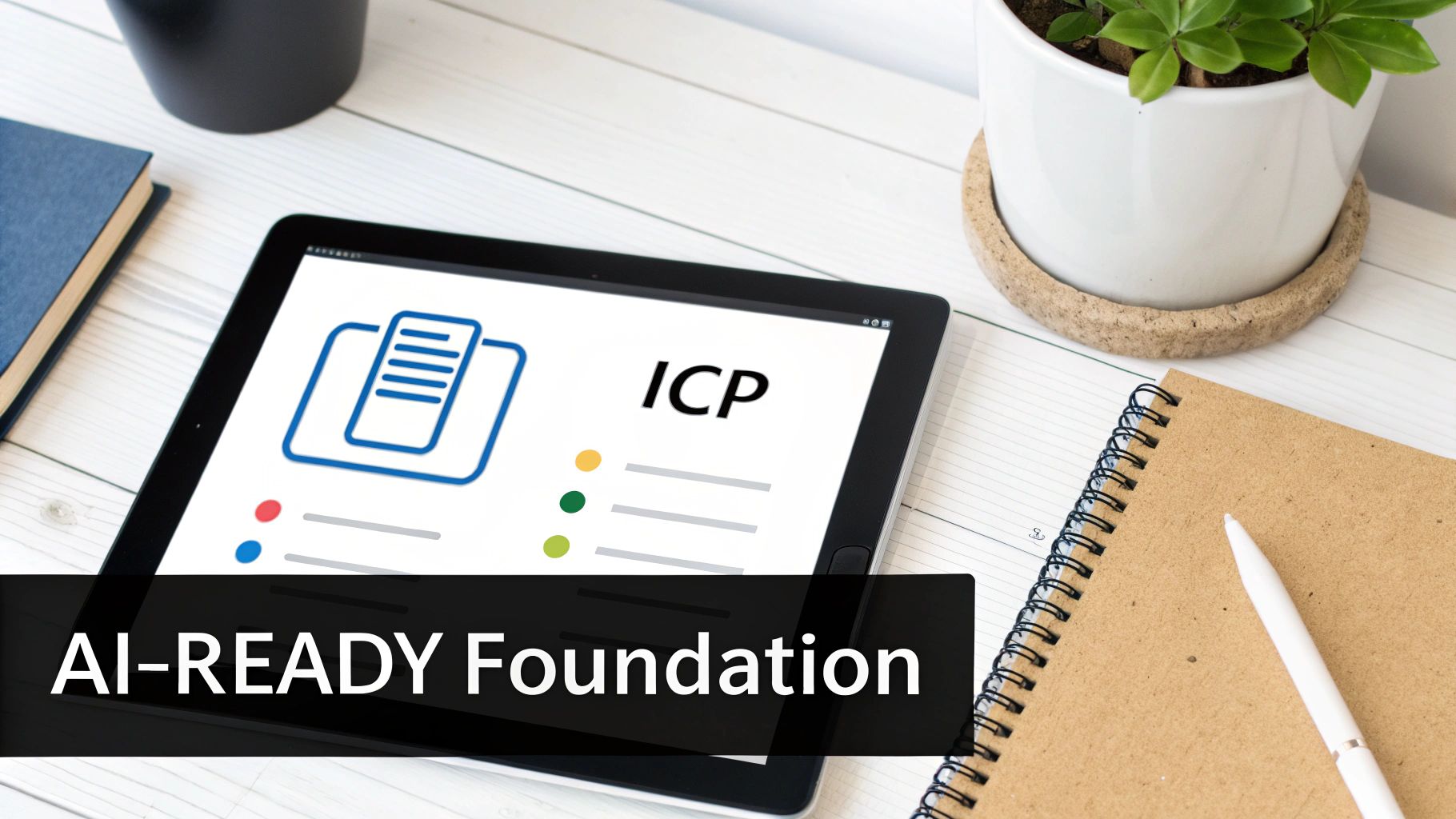
Your Ideal Customer Profile (ICP) is the absolute cornerstone of your AI strategy. Seriously, this is the rulebook your AI will live and die by. A generic ICP—something like "tech companies in North America"—is a recipe for disaster. It's just too broad and will clog your pipeline with leads that go nowhere.
You need to get way more granular. Think of your ICP as a detailed blueprint for a perfect-fit customer. AI is fantastic at spotting subtle buying signals and behavioral shifts, but only if you've told it exactly what to look for.
A strong, AI-ready ICP must include:
- Firmographics: The basics—industry, company size, revenue, and geography.
- Technographics: What tech are they already using? This is a huge qualifier. Think CRMs, marketing automation, or even competitor tools.
- Buying Triggers: These are the real tells. Look for recent funding rounds, key executive hires, big company announcements, or a sudden spike in hiring for specific roles.
- Pain Points: What keeps them up at night? What specific business challenges does your solution actually solve for this exact profile?
For example, a weak ICP is "SaaS companies with 50-200 employees." A powerful, AI-ready ICP is "B2B SaaS companies with 50-200 employees that use HubSpot, recently hired a 'Head of Sales,' and are actively posting jobs for SDRs." See the difference? The second one gives the AI specific, actionable criteria to hunt for high-intent prospects.
Master Your Data and Enrichment Strategy
Your CRM holds a potential goldmine of first-party data. The problem? It's probably a mess. Most are filled with incomplete records, outdated contacts, and flat-out wrong information. AI can't work its magic with bad data—in fact, it will just amplify the chaos, leading to wasted time and a torched sender reputation.
Start with a data audit. Where are the gaps? Are job titles missing? Is contact info stale? This is where AI-driven data enrichment becomes a game-changer.
AI enrichment tools do more than just fill in blank fields. They build a 360-degree view of your prospect, pulling in recent LinkedIn activity, verifying current job titles, and confirming email addresses in real-time. This ensures your outreach is always hitting the right person with the right context.
This process turns a dusty old contact list into a living, breathing intelligence asset. A clean and enriched database gives your AI the accurate fuel it needs to personalize messages and, crucially, to know the right moment to strike.
Choose the Right AI Platform
With a rock-solid ICP and clean data, the final piece of the foundation is your tech stack. The market is flooded with tools, and it's easy to get overwhelmed. To build a proper AI-ready foundation, spending some time exploring the landscape of dedicated AI SaaS companies is a smart move to see what's out there.
When you're evaluating platforms, focus on the core capabilities that actually solve B2B sales challenges. Don't get distracted by flashy features that sound cool but don't move the needle on revenue.
Here’s what you should be looking for, no exceptions:
| Feature | Why It's Non-Negotiable |
|---|---|
| Automated Lead Discovery | The platform has to be able to find net-new leads that match your hyper-specific ICP on its own, constantly feeding your pipeline. |
| Real-Time Data Verification | Look for multi-step email verification. This is essential for protecting your domain reputation and ensuring your emails actually land in the inbox. |
| Deep CRM Integration | The tool must have a bulletproof, two-way sync with your CRM (like Salesforce or HubSpot) to avoid data chaos. |
| Personalization Engine | It needs the ability to scan public data (like LinkedIn profiles) to generate relevant, human-sounding icebreakers and messaging snippets. |
Choosing a platform with these core functions means you’re not just buying another tool—you're implementing a system. It sets you up to build a scalable, automated, and genuinely effective outbound engine from day one.
Putting Your AI Lead Gen Engine in Motion
Alright, you've done the prep work. Your ICP is crystal clear, your data is clean, and your tools are connected. Now for the exciting part: moving from strategy to execution and launching your first AI-powered campaign.
This is where all that groundwork pays off, turning those carefully selected data points into real conversations with potential customers. Forget the old "spray and pray" mindset. This is about orchestrating a series of smart, personalized touchpoints that feel like they were written one-by-one, just for that specific person.
The beauty of using AI here is that it acts like a clone of your best salesperson—the one who always knows the right thing to say. It learns, adapts, and makes sure every interaction is timely, relevant, and sounds like it came directly from you, but at a scale a human could never manage.
Crafting Messages That Actually Get a Response
This is the number one place where people trip up. They treat the AI like a glorified mail merge, thinking the job is done after plugging in [FirstName] and [Company]. That's completely missing the point. You want the AI to be your co-writer, a partner that understands the DNA of your most successful outreach.
Start by showing it what works. Feed the AI a handful of your best-performing emails—the ones that didn't just get opened, but got positive replies and booked demos. The system will instantly break down the tone, structure, and language to build a messaging framework that feels authentically you.
From that baseline, the AI then weaves in hyper-relevant details for every single prospect. This is where it gets fun. It pulls in things like:
- LinkedIn Activity: Maybe they just shared a great post, got a promotion, or commented on something relevant.
- Company News: Did their company just get a round of funding, launch a new product, or win an award?
- Hiring Trends: Are they hiring for a role that signals a pain point you can solve? That's pure gold.
Instead of a tired, generic opener like, "I saw you're the VP of Sales," the AI can write something like this: "Saw your post on LinkedIn about scaling SDR teams—your point about data-driven coaching really hit home." That one sentence completely changes the dynamic. It proves you've done your research and makes the outreach feel like a genuine, one-to-one conversation.
Here's the key: AI doesn't just automate personalization; it gives it context. It connects the dots between public data points to build a believable story about why you're reaching out right now. A cold email instantly becomes a warm, relevant conversation starter.
Building Your Multi-Channel Sequence
A smart campaign never puts all its eggs in one basket. To really break through the noise, you need to combine different channels to create a consistent, but not annoying, presence. For B2B, the magic combination is almost always email and LinkedIn. Your AI platform should be able to run this sequence on autopilot, making smart decisions based on how a prospect engages.
A battle-tested AI sequence often looks something like this:
- Day 1 (Email): Kick things off with that highly personalized email, complete with the AI-generated icebreaker.
- Day 2 (LinkedIn): A simple, automated profile view. It's a subtle way to show up on their radar without being intrusive.
- Day 3 (LinkedIn): Send a connection request. I usually recommend sending it without a message to keep it casual and low-pressure.
- Day 5 (Email): A follow-up email that adds more value. This time, maybe you reference a different pain point or share a relevant case study.
- Day 8 (LinkedIn): If they accepted your request, now you can send a brief message tying back to your email. Something like, "Hey [FirstName], just wanted to connect here as well. Let me know if you had any thoughts on the note I sent over about [topic]."
The AI is the quarterback for this entire play. The second a prospect replies or books a meeting, the sequence stops dead in its tracks. This is critical—it prevents those embarrassing follow-ups that make you look clueless, a common mistake with more basic automation tools.
Don't Forget Your Inbound Traffic
Outbound is only half the story. AI is also a game-changer for how you handle people who are already on your website showing interest. This is where real-time, conversational AI comes into play.
Conversational AI is absolutely exploding right now, and for good reason. It captures buying intent the moment it happens, using chatbots and voice assistants to drive some seriously impressive conversion lifts. Industry data shows that AI-powered chatbots can qualify prospects instantly, cutting out the friction of long forms and boosting conversions on high-intent pages. They do this by gathering critical context—like budget, timeline, and use case—in a natural, conversational way. For a deeper dive, check out some of the latest lead generation trends on TheeDigital.com.
By adding a smart chatbot to your site, you can engage visitors who are actively looking for a solution like yours. It can qualify them, book demos straight onto your SDRs' calendars, and answer common questions 24/7. You literally never miss an opportunity. It’s the perfect complement to your outbound engine, creating a complete system that captures and nurtures leads from every possible angle.
Optimizing and Scaling Your Outreach Engine
Getting your first AI-powered campaign out the door is a big win, but the real magic happens next. A truly effective AI lead generation engine isn't something you just set and forget. It's a living system that gets smarter with every interaction. Think of your initial campaigns as the first draft—they're all about gathering the raw data you need to start refining your approach.
This is where you need to get agile. Forget waiting weeks for a campaign to finish before you look at the numbers. AI tools give you a real-time pulse on what’s happening. You can see which messages are landing and which are falling flat, letting you tweak your copy, adjust your sequence timing, or even tighten up your ICP definition right in the middle of a campaign.
This constant feedback loop is what separates a decent outreach strategy from a great one. You're not just blasting emails anymore; you're running a series of small, controlled experiments, and each one makes your engine more efficient.
Moving Beyond Opens and Clicks
To really know if your campaigns are working, you have to look past the vanity metrics. Sure, open and click-through rates can tell you if you have a deliverability problem, but they don't tell you if you're actually generating business. You need to tie your efforts directly to revenue.
I always tell my team to focus on these three numbers:
- Positive Reply Rate: How many people are actually responding with interest? This is your best indicator for message-market fit. If this number is low, your copy or your targeting is off.
- Meetings Booked: This is the North Star metric for outbound. It’s the clearest sign that your targeting is sharp and your message is compelling enough to get a spot on a busy person's calendar.
- Lead-to-Opportunity Conversion Rate: Of the meetings you book, how many become real, qualified sales opportunities? This metric tells you if you're talking to the right people—the ones with actual authority and budget.
Tracking these gives you a clear, no-fluff picture of your campaign’s health and its direct impact on the sales pipeline. No more guesswork.
The process itself is simple on the surface, but each step is supercharged by AI, boosting efficiency and overall impact.
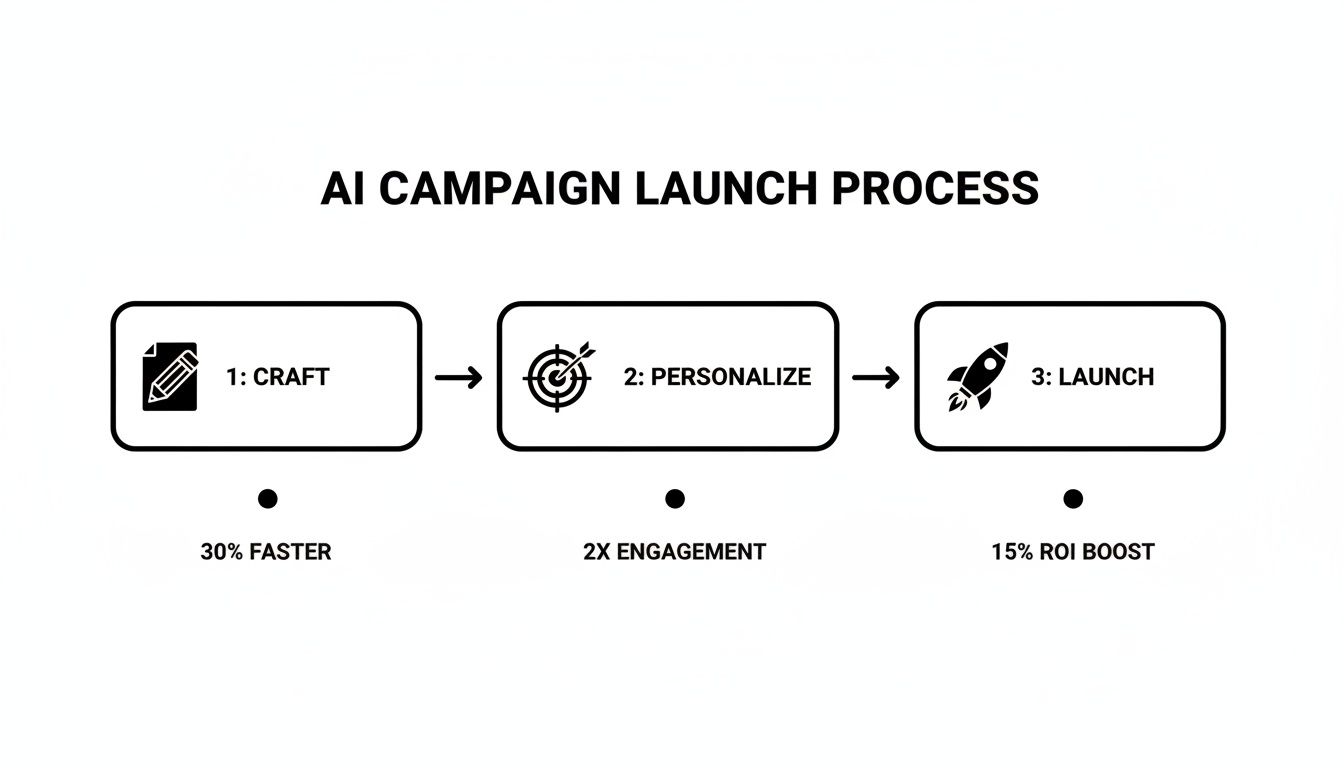
This entire workflow is designed to get you better results, faster.
Before we move on to scaling, it's crucial to understand which levers to pull when you analyze your campaign data.
Key AI Lead Generation Metrics and Optimization Levers
This table breaks down what each key metric tells you and gives you specific, AI-driven tactics you can use to improve it.
| Metric to Track | What It Tells You | AI-Driven Optimization Tactic |
|---|---|---|
| Positive Reply Rate | Your message is resonating with your ICP. | Use AI to A/B test different value propositions, pain points, and CTAs. Refine your ICP with AI-driven lookalike audiences based on high-responders. |
| Meetings Booked | Your call-to-action is effective and your offer is compelling. | Implement AI-powered scheduling tools to reduce friction. Analyze meeting-setter emails to find patterns in language and timing, then replicate. |
| Lead-to-Op Rate | You're targeting the right decision-makers with real purchasing intent. | Use AI enrichment to verify job titles and seniority. Score leads based on firmographic and technographic data to prioritize high-intent prospects. |
| Email Bounce Rate | The quality and freshness of your contact data. | Leverage AI-powered verification tools to clean your list before sending. Run automated data hygiene workflows to remove invalid contacts. |
| Unsubscribe Rate | Your messaging is either irrelevant or too frequent. | Let an AI analyze unsubscribes to spot patterns (e.g., a specific persona or industry). Use this to refine segmentation or adjust sequence cadence. |
Treat this table as your playbook. When a number dips, don't just guess what's wrong—use these tactics to make a data-backed adjustment.
Intelligent Scaling Strategies
So, you’ve found a winning formula and meetings are starting to roll in. The natural instinct is to floor it, right? Not so fast. Scaling too aggressively is one of the quickest ways to kill a successful campaign. You risk tanking your sender reputation and turning your carefully personalized outreach into generic spam.
The key is to scale methodically.
Instead of going from 50 to 500 new contacts a day, increase your volume gradually—think 15-20% each week. This slow, steady ramp-up signals to email providers that you're a legitimate sender, not a spammer. It also gives you breathing room to watch your metrics closely and make sure your positive reply and meeting book rates hold steady as you grow.
For those looking to expand into more complex, multi-step outreach, I'd recommend digging into the ultimate guide to AI automation through agentic workflows. This approach is perfect for when you start targeting different ICP segments or expanding into new markets and need your systems to handle more sophisticated tasks.
At the end of the day, using AI for lead generation isn't about replacing people. It's about building an intelligent system that learns from its own performance, getting more effective over time and creating a predictable revenue engine for your business.
The results speak for themselves. Recent studies show that 80% of teams using this kind of automation see a significant increase in leads, and 44% report a direct lift in revenue. The core of this success is letting AI handle lead management (a top feature for 44% of users), scoring (40%), and segmentation.
This frees up your team to focus on strategy and conversations, not manual tasks. This iterative cycle of testing, learning, and scaling is how you turn a single successful campaign into the cornerstone of your entire growth strategy.
Common AI Implementation Mistakes to Avoid
Bringing AI into your sales process is a game-changer, but it’s not a magic wand. I’ve seen too many teams jump in headfirst, only to end up with wasted time, frustrated reps, and campaigns that fall completely flat. They often stumble over the same handful of preventable errors.
The good news? Once you know what these traps are, they’re surprisingly easy to sidestep. Being mindful of these common blunders from the get-go will put you on the fast track to building a predictable, high-performing pipeline.
Let's break down the most frequent mistakes I see and, more importantly, how to steer clear of them.
Forgetting the Human Touch
This is, without a doubt, the biggest mistake. Teams get so dazzled by an AI's ability to "personalize" at scale that they forget a real person is on the receiving end. The result is outreach that sounds robotic, or even worse, a little creepy. It completely defeats the purpose.
Here’s a classic example: A salesperson lets their AI tool pull a prospect's recent LinkedIn post and shoehorn it into an email. The message ends up with an awkward line like, "I saw your interesting post about Q3 financial planning." It feels forced and immediately screams "automation," not genuine interest.
The fix is to reframe how you see the AI. Treat it as a world-class research assistant, not your copywriter. Use the insights it surfaces as a jumping-off point, but always add your own human layer. Edit the AI-generated snippets to sound like you. Add your perspective. Ask a genuine question. Your goal should be AI-assisted outreach, not fully autonomous spam.
Relying on Dirty or Incomplete Data
An AI platform is a precision instrument. Feeding it bad data is like asking a Michelin-star chef to cook with rotten ingredients—the outcome is never going to be good. If your CRM is a graveyard of outdated contacts, half-finished profiles, and wrong job titles, your AI will just scale those mistakes at lightning speed. You'll be hit with high bounce rates, wasted effort, and a tanking sender reputation.
You can't expect the AI to magically clean up years of data neglect. Before you launch a single campaign, you have to prioritize data hygiene.
- Run a CRM Audit: Where are the biggest holes? Are you missing critical fields like industry, employee count, or specific tech stack info?
- Enrich and Verify: Use your AI platform's built-in enrichment features (or a dedicated tool like Clearbit or ZoomInfo) to fill in the gaps and validate what’s already there.
- Set New Rules: Create clear data entry standards for your team moving forward. This stops the "bad data in" problem at its source.
A clean database is the absolute, non-negotiable foundation for successful AI lead generation. Seriously, spending one solid week on data hygiene now will save you months of headaches and dismal performance later.
Ignoring Deliverability Best Practices
Many teams make the dangerous assumption that because an AI is handling the outreach, all the technical stuff like deliverability is taken care of. While modern platforms have some great safeguards, you are still the owner of your domain's reputation. Ignoring email authentication and warm-up protocols is a one-way ticket to the spam folder.
Picture this: A team gets their shiny new AI tool, uploads 5,000 contacts, and blasts a campaign from a brand-new email address. Within hours, their domain is red-flagged, and their messages are getting blocked. They’ve effectively torched their sending reputation before they even got started.
You have to treat your AI-powered outreach with the same technical diligence as any other email program.
- Warm Up Your Domain: Always start slow. Send a very small volume of emails and gradually ramp it up over several weeks. Most good AI platforms have an automated warm-up sequence—use it.
- Authenticate Everything: Make sure your SPF, DKIM, and DMARC records are correctly configured. This is how you prove to inbox providers like Gmail and Outlook that you're a legitimate sender.
- Watch Your Metrics Like a Hawk: Keep a close eye on your bounce rates and spam complaint rates. If those numbers start creeping up, it’s an early warning sign that something’s wrong with your deliverability.
Navigating these challenges is just part of the process. By anticipating these common slip-ups, you move from a reactive position to a strategic one, making sure your investment in AI actually pays off from day one.
Frequently Asked Questions
It's completely normal to have a few questions when you're looking at a major shift like bringing AI into your lead generation process. Moving away from purely manual methods is a big step, and you need to be sure it’s the right one for your team.
Let's tackle some of the most common questions B2B teams ask when they're on the fence about using AI for sales. My goal here is to give you straight, practical answers to help you feel confident about building your own automated sales engine.
How Does AI Actually Personalize Outreach at Scale?
This is the magic, right? It's not just a fancy mail merge. Think of a good AI platform as a tireless research assistant that’s plugged into the entire internet.
It constantly scans a prospect's public digital footprint—their LinkedIn, company news, even interviews they've given. It's looking for a hook. Maybe they just got a promotion, their company announced a new funding round, or they wrote an interesting post.
The AI then uses natural language generation (NLG) to write a unique, relevant sentence about that specific trigger. This "icebreaker" gets dropped right into your email template. The system also learns your tone and style from past successful emails, so the personalization feels like it genuinely came from you. It’s the difference between a generic [FirstName] and a message that shows you actually did your homework.
Will Using AI for Lead Generation Replace My SDR Team?
Absolutely not. The real point of AI in sales isn't to replace your Sales Development Reps (SDRs), but to make them exponentially better at their jobs. It's a force multiplier.
AI takes over the soul-crushing, repetitive tasks that bog down even the best SDRs:
- Digging for accurate contact info.
- Manually researching every single account and prospect.
- Keeping track of who needs a follow-up and when.
By automating all that grunt work, you free up your team to focus on what humans do best: building relationships. They can spend their day handling replies from warm leads, running discovery calls, and actually talking to people. If you don't have an SDR team, AI can certainly fill that gap. But if you do, it's about amplifying their impact, not making them redundant.
How Much Technical Skill Is Needed to Implement an AI Platform?
You don't need to be a developer. Honestly, the best AI lead gen platforms are built for sales and marketing folks, not engineers. The whole point is to hide the complexity behind a clean, intuitive interface.
Getting started usually just involves a few straightforward steps:
- Defining your Ideal Customer Profile (ICP) with some simple filters.
- Connecting your email account, which is usually a secure, one-click process.
- Reviewing and approving the messaging frameworks the AI suggests.
You’re not writing code or wading through data science jargon. The platform does the heavy lifting. The dashboard gives you the controls you need to steer the ship, letting you focus on strategy instead of getting stuck on technical setup.
The real advantage is that these platforms are built for action. A sales leader should be able to get a campaign running within a day, not weeks. The focus is on results, not on a steep technical learning curve.
How Do I Ensure My AI-Sent Emails Avoid the Spam Folder?
Deliverability isn't just a feature; it's a fundamental part of any serious AI sales platform. These systems are designed from the ground up to protect your domain's reputation and make sure your messages actually get read.
It’s a multi-pronged approach. The platform intelligently manages how many emails are sent and "warms up" new email accounts to mimic human sending patterns, which is crucial for staying out of trouble with spam filters. It also verifies every email address is valid before a single message goes out, which keeps your bounce rate near zero.
On top of that, many platforms guide you through setting up essential email authentication records, proving to providers like Google and Microsoft that your emails are legitimate. When done right, this tech-driven approach often leads to even better deliverability than you'd get sending manually.
Ready to stop prospecting and start selling? Roger is the AI-powered sales platform that runs your entire outbound motion for you. It handles the research, personalization, and sequencing so your team can focus on what they do best: closing deals. Book more meetings with Roger.