What Is an SDR in Sales? A Practical Guide to Prospecting Success
January 1, 2026

Think of the Sales Development Representative (SDR) as the special forces of a sales team. They're the experts who handle the critical, first-contact mission: finding and vetting potential customers. Their work builds a solid pipeline of high-quality opportunities for the rest of the team to pursue, making them the true engine of any modern sales organization.
Decoding the SDR Role in Modern Sales

So, what is an SDR in sales, really?
Imagine an expedition crew preparing to explore new territory. Before the main party—the Account Executives (AEs)—sets out, a skilled scouting team goes ahead. These scouts map the terrain, identify the most promising routes, and confirm which areas are worth the expedition's valuable time and resources.
That's precisely what an SDR does for a sales team. They are masters of the top of the sales funnel, meticulously researching companies and pinpointing the key decision-makers who are a perfect match for what you're selling.
The Strategic Importance of Specialization
Years ago, a single salesperson did it all, from cold calling to closing the final deal. But the game has changed. Today, specialized roles create a much more effective sales machine.
By having SDRs focus exclusively on outbound prospecting, you free up your AEs to do what they do best: run compelling demos, navigate complex negotiations, and close deals. This simple division of labor makes the entire sales process more efficient and, most importantly, more predictable.
Of course, the SDR's work is just one piece of the puzzle. Their efforts are the crucial first step in any proactive sales motion, so it helps to have a solid grasp of the bigger picture by understanding outbound sales strategies as a whole.
The core function of the SDR is to bridge the gap between marketing efforts and the sales cycle, turning potential interest into qualified sales appointments.
The table below provides a quick snapshot of what the SDR role entails and why it's so vital for business growth.
The SDR Role at a Glance
| Core Function | Primary Goal | Key Business Impact |
|---|---|---|
| Outbound Prospecting & Research | Identify and engage potential customers who fit the Ideal Customer Profile (ICP). | Creates a predictable and scalable source of new business opportunities. |
| Lead Qualification | Determine if a prospect has a genuine need, budget, and authority to buy. | Ensures Account Executives spend their time on high-potential deals, increasing win rates. |
| Appointment Setting | Secure initial meetings or product demos for Account Executives. | Directly feeds the sales pipeline and accelerates the sales cycle. |
This specialization is not just a trend; it's a fundamental shift in how successful companies approach sales, creating a more focused and effective go-to-market strategy.
The SDR role has become a significant part of the global sales workforce. There are roughly 677,479 SDRs worldwide, making up about 25.1% of all inside sales professionals. On average, a single SDR is responsible for generating around 11 closed deals for their team every quarter, proving just how much they directly contribute to the bottom line.
The Daily Playbook of a Sales Development Representative
Ever wonder what a Sales Development Representative actually does all day? It's far from random. A top-performing SDR’s day is a masterclass in disciplined execution, blending high-volume outreach with sharp, strategic thinking.
Think of it less like a sprint and more like a triathlon. Each leg of the race—research, outreach, and follow-up—requires a different skill set and energy level. The entire day is structured to build and maintain momentum, all with the goal of consistently setting qualified meetings.
The Core Rhythm of an SDR
The secret to SDR success isn't just about working hard; it's about working smart within dedicated time blocks. This prevents the constant context-switching that kills productivity and ensures every part of the prospecting puzzle gets the focus it needs.
Digging for Gold (Account Research): This is where it all begins. Before a single email is sent or call is made, an SDR is playing detective. They're scouring target accounts to pinpoint the right decision-makers, uncovering recent company news, and hunting for "sales triggers"—things like a new round of funding, an executive hire, or a company expansion that opens the door for a relevant conversation.
Crafting the Hook (Personalized Outreach): With solid research in hand, the SDR moves from detective to wordsmith. This isn't about blasting out a generic template to hundreds of people. It’s about creating a multi-step, multi-channel approach using tailored emails and LinkedIn messages that speak directly to a prospect’s world.
Making the Connection (Strategic Calling Blocks): This is where the rubber meets the road. SDRs carve out specific, focused blocks of time—usually 60 to 90 minutes—for pure, uninterrupted cold calling. The mission is simple: connect with prospects, quickly qualify their needs, and book that crucial first meeting.
A Day in the Life: A Sample Schedule
To bring this to life, here’s what a typical day might look like on an SDR’s calendar:
9:00 AM - 10:30 AM: Research & Game Plan The day kicks off with reviewing the target account list for the day. The SDR is on LinkedIn, digging into contacts, and crafting personalized opening lines for their calls and emails. To stay ahead, top SDRs are always using the best sales prospecting tools to find and qualify the right people.
10:30 AM - 12:00 PM: Power Hour - Calling Block 1 Time to hit the phones. This is a high-energy, focused session to reach the prospects they just researched. The goal isn't just to dial, but to have real conversations that lead to booked meetings.
1:00 PM - 2:30 PM: Email & Social Outreach After a lunch break, the focus shifts to written communication. The SDR launches their personalized email sequences and gets active on LinkedIn, sending connection requests or dropping thoughtful comments on a prospect’s post.
An SDR's effectiveness is a combination of the sales pipeline they generate and the win rate from those opportunities. It's not just about booking meetings; it's about booking the right meetings.
2:30 PM - 4:00 PM: Power Hour - Calling Block 2 Back on the phones for another dedicated calling session. This block might be used to target prospects in different time zones or to follow up with people who didn't pick up in the morning.
4:00 PM - 5:00 PM: Admin & Prep for Tomorrow The day winds down with critical admin work. This means meticulously updating the CRM with notes from every single touchpoint, replying to any inbound messages, and teeing up the next day's list. This discipline is what prevents leads from falling through the cracks and ensures the pipeline keeps humming.
2. SDR vs. BDR vs. AE: Unpacking Key Sales Roles
The sales world is full of acronyms, and it’s easy to get the key players mixed up. While Sales Development Representatives (SDRs) are the engine of modern sales teams, they don’t work alone. To really get what an SDR does, you have to see how they fit in with their closest colleagues: the Business Development Representative (BDR) and the Account Executive (AE).
A simple sports analogy works well here. Think of the SDRs and BDRs as specialized scouts. Their job is to find the best talent and get them interested in trying out for the team. The AE is the head coach who takes that interested talent, runs the full tryout (the sales demo), negotiates the contract, and gets them to sign on the dotted line.
Inbound vs. Outbound: The SDR and BDR Divide
Okay, so what's the real difference between an SDR and a BDR? While some companies use the terms interchangeably, there's a classic distinction that comes down to one thing: where their leads come from.
SDRs typically handle inbound leads. When someone downloads a whitepaper from your website, fills out a "request a demo" form, or interacts with your marketing content, they're raising their hand. An SDR is the first person to follow up, qualifying that interest to see if it’s a real, sales-ready opportunity worth an AE's valuable time.
BDRs are all about outbound prospecting. These are the hunters. They don't wait for leads to come to them; they go out and create opportunities from scratch. BDRs build lists of ideal companies, find the right people to talk to, and kick off cold outreach through calls, emails, and social platforms like LinkedIn.
This playbook shows how a typical day unfolds for an SDR, moving from research and outreach to a qualified meeting.
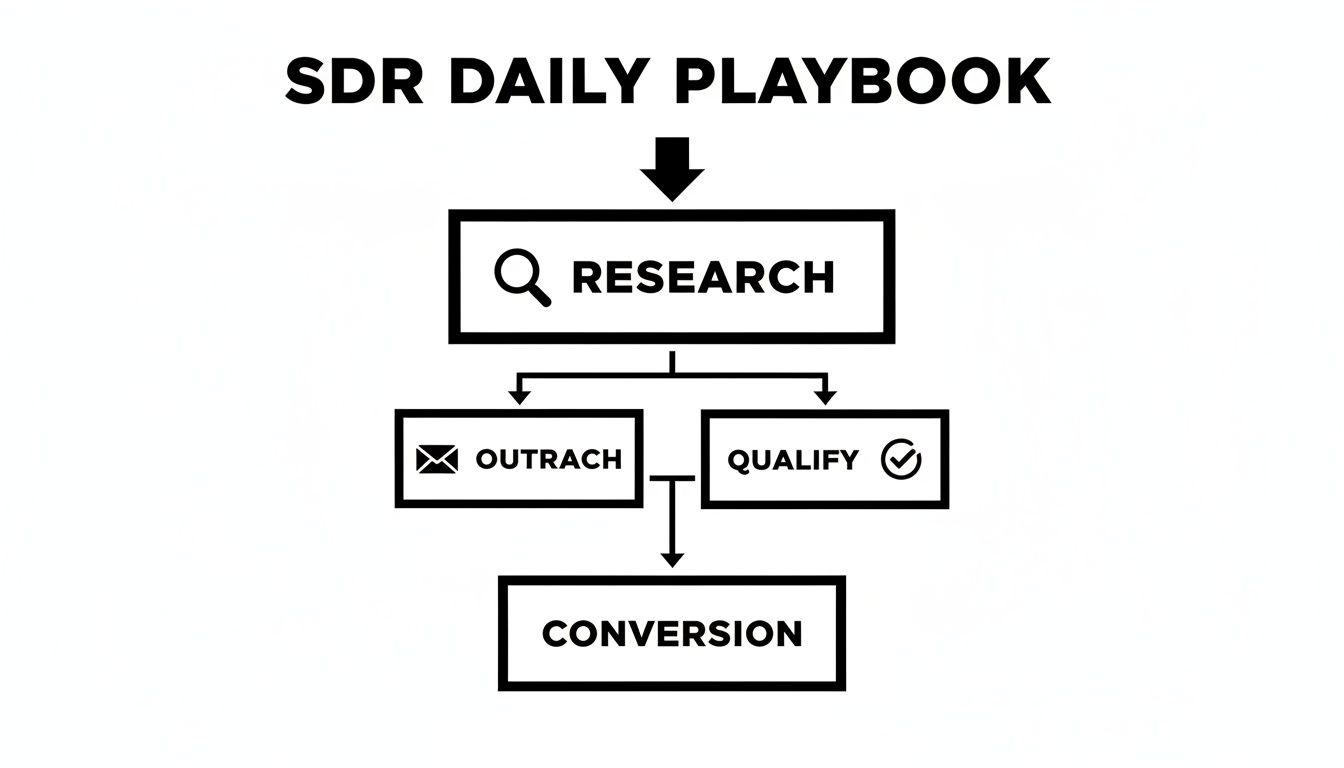
It’s this methodical process of research, outreach, and qualification that turns a name on a list into a genuine sales opportunity.
The Hand-Off to the Account Executive
Whether a lead was warmed up by an SDR or hunted down by a BDR, the ultimate goal is the same: book a qualified meeting for an Account Executive. This is where the roles change completely.
Once that meeting is set, the AE takes the baton. They own the opportunity from that first discovery call all the way through contract negotiations and closing the deal.
The SDR and BDR are specialists in starting conversations. The AE is the specialist in closing deals. Their teamwork is what turns prospecting into actual revenue.
This division of labor is incredibly effective. It allows each person to become a master of their craft. SDRs and BDRs get really good at opening doors, while AEs can focus all their energy on guiding qualified prospects through the buying journey to become happy customers.
To make these distinctions crystal clear, here’s a side-by-side comparison.
Comparison of SDR, BDR, and AE Roles
| Attribute | Sales Development Representative (SDR) | Business Development Representative (BDR) | Account Executive (AE) |
|---|---|---|---|
| Primary Focus | Qualifying inbound leads from marketing. | Generating outbound leads through prospecting. | Closing deals and managing the full sales cycle. |
| Key Activity | Responding to inquiries, nurturing warm leads. | Cold calling, emailing, social selling. | Running demos, negotiating contracts, managing pipeline. |
| Main Goal | Book a qualified meeting or demo for an AE. | Book a qualified meeting or demo for an AE. | Win new business and hit revenue quotas. |
| Lead Source | Marketing-generated (website forms, content downloads). | Self-sourced (prospecting lists, networking). | Handed off from SDRs/BDRs. |
| Analogy | The Fisherman (catching fish that are already biting). | The Hunter (seeking out new opportunities). | The Closer (bringing the deal home). |
This table shows how each role has a distinct but complementary part to play in a high-functioning sales organization.
Charting the Modern SDR Career Path and Compensation
Think of the Sales Development Representative role less as a job and more as a launchpad. It’s one of the best ways to break into a high-growth career in tech sales, acting as a boot camp where you build the core skills that matter everywhere: resilience, sharp communication, and a knack for process.
This experience makes a top-performing SDR a hot commodity. You’re not just learning to sell; you're mastering the art of starting meaningful business conversations and identifying real pain points right from the get-go. That skill set is pure gold and highly transferable.
Where Do SDRs Go Next?
The most well-trodden path for a successful SDR is a promotion to Account Executive (AE). After spending 12 to 18 months in the trenches—prospecting, qualifying, and consistently hitting targets—you’ve developed a sixth sense for the customer and the sales cycle. This makes for a pretty seamless transition into a closing role.
But becoming an AE is far from the only option. The skills you sharpen as an SDR open up a surprising number of doors:
- Senior SDR or Team Lead: If you’ve got a talent for leadership, you can step up to mentor new hires and help steer the team’s strategy.
- Sales Operations: Love the data and the "how" behind the sales process? A move into sales ops lets you fine-tune the tools and workflows that power the entire sales organization.
- Marketing: SDRs are on the front lines, hearing every customer objection and pain point imaginable. This firsthand intelligence makes them fantastic candidates for product marketing or demand generation teams.
- Customer Success: The ability to build genuine rapport and truly understand a customer's needs is the foundation of customer success. It's a natural fit for an SDR focused on nurturing long-term relationships.
Breaking Down SDR Pay and Quotas
Let's talk money. The financial upside is a huge part of the SDR role's appeal, and it's usually built on a base salary plus performance-based commission. The total package is what we call On-Target Earnings (OTE)—the full amount you can expect to make if you hit 100% of your quota.
Your OTE as an SDR isn't just a number; it's a direct reflection of your ability to create qualified pipeline for the business. It’s designed to reward skill, consistency, and the drive to hit your goals.
Compensation packages can swing quite a bit depending on where you are, the size of the company, and your experience level. On average, you can expect a base salary somewhere around $55,000, with a total OTE closer to $85,000.
But it’s important to go in with your eyes open. The latest data shows that only about 55% of SDRs actually hit their quota. This highlights just how challenging the role can be—but also how rewarding it is when you get it right. You can find more details on SDR compensation and quota realities on ActivatedScale.com. Ultimately, this structure is designed to reward high performers and tie your personal success directly to the company's growth.
How AI Is Transforming the SDR Role

The classic SDR playbook—filled with manual research, repetitive data entry, and endless cold calls—is getting a serious upgrade. Artificial Intelligence is no longer just a buzzword; it's becoming a practical, day-to-day tool that’s changing what it means to be an SDR. The goal isn't to replace SDRs with robots, but to make them exponentially better at their jobs.
Think of it this way: AI acts like a strategic co-pilot for the SDR. Instead of getting bogged down in the tedious work of finding leads, building lists, and sending out hundreds of nearly identical emails, the AI handles all that groundwork. This frees up the human SDR to do what they do best—build real relationships, handle nuanced conversations, and provide the creative, personal touch that a machine simply can't.
Automating the Grind So Humans Can Connect
The real magic of AI in sales development is its ability to chew through the time-consuming, repetitive tasks with incredible speed and accuracy. This doesn't just save time; it allows SDRs to shift their energy toward activities that actually drive revenue and build the pipeline.
Here’s a look at how AI is changing the daily workflow:
- Automated Lead Sourcing: AI tools are constantly at work, scanning millions of sources to identify prospects who are a perfect match for your Ideal Customer Profile (ICP). This completely does away with the old, manual process of building lists from scratch.
- Hyper-Personalization at Scale: Forget generic templates. Modern AI can instantly analyze a prospect’s LinkedIn activity, recent company news, and even social media posts to draft a personalized message that feels genuine and relevant.
- Intelligent Follow-Ups: AI-powered systems can manage entire follow-up sequences automatically. They know just when to send the next message based on how a prospect interacts, making sure no warm lead ever goes cold.
This isn’t just a small tweak to the process; it’s a complete overhaul of how sales pipelines get built. The market is taking notice, and the investment in this technology is skyrocketing.
The AI sales development representative market, currently valued at $3.85 billion, is on track to explode to $32.23 billion by 2033. This incredible growth highlights just how critical automated prospecting has become for companies that want a competitive edge. You can dive deeper into these findings from Grand View Research.
The Rise of the Strategic SDR
When AI takes over the administrative heavy lifting, the SDR’s job transforms. They evolve from being a high-volume task-executor into a strategic conversationalist. The key metric is no longer "how many calls did I make?" but rather, "how many meaningful conversations did I start?"
This new approach, powered by platforms like Roger, enables a single SDR to achieve the output of an entire team. The AI handles the prospecting, the initial research, and even the calendar scheduling. All the SDR has to do is show up and engage with qualified prospects who are genuinely interested. The result? Higher meeting conversion rates, a more reliable pipeline, and a sales engine that can scale without limits.
Building a High-Performing SDR Team from the Ground Up
Putting together an elite SDR team is a lot like building a custom engine. You can't just throw parts together; you need the right components, a meticulous assembly process, and a culture of excellence to create a machine that reliably drives revenue. And it all starts with hiring for a few specific, non-negotiable traits.
Sure, sales experience is nice to have, but the things that truly predict success in an SDR role often can't be found on a resume. When you're hiring, look past the CV and focus on the candidate's mindset. The person you want isn't just a smooth talker; they're a natural problem-solver who brings a rare mix of intense personal drive and a genuine willingness to learn.
The Winning SDR Formula
I've found that the best SDRs almost always share three core characteristics. These are the traits that show they can handle the daily grind and unique pressures of sales development.
- Resilience: This job is full of rejection. A great SDR can get shut down on one call and bounce right back with the same positive energy for the very next one.
- Curiosity: They have to be genuinely interested in understanding a prospect's business pains. Instead of launching into a pitch, they ask smart, insightful questions to get to the root of the problem.
- Coachability: The top performers I've seen are always hungry for feedback. They don't just accept it; they actively seek out ways to refine their process, sharpen their messaging, and get better every single day.
Once you find the right people, you have to set them up to win. Tossing new hires into the deep end with a "figure it out" mentality is a recipe for disaster. They need a crystal-clear, documented playbook that takes the guesswork out of their first 90 days and gives them a proven roadmap to follow.
A powerful onboarding program does more than teach product features. It instills the company's sales methodology, clarifies performance expectations, and gives new SDRs the confidence to start contributing to the pipeline quickly.
Your training has to be hands-on, not just theoretical. It should include deep dives into your product, total mastery of your tech stack (like your CRM and sales engagement tools), and plenty of role-playing to practice handling the objections they'll hear every day. This is how you prepare them for real-world conversations.
Finally, build a culture that celebrates wins—big and small—and champions continuous improvement. Give public shout-outs to top performers, set up mentorship programs with seasoned reps, and create a team environment where people aren't afraid to share what's working and what isn't. That’s how you turn a group of individuals into a powerhouse team that consistently crushes its goals and keeps your sales pipeline full.
Got Questions About the SDR Role? We've Got Answers.
Jumping into sales development usually sparks a few questions. Let's get right to it and tackle some of the most common ones you're probably thinking about.
This role really is a unique blend of people skills and tech savvy. You can't just be good at one or the other; success comes from weaving them together to connect with people and get results.
What Skills Does a Top-Tier SDR Actually Need?
To really crush it as an SDR, you need a mix of different strengths. It all starts with the soft skills—the stuff that helps you handle the human side of sales—but you also need the hard skills to get the job done efficiently day in and day out.
The "Must-Have" Soft Skills:
- Thick Skin (aka Resilience): You're going to hear "no" a lot more than you hear "yes." Being able to shake off rejection and keep your energy up is absolutely critical.
- Genuine Curiosity: The best SDRs don't just rattle off a script. They ask smart, thoughtful questions to dig into a prospect's real problems.
- A Hunger for Feedback (aka Coachability): Top performers are always looking for ways to get better. They actively seek out advice and aren't afraid to tweak their approach.
The Essential Hard Skills:
- CRM Wizardry: You need to know your way around your company's CRM, whether it's Salesforce or another platform. It's your home base for tracking everything.
- Sharp Communication: This isn't just about talking. It’s about writing emails that are clear and compelling, and it's about truly listening when you're on a call.
How Long Until a New SDR is Actually Hitting Their Numbers?
Look, becoming a fully productive SDR doesn't happen overnight. You can generally expect a ramp-up period of about three to six months before a new hire is consistently effective and hitting their meeting quota.
Of course, this timeline isn't set in stone. It can change depending on how complex the product is, how good the company’s training is, and whether the person has any prior sales experience. A solid, structured onboarding plan is the key to speeding things up.
The first few months are less about just booking meetings and more about building a process that works. It's about getting comfortable with the tech, truly understanding the product's value, and getting inside the head of your ideal customer.
Can I Start an SDR Program Without a Huge Budget?
Yes, you absolutely can. It used to be that launching an SDR team meant shelling out big bucks for a whole suite of tools for prospecting, emailing, calling, and finding data. That's not the world we live in anymore.
New AI-powered platforms have changed the game by offering an all-in-one solution that’s way more affordable. They automate the most grueling parts of the job—finding leads, researching them, and crafting outreach—which means one person can suddenly have the impact of a much larger team. It makes building a powerful sales engine possible, even on a lean budget.
An AI platform like Roger can run your entire outbound sales motion for you, from identifying the right customers to personalizing outreach and getting meetings on the calendar. It handles the grunt work, freeing up your team to do what they do best: close deals. Learn how Roger can build your pipeline for you.