A Practical Guide to B2B Data Enrichment
December 15, 2025
Think of your current contact list as a basic sketch. You have names and maybe an email address, but the important details are missing. B2B data enrichment is the process of coloring in that sketch, turning it from a simple outline into a rich, detailed portrait. It takes the raw data you already have and layers on crucial information from other sources.
This lets your sales team stop guessing and start connecting with the people who actually matter.
What Is B2B Data Enrichment Anyway?
Let’s use an analogy. Imagine your CRM is a map with just the city names marked on it. You know where your contacts are, generally speaking, but that’s about it. It’s not very useful for actually navigating.
Data enrichment is like upgrading that map to a full-featured, live GPS. Suddenly, you can see the street names (job titles), key landmarks (company size, industry), and even live traffic updates (buying signals). You know the best route to take and the best time to arrive.
It’s not just about adding more fields to a spreadsheet; it’s about adding context. A simple entry like "Jane Doe, jane@company.com" becomes a story. Now you know Jane is the new VP of Marketing at a 500-person SaaS company that just secured a new round of funding and currently uses your main competitor. See the difference? That’s actionable intelligence.
The Constant Battle Against Data Decay
So, why is this continuous process so important? Because B2B data has a surprisingly short shelf life. It’s constantly changing, a phenomenon known as data decay. People get promoted, switch jobs, or change phone numbers. Companies get acquired or pivot their focus.
The statistics are pretty stark: studies show that up to 30% of B2B data becomes inaccurate every single year.
If you ignore this, the consequences pile up quickly:
- Wasted Efforts: Your reps burn through their days calling wrong numbers or trying to reach people who left the company six months ago.
- High Bounce Rates: Your carefully crafted email campaigns hit a wall of invalid addresses, which tanks your sender reputation.
- Inaccurate Forecasting: A sales pipeline built on bad data is just a house of cards, leading to missed quotas and flawed strategy.
Data enrichment is your best weapon in the fight against data decay. It’s a constant refresh button for your database, ensuring your view of the market is accurate, powerful, and ready for action.
By regularly enriching your data, you’re not just filling in the gaps—you’re verifying that the information you depend on is still correct. For a deeper dive into turning raw data into real opportunities, this complete guide to B2B data enrichment is a fantastic resource. Ultimately, it’s the difference between navigating with a crumpled, outdated paper map and driving with a real-time, turn-by-turn guide.
Understanding the Four Pillars of Enrichment Data
Think of B2B data enrichment as building a highly detailed dossier on your ideal customer. You start with a name, but each new piece of information adds another layer, another dimension. Slowly, a flat, one-dimensional contact record transforms into a rich, three-dimensional profile of a real opportunity.
This whole process rests on four key pillars of data. Grasping what each one does is the difference between having a simple contact list and building a genuinely data-driven sales strategy. Each data type answers a critical question, telling you not just who to contact, but why and when.
This is what that transformation looks like—from a basic, raw lead into a fully fleshed-out profile packed with actionable intel.
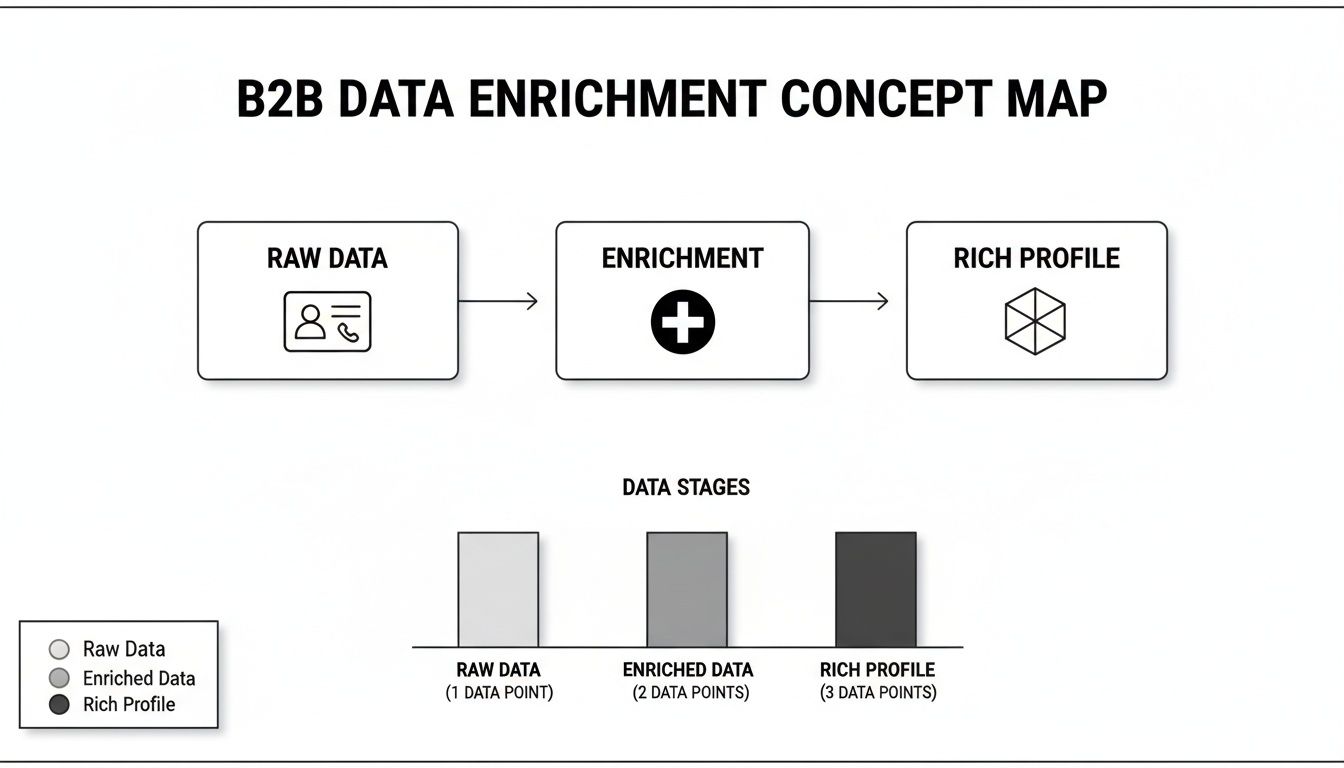
As you can see, it's not just about tacking on more information. It's about creating a clearer, more complete asset that your sales team can actually use to win deals.
Pillar 1: Firmographic Data (Who They Are)
First up, you have firmographic data. This is the bedrock—the fundamental "who" and "where" that tells you about the company itself. These are the classic qualifiers you use to see if a company even fits your ideal customer profile (ICP).
You’re looking for basics like:
- Company Size: How many employees work there?
- Annual Revenue: What’s their financial scale?
- Industry: Which vertical do they operate in (e.g., SaaS, healthcare, logistics)?
- Location: Where is their headquarters or main office?
Without solid firmographics, your sales team is just guessing. You can’t segment your market, you can’t prioritize accounts, and you’ll waste countless hours chasing companies that were never a good fit to begin with.
Pillar 2: Technographic Data (What They Use)
Next comes technographic data, which is your inside look at a company’s tech stack. This is a game-changer. Knowing the software, hardware, and other tools they rely on gives you a massive strategic advantage by revealing their operational DNA.
Let’s say you discover a prospect is using a direct competitor’s CRM. Now you can craft a message that speaks directly to the pain points of that specific platform. Or maybe you find they use a tool that integrates perfectly with your product. That’s your in—an opportunity to position your solution as the missing piece in their workflow.
Pillar 3: Verified Contact Data (Who to Talk To)
This pillar is all about precision. Verified contact data moves you beyond a company name to the actual people you need to reach. We’re talking accurate job titles, direct-dial phone numbers, and—most importantly—validated email addresses that won’t bounce.
This is what separates professional outreach from spam. It’s the difference between landing in a decision-maker’s personal inbox versus a generic "info@" address or, even worse, the inbox of someone who left the company six months ago.
Pillar 4: Behavioral and Intent Data (When to Reach Out)
Finally, we have the timing mechanism: behavioral and intent data. This is the secret to knowing when to make your move. This data captures the digital breadcrumbs a prospect leaves across the web that signal they’re actively in a buying cycle.
These signals could be anything from them downloading a whitepaper on a relevant topic, visiting a competitor's pricing page, or searching for keywords related to the problem you solve.
When you combine a verified decision-maker’s contact info with strong intent signals, your outreach lands with incredible impact. You’re no longer a cold caller; you’re a problem-solver showing up at the exact moment they need one.
To put it all together, here’s a quick summary of how these four data types work in harmony to power a smarter go-to-market strategy.
How Key Data Types Fuel Your Go-To-Market Strategy
| Data Type | Key Information Provided | Strategic Business Impact |
|---|---|---|
| Firmographic | Company size, revenue, industry, location. | Defines your Ideal Customer Profile (ICP), enables market segmentation, and helps you prioritize high-value accounts. |
| Technographic | The software, hardware, and tools a company uses. | Uncovers integration opportunities, identifies competitor weaknesses, and enables highly relevant, tech-focused messaging. |
| Contact | Verified names, job titles, direct emails, and phone numbers. | Ensures your message reaches the actual decision-maker, dramatically improving connect rates and email deliverability. |
| Behavioral/Intent | Online research, content downloads, keyword searches. | Tells you when a prospect is in-market, allowing you to time your outreach for maximum impact and connect with active buyers. |
Ultimately, it’s the synergy between these four data pillars that creates a powerful, intelligent framework. You're not just collecting data; you're building a comprehensive understanding of your market that lets you engage the right companies, with the right people, at the perfect time.
How Enriched Data Fuels Your Sales Engine
Let's move from theory to practice. Think of B2B data enrichment as the high-octane fuel your sales engine needs to perform at its best. Without it, your sales team is basically driving with the parking brake on—they're working hard, but they aren't getting very far. Good data removes that friction, directly connecting insights to actual sales results.
Picture two sales teams. Team A has a raw list of names and companies. That's it. Their outreach is generic, their targeting is a shot in the dark, and their results are all over the place.
Now, look at Team B. They're working with enriched data. They know exactly which accounts match their Ideal Customer Profile (ICP), what technology their prospects are using, and who the real decision-makers are. This intelligence completely changes their sales process, turning guesswork into a precise, revenue-focused strategy.
Build Hyper-Targeted Account Lists
The first and most obvious win is that your team can stop wasting time on leads that are a bad fit. With solid firmographic data, you can slice and dice your entire market by company size, revenue, industry, and location. This lets you build incredibly specific account lists filled only with companies that can genuinely get value from what you're selling.
Instead of the old "spray and pray" method, your reps can pour all their energy into high-potential accounts. This isn't just a morale booster; it makes your entire outbound operation dramatically more efficient.
Unlock Deep Personalization at Scale
Nothing gets an email deleted faster than generic outreach. Enriched data gives you the specific details you need to personalize your messaging in a way that actually grabs someone's attention.
- Technographic Insights: Knowing a prospect uses a competitor’s tool is gold. You can write a message that hits on a known pain point, like, "Saw you're using [Competitor Tool]. I know a lot of teams struggle with its clunky integrations. We built our platform to fix that."
- Company Triggers: Did a target account just land a new round of funding or hire a new VP of Engineering? These are huge buying signals. Enrichment brings this news right to you, so you can send a timely note like, "Congrats on the new funding! As you start to scale, our solution can help..."
This kind of detail shows you’ve done your homework. It turns a cold email into a relevant conversation starter that provides immediate value.
Improve Operational Excellence and Pipeline Hygiene
Beyond just making your messaging better, data enrichment cleans up the messy backend of sales operations. Having verified contact information means fewer bounced emails, which protects your sender reputation and ensures your messages actually get delivered. This is a critical but often overlooked part of maintaining a strong outreach cadence.
Poor data quality is a massive drag on B2B companies, costing them an average of $12.9 million annually. This comes from wasted effort, lost deals, and compliance headaches. The problem is amplified by a scary fact: 25-30% of B2B data goes bad every single year.
The payoff for getting this right is huge. Research shows that 80% of businesses that use contact enrichment see a healthier sales pipeline. They also report a 20% revenue uplift and a 25% jump in productivity, all while shortening their sales cycles by 15%. If you want to dig into the numbers, you can explore more data enrichment findings.
At the end of the day, better data hygiene leads to a more reliable pipeline, more accurate forecasting, and a predictable revenue stream.
Putting AI-Powered Enrichment to Work in Your CRM
In the not-so-distant past, getting enriched data into your CRM was a messy, manual slog. We’re talking endless spreadsheets, CSV uploads, and a whole lot of hoping the columns matched up. Thankfully, things have changed. Today's AI-powered platforms do all that heavy lifting for you, plugging directly into the CRM where your sales team actually works.
This isn’t just a simple connection; it fundamentally changes what your CRM is capable of. It stops being a static database and becomes an active, intelligent partner for your sales team. The whole process hums along quietly in the background, feeding your reps the exact insights they need, right when they need them.
From Basic Lead to Actionable Profile
Let's walk through a real-world scenario. A new lead pops into your system. Maybe they filled out a form or you met them at a conference. All you have is a name and an email address—not much to go on.
This is where an AI-powered engine, like the one we've built at Roger, springs into action. Without a sales rep lifting a finger, the system kicks off an enrichment sequence in real time:
- Lead Identification: The system flags the new entry instantly.
- Data Append: It immediately scans a vast network of verified data sources, pulling in all the missing pieces of the puzzle.
- Verification: Crucially, it double-checks the data you already have, like email addresses and phone numbers, to make sure they're still valid and won't bounce.
- CRM Sync: The fully fleshed-out, verified profile is pushed directly back into your CRM.
In a matter of seconds, that simple name and email have blossomed into a rich, actionable profile. Your team now sees the lead’s job title, the company's size and industry, the tech stack they’re using, and maybe even some recent social media posts that hint at what they're looking for.
The Power of Automated, Real-Time Updates
Here’s the thing, though: data enrichment isn't a one-and-done deal. Data goes stale—fast. People switch jobs, get promotions, and companies change direction. An AI platform keeps a constant watch over your database, looking for these exact changes.
Think about it: when a key contact at a target account moves to a new company, that’s not a dead lead. That's a golden opportunity. The system can flag this change automatically, letting your team congratulate them on the new role and start a conversation at their new organization.
This kind of proactive monitoring means your data is always fresh and ready to go. It completely eliminates the soul-crushing manual research that used to eat up up to 20% of a sales rep's time.
Instead of digging for information, they can focus on what they were hired to do: build relationships and close deals. By weaving this intelligence directly into your CRM, you build a system where every lead is automatically primed for a meaningful conversation.
How to Choose the Right Data Enrichment Partner
Picking a B2B data enrichment partner isn't like buying software off the shelf; it's more like bringing on a new, mission-critical member of your team. The provider you choose has a direct line to the quality of your entire go-to-market strategy, so getting this decision right is a must. We're not just talking about getting more data—we're talking about getting the right data, delivered in a way that actually helps your team win.
The market for these tools has blown up as companies scramble to get a handle on customer data. Right now, it’s valued at around $2.5 billion and is on track to hit $5 billion by next year. That kind of growth tells you just how critical this has become, especially with AI and machine learning making enrichment more powerful than ever. You can dig into more of the numbers and trends in this detailed market report.
Check Under the Hood: Data Accuracy and Sources
Accuracy is the absolute bedrock of a good data partner. Don't be shy about asking potential vendors tough questions. Where does their data come from? How, exactly, do they verify it? A provider worth their salt will be completely transparent about their mix of public sources, private data partnerships, and their own validation techniques.
Look for a service-level agreement (SLA) or some kind of guarantee around data accuracy. A confident partner will stand behind their data with hard numbers, like a guaranteed email deliverability rate. Think of this as your first line of defense against paying for bad info that will only tarnish your sender reputation.
Does It Play Well with Others? Integration and Workflow
The most accurate data on the planet is worthless if it's stuck in another system. Your enrichment tool has to plug right into your existing tech stack, especially your CRM (like Salesforce or HubSpot) and any sales automation platforms you rely on.
A great partner doesn't just sell you data; they provide a solution that enhances your team's existing workflow. The goal is to make your sales reps' lives easier, not add another complex tool they have to manage.
Here’s what to look for when it comes to integration:
- Real-Time Enrichment: Can the tool automatically enrich new leads the moment they hit your CRM?
- Batch Updates: Is there a simple way to clean up and refresh your entire existing database on a regular basis?
- Workflow Triggers: Can you set up automations in your CRM based on enriched data? For instance, you could trigger a task for a rep when a target account announces a new funding round.
Don't Skip the Fine Print: Data Compliance
Finally, and this one's a biggie, you have to nail down data compliance. In a world governed by strict rules like GDPR and CCPA, getting into bed with a non-compliant vendor is just asking for legal and financial trouble.
Make sure any provider you're considering has a solid compliance framework. They should be able to walk you through how they source their data ethically and ensure it follows global privacy laws. Ask them directly how they handle data subject requests and manage do-not-contact lists. Choosing a partner who takes compliance seriously protects your company and, just as importantly, builds trust with the people you're trying to reach.
Measuring Success and Avoiding Common Pitfalls
Bringing a B2B data enrichment strategy into your sales process is a huge step forward, but it’s definitely not a "set it and forget it" kind of deal. To see a real, lasting return on that investment, you need a solid way to measure what’s working and an eye for the common traps that can trip you up.
Success isn't just about having more data. It's about seeing real, tangible improvements in your sales numbers. Think of it like this: you just put high-octane fuel in your sales engine. Now you have to check the dashboard. Are you getting better mileage? Is the engine running smoother? Tracking the right metrics is the only way to know for sure.
Key Performance Indicators for Data Enrichment
To really prove the value of your enrichment efforts, zero in on a few core KPIs that tie data quality directly to revenue. These are the numbers that tell the true story.
- Improved Lead Conversion Rates: Start tracking the percentage of enriched leads that actually turn into qualified opportunities. A clear lift here is a dead giveaway that you're finally talking to the right people with the right message.
- Shorter Sales Cycles: When your reps can skip the tedious manual research and get straight to building relationships, deals close faster. Keep an eye on how long it takes an enriched lead to go from that first touchpoint to a signed contract.
- Lower Customer Acquisition Cost (CAC): Your team's efficiency should go through the roof when they stop chasing bad-fit leads and dead-end contacts. This improvement should show up as a lower cost to bring in each new customer.
Common Mistakes and How to Avoid Them
Even with the best intentions, it's easy to make a few missteps that can dilute the impact of your B2B data enrichment. Here are three major pitfalls to watch out for:
- Treating Enrichment as a One-Time Project: Data decay is a constant, relentless force. That database you clean up today will be stale within a year. Best Practice: Set up a continuous enrichment process. Your data should be refreshed automatically, ideally in real-time as new leads hit your CRM.
- Relying on a Single Data Source: No single provider has a monopoly on perfect, all-encompassing data. Putting all your eggs in one basket creates blind spots and just increases your risk of inaccuracies. Best Practice: Blend data from multiple, trusted sources. This gives you a much more complete and reliable picture of your prospects and accounts.
- Overlooking Data Hygiene and Governance: Pouring fresh, enriched data into a messy database is like pouring clean water into a muddy bucket. You're just going to get murky results. Best Practice: Establish clear data governance rules from day one. To make sure your enrichment efforts pay off, you have to get the fundamentals right. Learning how to improve data quality is the first step to building that solid foundation.
Frequently Asked Questions About Data Enrichment
It's natural to have a few questions when you're diving into B2B data enrichment. Let's tackle some of the most common ones so you can move forward with confidence.
How Often Should We Enrich Our B2B Data?
Think of data enrichment as an ongoing maintenance plan, not a one-time fix. B2B data goes stale surprisingly fast—about 30% of it becomes outdated every year as people change jobs, companies get acquired, and phone numbers switch.
For brand-new leads coming into your CRM, real-time enrichment is the way to go. This gives your sales team a complete, accurate profile to work with from the very first interaction. For the rest of your database, running a refresh every quarter is a great rule of thumb. This cadence keeps you ahead of data decay, ensuring your outreach is always hitting the right people with the right information.
What Is the Difference Between Data Cleansing and Data Enrichment?
It’s easy to mix these two up, but they serve very different purposes. A good analogy is renovating a house.
Data cleansing is the repair work. It's about fixing what you already have—patching holes (like correcting typos), getting rid of clutter (deleting duplicate contacts), and applying a fresh coat of paint (standardizing formatting). Cleansing shores up the foundation of your database.
B2B data enrichment, on the other hand, is like adding a brand-new wing to the house. You're bringing in valuable new information you never had before, like a company's revenue, its tech stack, or a key contact's direct phone number. Cleansing fixes what's broken; enrichment adds what's missing.
Cleansing gets your database in order. Enrichment makes it a powerful engine for growth, giving your teams the strategic insights they need to find and close more deals.
How Does Data Enrichment Support Account-Based Marketing?
Data enrichment is the fuel for any modern Account-Based Marketing (ABM) campaign. The whole point of ABM is to laser-focus on a curated list of high-value target accounts, and enrichment gives you the intelligence to do that effectively.
Here’s exactly how it helps:
- Defining Your Ideal Customer Profile (ICP): You can use detailed firmographic and technographic data to build a crystal-clear picture of your ideal customer, making it much easier to identify the right accounts to go after.
- Reaching the Whole Buying Committee: Enriched data helps you identify and connect with multiple decision-makers and influencers within a target account, not just one person. This multi-threaded approach is critical for complex B2B sales.
- Personalizing at the Right Moment: Enrichment uncovers buying signals, like a recent funding round or a new technology purchase. This allows you to craft timely, relevant outreach that actually gets a response.
Ready to stop guessing and start selling with data-driven precision? Roger handles the entire outbound process for you, from finding and enriching leads to personalizing outreach at scale. Book more meetings today.