12 Best AI Sales Tools to Automate Your Pipeline in 2025
December 6, 2025
Sales has always been a numbers game, but the rules are changing. It's no longer just about the volume of calls or emails, but the intelligence behind every single touchpoint. Traditional sales tools helped teams organize their efforts; modern AI sales tools are here to execute. This fundamental shift from manual assistance to autonomous action is what separates legacy platforms from the tools that will define the next decade of revenue growth. To delve deeper into this evolution, you can explore the detailed breakdown in our guide on Why Every Sales Team Needs an AI Sales Assistant in 2025.
This guide moves beyond generic feature lists to provide a deep, tactical dive into the 12 best AI sales tools available today. We'll analyze platforms that don't just assist your team but act as genuine autonomous agents, handling everything from hyper-personalized prospecting and multi-channel sequencing to lead qualification and meeting scheduling. Our analysis covers end-to-end platforms like Roger, specialized marketplaces like the Salesforce AppExchange, and integrated CRM solutions from HubSpot and Google.
Each review is designed to give you a clear, actionable understanding of the tool's real-world application. We include screenshots, direct links, and a practical breakdown of pros, cons, and ideal use cases. This resource will help you identify which tool can genuinely automate your pipeline, save hundreds of operational hours, and empower your team to focus exclusively on what they do best: closing deals.
1. Roger
Best For: End-to-end outbound sales automation.
Roger stands out as a powerful, all-in-one AI sales platform designed to manage the entire outbound process from lead discovery to sequenced outreach. It automates the most time-consuming aspects of prospecting, allowing sales teams to shift their focus from manual tasks to engaging qualified leads and closing deals. The platform operates as a virtual Sales Development Representative (SDR), continuously identifying decision-makers who match your Ideal Customer Profile (ICP), verifying their contact information, and executing multi-channel outreach campaigns.
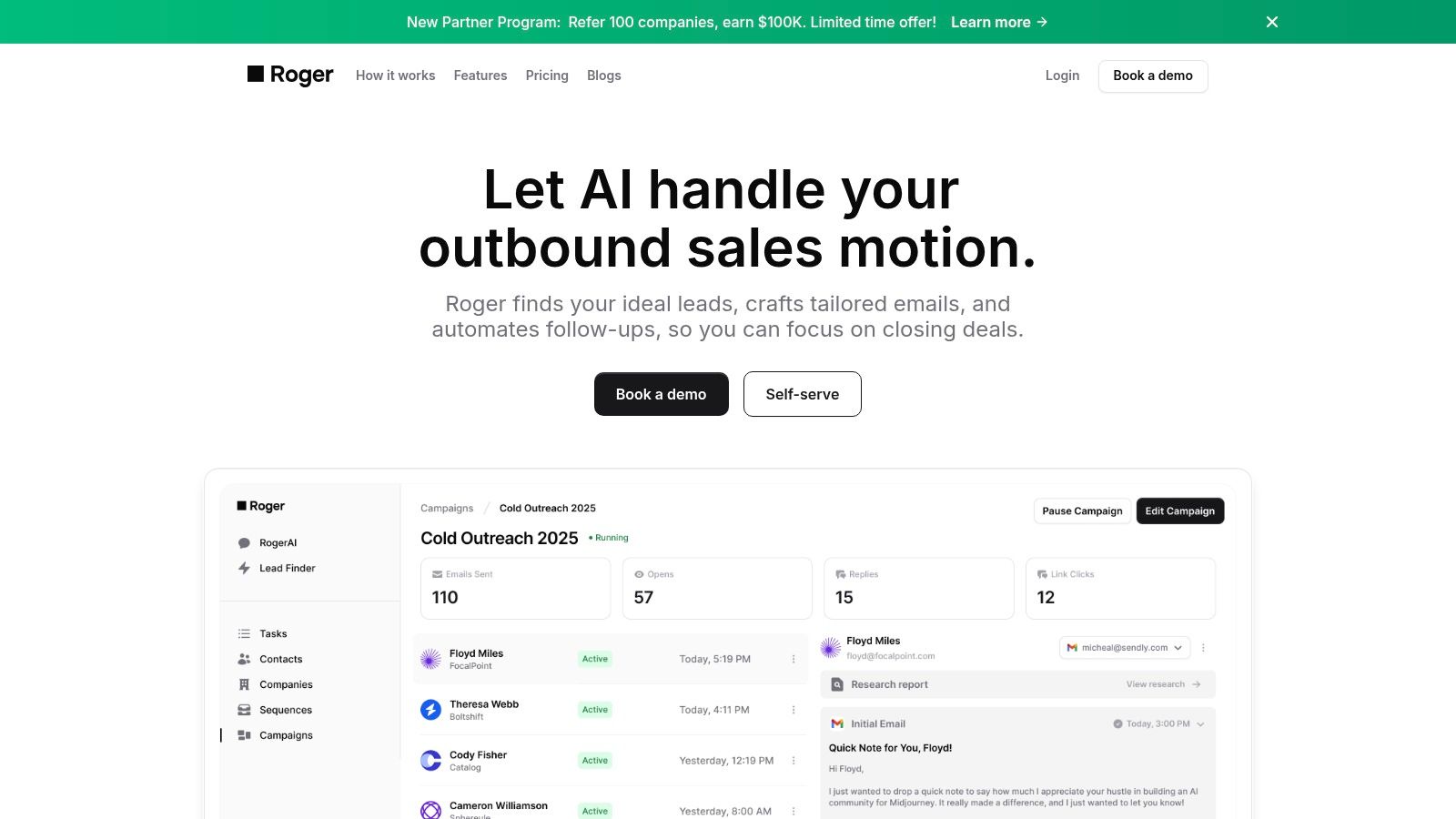
What truly distinguishes Roger is its ability to personalize outreach at scale. After a brief onboarding where you define your target audience and provide samples of past successful emails, Roger's AI learns your unique tone and style. It then enriches each prospect's profile with data from LinkedIn, Twitter, and company websites, generating hyper-relevant, research-driven messages that feel authentic and human-written. This combination of autonomous prospecting and deep personalization makes it one of the best AI sales tools for B2B teams aiming for high-velocity, high-quality pipeline generation.
Key Features & Use Cases
- Autonomous Prospecting & Enrichment: Roger continuously scours sources like LinkedIn and company sites to find new leads matching your ICP. It then verifies their email addresses and compiles a detailed research report on each prospect, pulling insights from their social media activity and professional background. This is ideal for teams looking to build a consistent pipeline without hiring dedicated SDRs.
- AI-Powered Copywriting: The platform analyzes your past communications to learn your voice and brand messaging. It uses this model to write personalized first-touch emails and intelligent follow-ups that reference prospect-specific details, significantly boosting reply rates.
- Multi-Channel Sequencing: Execute automated, persistent outreach campaigns across both email and LinkedIn. Roger manages the scheduling and follow-up logic, ensuring no lead falls through the cracks and saving reps hours each day.
- Scalable Architecture: Roger is built to grow with your team. With plans ranging from a Basic tier for startups to a comprehensive Enterprise solution, it offers features like unlimited sequences, advanced analytics, dedicated support, and custom integrations to meet complex needs.
Pricing & Implementation
Roger offers tiered pricing to accommodate different team sizes and outreach volumes:
- Basic: $800/month for approximately 800 new leads.
- Standard: $2,000/month, designed for larger teams with higher volume needs.
- Premium: $3,000/month, including higher outreach caps and real-time Slack support.
- Enterprise: Custom pricing for unlimited sequences, enhanced security, and dedicated support.
Getting started involves a straightforward onboarding process, either through a self-serve option or a guided demo. The platform's effectiveness hinges on providing a well-defined ICP and high-quality email examples for the AI to learn from.
Pros:
- True end-to-end automation from lead discovery to multi-channel outreach.
- Data-driven personalization creates highly relevant messaging at scale.
- Scalable plans with enterprise-grade features and support options.
- Built-in email verification helps maintain high deliverability rates.
Cons:
- Starting price of $800/month may be steep for very early-stage startups.
- Performance is highly dependent on the quality of the initial ICP definition and training data.
- Limited public-facing case studies or third-party performance metrics.
Website: https://hireroger.com
2. G2 – AI Sales Assistant category
Rather than a single tool, G2's AI Sales Assistant category is a vital starting point for your research. It functions as a comprehensive, crowd-sourced marketplace for discovering and vetting the top AI sales tools available. This platform aggregates hundreds of software solutions, providing live rankings and verified user reviews to help you cut through the marketing noise and understand real-world performance.
The platform excels at helping sales leaders shortlist vendors efficiently. You can apply filters based on specific features like lead scoring or automated outreach, company size (from SMB to enterprise), and pricing models. This granular control ensures you only evaluate tools relevant to your specific operational needs. G2's side-by-side comparison feature is particularly useful for quickly stacking up your top three or four contenders on key criteria.
Practical Use and Considerations
G2 is most effective when used as a validation and discovery hub. Before committing to a demo, check a tool's G2 profile to gauge user sentiment on its ease of use, quality of support, and overall ROI.
Key Features:
- Live Grid Rankings: See how tools stack up based on user satisfaction and market presence.
- Verified User Reviews: Gain authentic insights from peers who have hands-on experience.
- Advanced Filtering: Narrow your search by essential criteria like integrations, features, and target business size.
- Side-by-Side Comparisons: Directly compare features and user ratings for a handful of shortlisted products.
While invaluable, be aware that sponsored placements can affect which tools appear most prominently. It's wise to sort by "Highest Rated" or apply specific filters to get an unbiased view. Pricing information is often not listed directly, requiring a click-through to vendor sites.
3. Capterra – AI Sales Assistant software directory
Similar to G2, Capterra’s AI Sales Assistant directory serves as a high-level research hub for discovering new software. It aggregates a wide range of tools, from lead engagement agents to conversation intelligence platforms, into a single searchable database. This makes it a great resource for identifying and comparing the best AI sales tools on the market.
Capterra's main advantage is its focus on scannable, practical information. Many profiles feature pricing snippets and direct comparisons with suggested alternatives, allowing for quick feature and cost assessments without leaving the site. This is particularly useful for sales leaders who need to rapidly build a longlist of potential vendors before diving into deeper research or demos.
Practical Use and Considerations
Use Capterra for initial market scanning, especially when you need a quick overview of pricing models and core features. It’s an effective way to find alternatives to a tool you’re already considering or to discover niche solutions that might not appear on other platforms.
Key Features:
- Product Profiles: Detailed pages with features, vendor details, and user reviews.
- Compare Function: Place selected tools side-by-side to evaluate their offerings.
- Pricing Callouts: Many listings include starting prices or tier information, speeding up budget alignment.
- Suggested Alternatives: Each profile recommends similar tools for broader comparison.
While the pricing information is a major plus, it's not always comprehensive, and many links will direct you to vendor websites for full details. Additionally, some product listings have sparse reviews, so it's wise to cross-reference your findings with other sources like G2 for a more complete picture of user sentiment.
Website: https://www.capterra.com/ai-sales-assistant-software/
4. Product Hunt – Sales topic
For sales leaders hunting for the next big thing, Product Hunt’s Sales topic is the go-to discovery platform. It’s a real-time feed of newly launched and trending sales applications, many of which are AI-native and built to solve modern outreach, prospecting, and automation challenges. Unlike established review sites, Product Hunt gives you a first look at emerging technologies before they become mainstream.
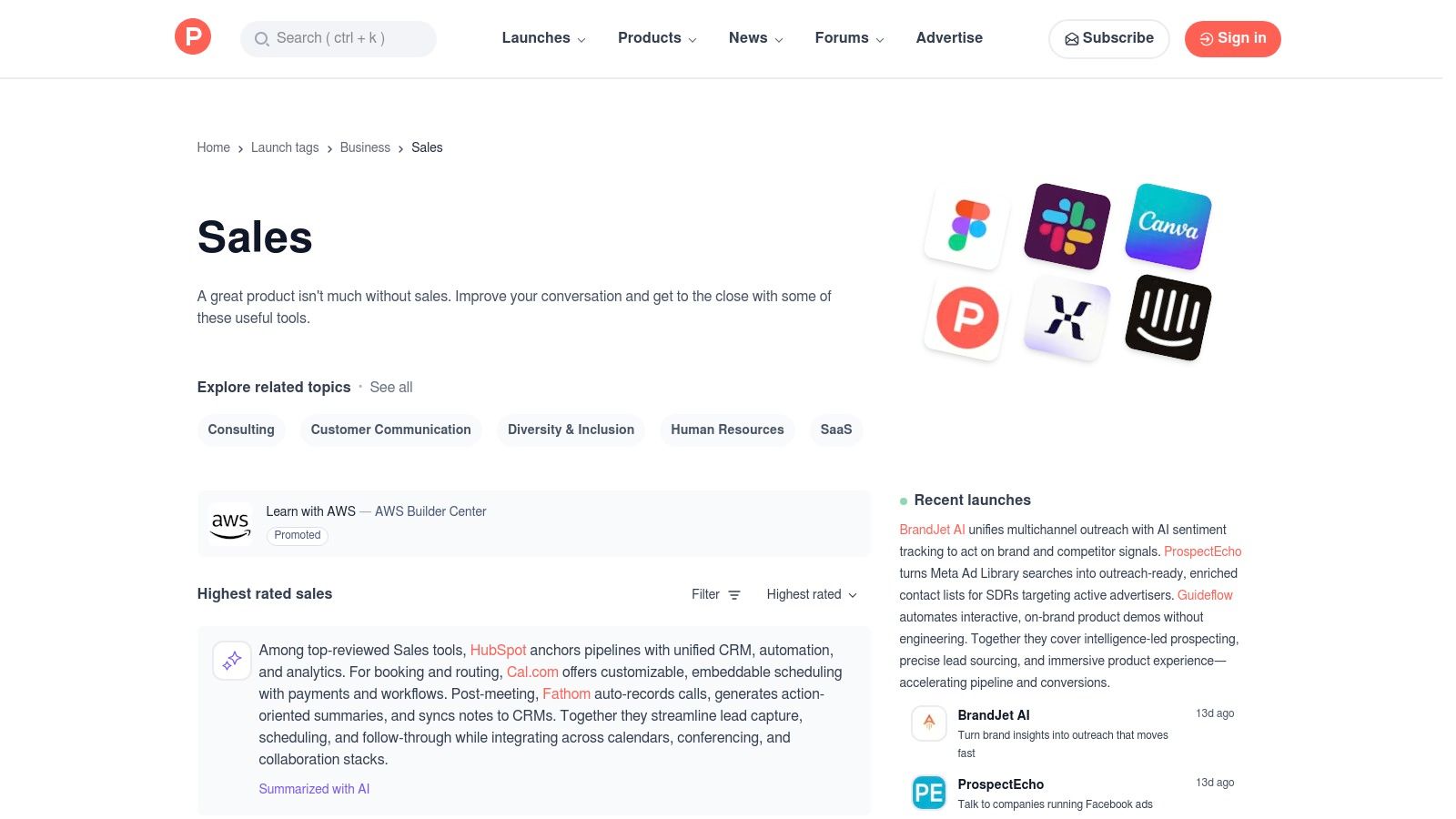
This platform provides an unfiltered look at innovation in the AI sales tools space. Each product has a dedicated launch page featuring demos, maker Q&As, and an active comment section. This community-driven feedback is invaluable for understanding potential use cases and uncovering early-stage issues that aren't mentioned in marketing copy. You can often find exclusive lifetime deals (LTDs) here, offering a low-risk way to adopt new tech.
Practical Use and Considerations
Use Product Hunt to spot innovative tools that could give you a competitive edge. It's excellent for finding niche solutions, such as AI agents for specific industries or unique prospecting Chrome extensions, that haven’t hit larger marketplaces yet. Before committing, read the comment threads to see real user questions and developer responses.
Key Features:
- Launch Pages: Get a direct look at new tools with demos, descriptions, and Q&As with the creators.
- Community Feedback: Read comments and reviews from early adopters to gauge viability and spot potential bugs.
- Daily Rankings: See which new sales tools are gaining the most traction with the tech community.
- Exclusive Deals: Access special discounts or lifetime deals offered to the Product Hunt community during a launch.
Keep in mind that many products are in their infancy, so quality and support can be variable. Enterprise-grade security and governance features may also be limited. It’s best used for finding supplementary tools for agile teams rather than core, mission-critical platforms.
5. Salesforce AgentExchange (Agentforce marketplace)
For teams already embedded in the Salesforce ecosystem, AgentExchange is a curated marketplace designed to extend Sales Cloud capabilities with specialized AI agents. Instead of a standalone tool, it acts as a secure, integrated app store for pre-built AI assistants that handle tasks like lead follow-up, account research, and sales forecasting directly within your CRM environment. This native integration is its key differentiator, ensuring that AI-driven actions leverage your existing data model and security controls.
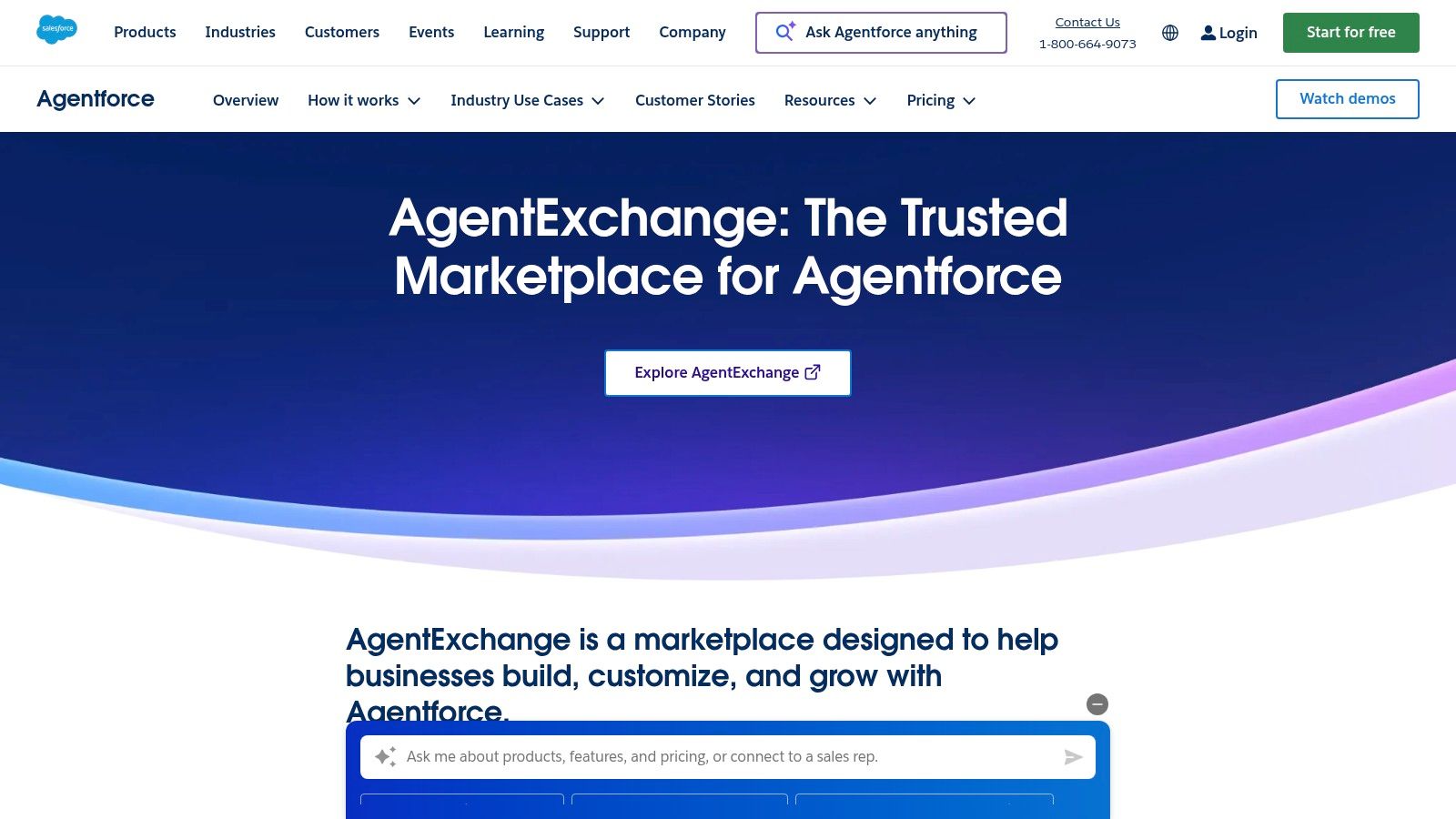
The marketplace offers a centralized hub for discovering and deploying Salesforce-ready agents, eliminating the complex integration work often associated with third-party AI sales tools. You can find industry-specific agents or even tie into low-code Agent Builder tools for custom solutions. Every agent listed has been vetted and security-reviewed by Salesforce, providing a layer of trust and reliability, particularly for enterprise teams concerned with data governance via the Einstein Trust Layer.
Practical Use and Considerations
AgentExchange is best utilized as a force multiplier for existing Salesforce users, particularly those with Enterprise editions or higher. Use it to find and deploy task-specific agents that automate repetitive work without ever leaving your CRM. This makes it one of the best AI sales tools for maintaining data hygiene and process consistency.
Key Features:
- Vetted Agent Listings: Discover security-reviewed AI agents built specifically for Salesforce integration.
- Native Data Governance: Agents operate within the Salesforce environment, inheriting its robust security and data controls.
- Industry-Specific Solutions: Find pre-built agents designed for verticals like finance, healthcare, and retail.
- Low-Code Builder Tie-ins: Access tools to create custom agents that meet unique business process needs.
While the native integration is a significant advantage, its value is maximized for current Salesforce customers. Pricing for agents is set by individual vendors and often requires a formal quote, adding an extra step to the procurement process. A free Foundations tier is available for eligible editions to test Agentforce conversations.
Website: https://www.salesforce.com/agentforce/agentexchange/
6. AWS Marketplace – AI agents and sales solutions
For organizations already embedded in the Amazon Web Services ecosystem, the AWS Marketplace is a powerful procurement hub rather than a single tool. It allows companies to discover, subscribe to, and deploy third-party AI agents and sales solutions while leveraging their existing AWS billing and procurement agreements. This approach significantly streamlines the often lengthy legal and security review process, making it one of the best AI sales tools for enterprises looking for IT-approved solutions.
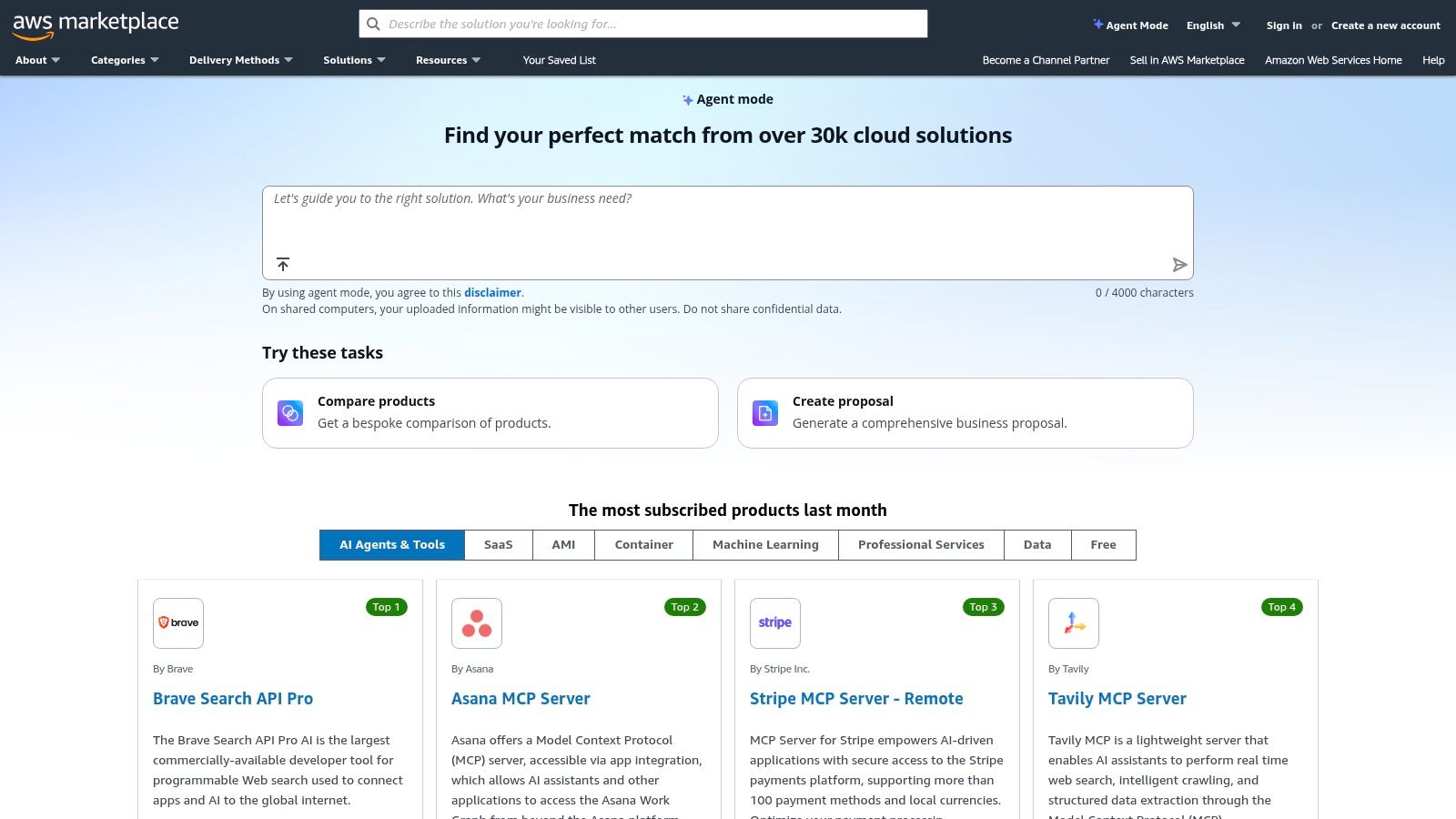
The marketplace stands out by centralizing procurement. Instead of managing dozens of individual vendor contracts, teams can consolidate their software spend onto a single AWS bill. It's particularly useful for sales operations and IT leaders who need to maintain strict vendor governance and security standards while still accessing a broad ecosystem of pre-built sales agents and advanced analytics platforms from vetted partners.
Practical Use and Considerations
Use the AWS Marketplace as a pre-approved channel for acquiring new sales technology. The ability to engage sellers for private offers allows for customized pricing and terms that fit enterprise-level needs, a crucial feature not always available directly from vendors.
Key Features:
- Consolidated AWS Billing: Simplifies accounting by adding software costs to your existing AWS invoice.
- Searchable AI Listings: Discover a wide range of AI-powered sales tools, from analytics to autonomous agents.
- Private Offers & Controls: Negotiate custom terms and pricing directly with sellers for large-scale deployments.
- Streamlined Procurement: Drastically reduces the time spent on legal, security, and compliance reviews.
While the platform accelerates purchasing, the depth and quality of product reviews can vary significantly between listings. Many solutions, especially enterprise-grade ones, require you to contact the seller directly for pricing details, as transparent, public pricing is not always the norm.
Website: https://aws.amazon.com/marketplace/
7. Microsoft Marketplace (Azure + AppSource)
For organizations deeply embedded in the Microsoft ecosystem, the unified Microsoft Marketplace is a critical discovery hub. It consolidates thousands of AI applications and agents from both Azure Marketplace and AppSource into a single catalog, making it the definitive starting point for teams leveraging Dynamics 365, Microsoft 365, and Azure cloud services. This marketplace isn't just a list; it’s an integrated procurement platform designed for enterprise control and seamless deployment.
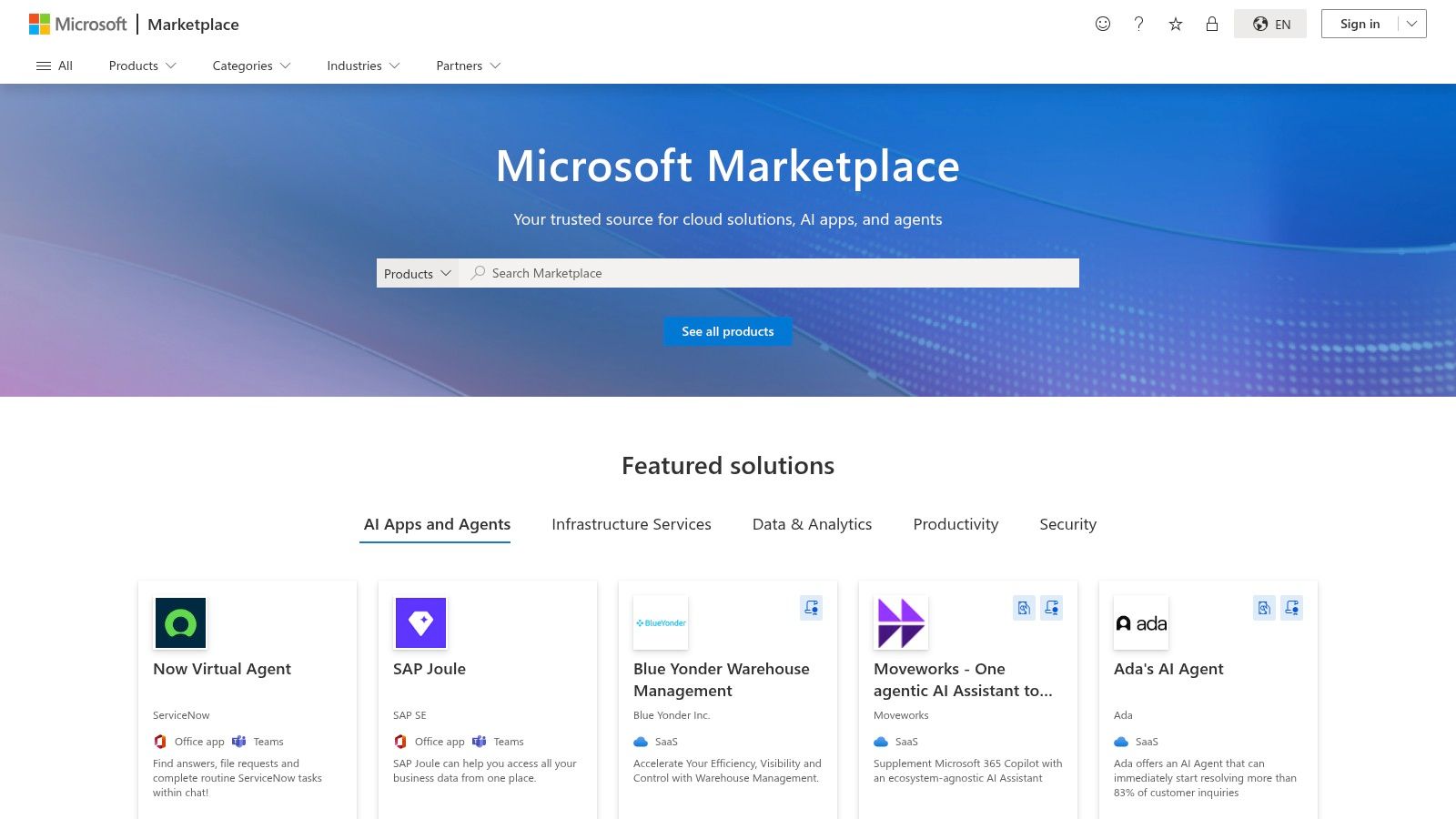
The primary advantage is finding AI sales tools built specifically for Microsoft environments, offering deep integrations with platforms like Dynamics 365 Sales or Microsoft Copilot. This streamlines provisioning, governance, and user management significantly. You can find, test, and buy solutions using your existing Microsoft enterprise agreement, simplifying billing and vendor management. This makes it one of the best sources for enterprise-grade AI sales tools that are pre-vetted for compatibility and security.
Practical Use and Considerations
Use the Marketplace to find certified applications that extend the functionality of your current Microsoft stack. Filter for tools with "transactable" offers to purchase directly through Azure, which simplifies procurement and centralizes costs. This is particularly useful for IT and sales operations leaders who need to maintain strict governance and control over the software an organization adopts.
Key Features:
- Deep Microsoft Integrations: Discover apps certified to work seamlessly with Dynamics 365, Power BI, and Microsoft 365.
- Unified Catalog: A single destination to search for both business-focused (AppSource) and technical (Azure) solutions.
- Enterprise Provisioning: Leverage existing enterprise agreements for centralized billing, procurement, and governance.
- Certified Solutions: Find applications that have been vetted by Microsoft for security, performance, and reliability.
While the platform offers incredible convenience for Microsoft-centric companies, pricing is not always transparent, with many listings requiring you to contact the vendor directly. Additionally, the availability of certain AI tools can vary by geographical region, so it’s important to verify access for your specific location.
Website: https://appsource.microsoft.com/
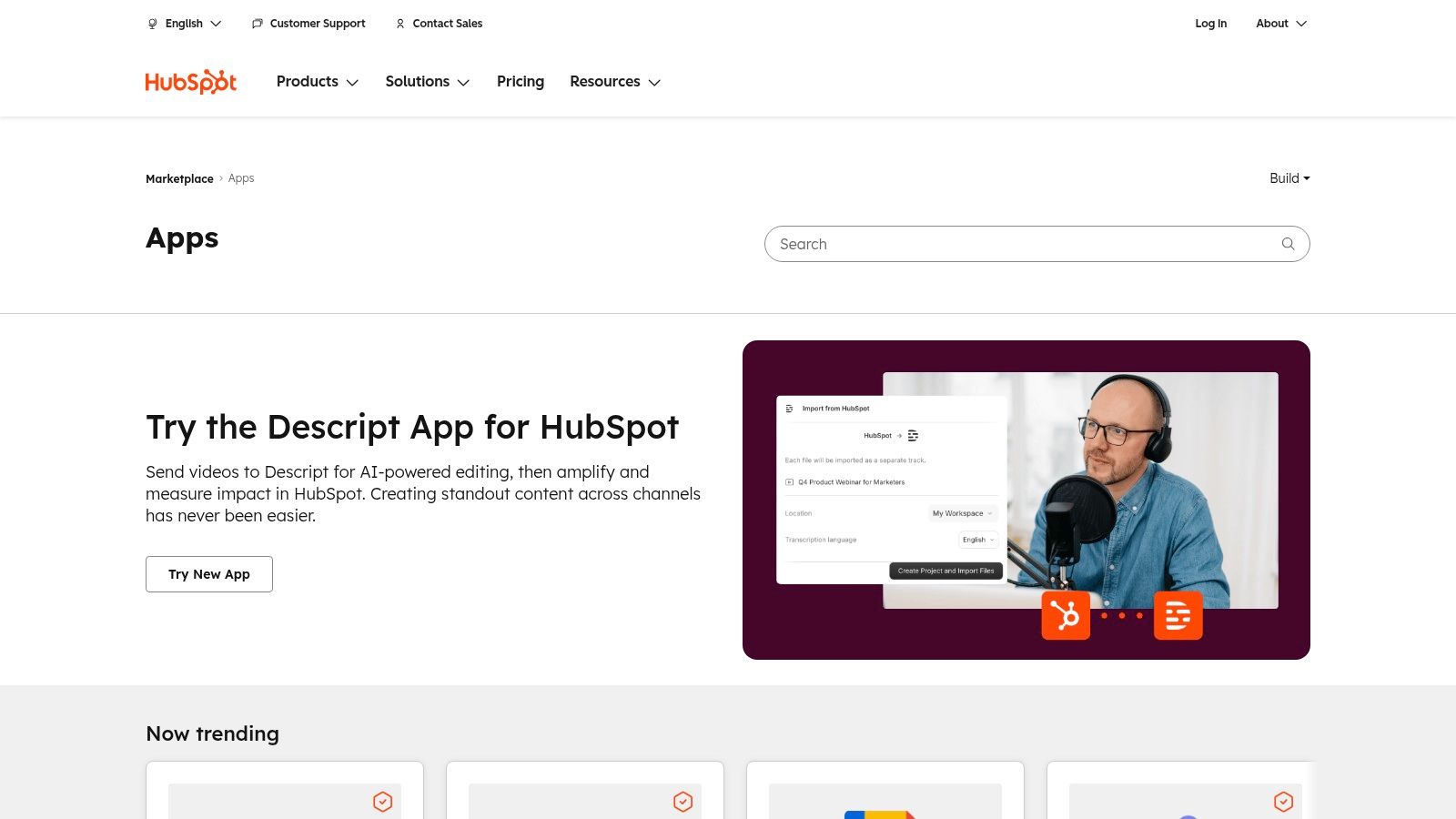
8. HubSpot App Marketplace – AI + Sales apps
For sales teams already embedded in the HubSpot ecosystem, the App Marketplace is the most direct route to finding vetted AI sales tools. Rather than a standalone platform, it's a curated library of integrations designed to enhance HubSpot Sales Hub with specialized AI capabilities. This is where you can discover and seamlessly install tools like AI-powered email assistants, intelligent voice agents, and automated SDR bots directly into your existing CRM workflows.
The primary advantage is the deep, native integration. These apps are built to work with your HubSpot data, triggering actions based on contact properties or deal stages, and logging all AI-driven activities back to the contact record. This ensures data continuity and avoids the hassle of managing disparate systems, making it a powerful resource for teams looking to augment their current processes without a major operational overhaul.
Practical Use and Considerations
Use the marketplace to fill specific gaps in your sales process. If your team struggles with lead follow-up, search for an AI bot to handle initial engagement. The listings clearly show user reviews, required HubSpot plan levels, and pricing information, which helps in making an informed decision before installing.
Key Features:
- Direct Installation: Apps can be added to your HubSpot portal with a few clicks, often with pre-built workflow actions.
- Vetted Integrations: Discover tools guaranteed to work with HubSpot data, ensuring CRM data integrity.
- User Reviews & Ratings: See feedback from other HubSpot users to gauge an app’s effectiveness and ease of use.
- Free Trials & Tiers: Many applications offer free trials or freemium plans, allowing you to test functionality with zero commitment.
While the integration is seamless, remember that most apps require a separate subscription with the third-party vendor. Also, some of the newer, more innovative AI tools may have limited reviews, so it’s wise to take advantage of trial periods before committing to a paid plan.
9. Google Workspace – AI for Sales (Gemini)
For teams already embedded in the Google ecosystem, Gemini for Workspace offers a natively integrated approach to AI in sales. Instead of a standalone platform, Google infuses its powerful AI, Gemini, directly into the tools your sales team uses daily like Gmail, Docs, and Sheets. This transforms familiar applications into dynamic, AI-powered sales assistants, streamlining workflows from within the user's primary workspace.
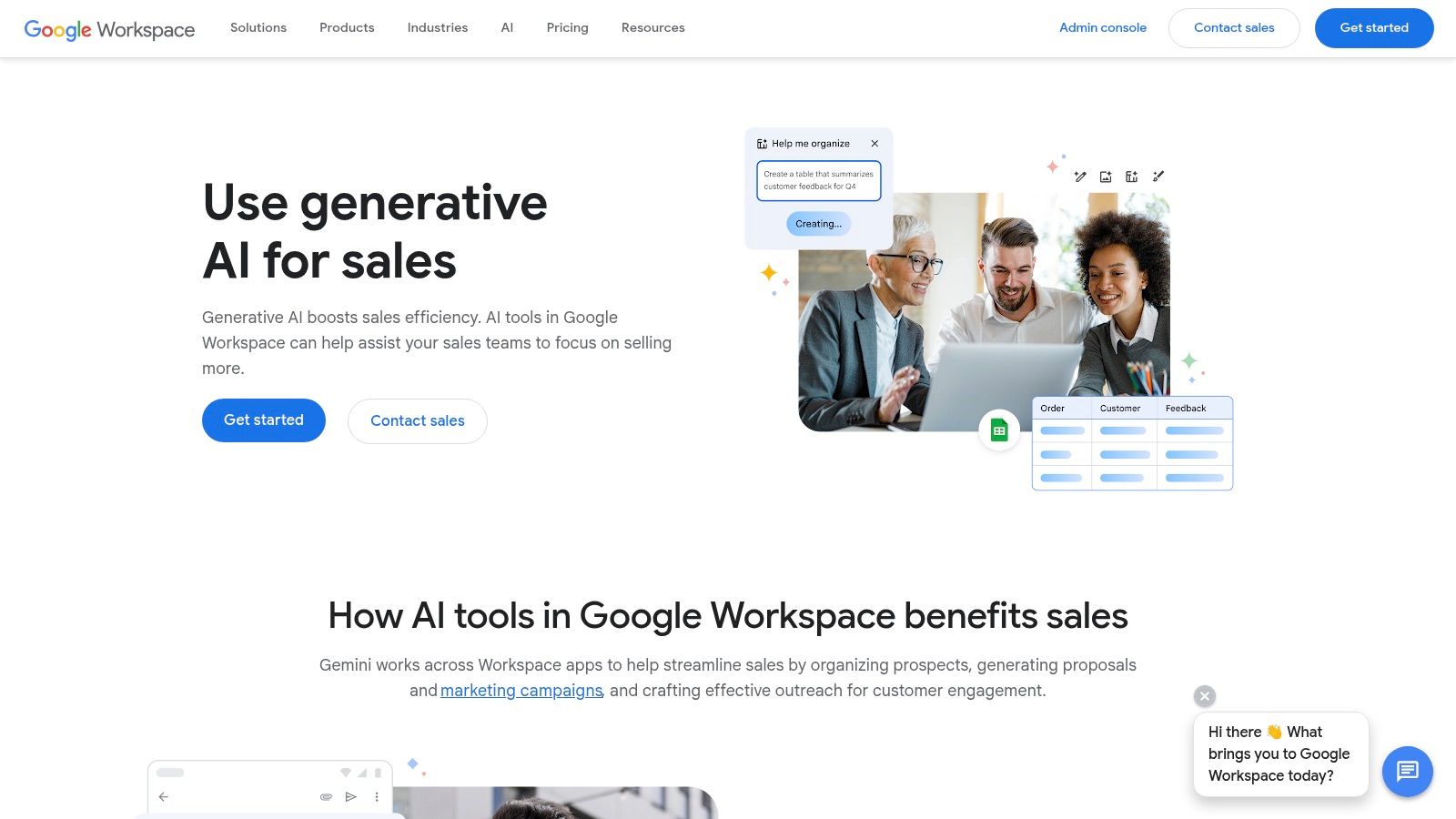
The core advantage is its seamless integration, which eliminates the friction of context-switching between different apps. Sales reps can use the Gemini side panel in Gmail to draft personalized outreach emails, summarize long threads, or use Google Docs to generate sales proposals and call scripts from simple prompts. Google also provides a library of pre-built templates and operational guides specifically for sales teams, helping them operationalize AI without a steep learning curve.
Practical Use and Considerations
Google Workspace with Gemini is best for sales teams seeking to enhance productivity without adopting entirely new software. It excels at content generation, meeting summaries, and internal collaboration tasks. For instance, you can ask Gemini to create a presentation in Slides based on a project brief in Docs or analyze sales data in Sheets to identify trends.
Key Features:
- Gemini Side-Panel Assistance: AI help is available directly within Gmail, Docs, Sheets, and Slides.
- Pre-built Sales Workflows: Access templates and guides to quickly apply AI to common sales tasks.
- Admin-Safe Agent Building: Allows for the creation of custom AI agents with enterprise-grade security controls.
- Integrated with Core Tools: Leverages the entire Workspace suite for a unified workflow.
While the integration is a major benefit, its dependency on the Google ecosystem may not suit all businesses. Advanced agentic features are also being rolled out progressively, so some capabilities may not be immediately available to all users. Proper admin configuration is crucial to ensure data security and governance.
10. Gong – Revenue Intelligence
Gong is a powerhouse in the revenue intelligence space, moving far beyond simple call recording. The platform uses AI to analyze customer-facing conversations from calls, emails, and video conferences, then automatically surfaces critical deal insights, competitive mentions, and coaching opportunities. It connects directly with your CRM and communication stack to create a unified view of every interaction, helping teams understand what truly drives wins and losses.
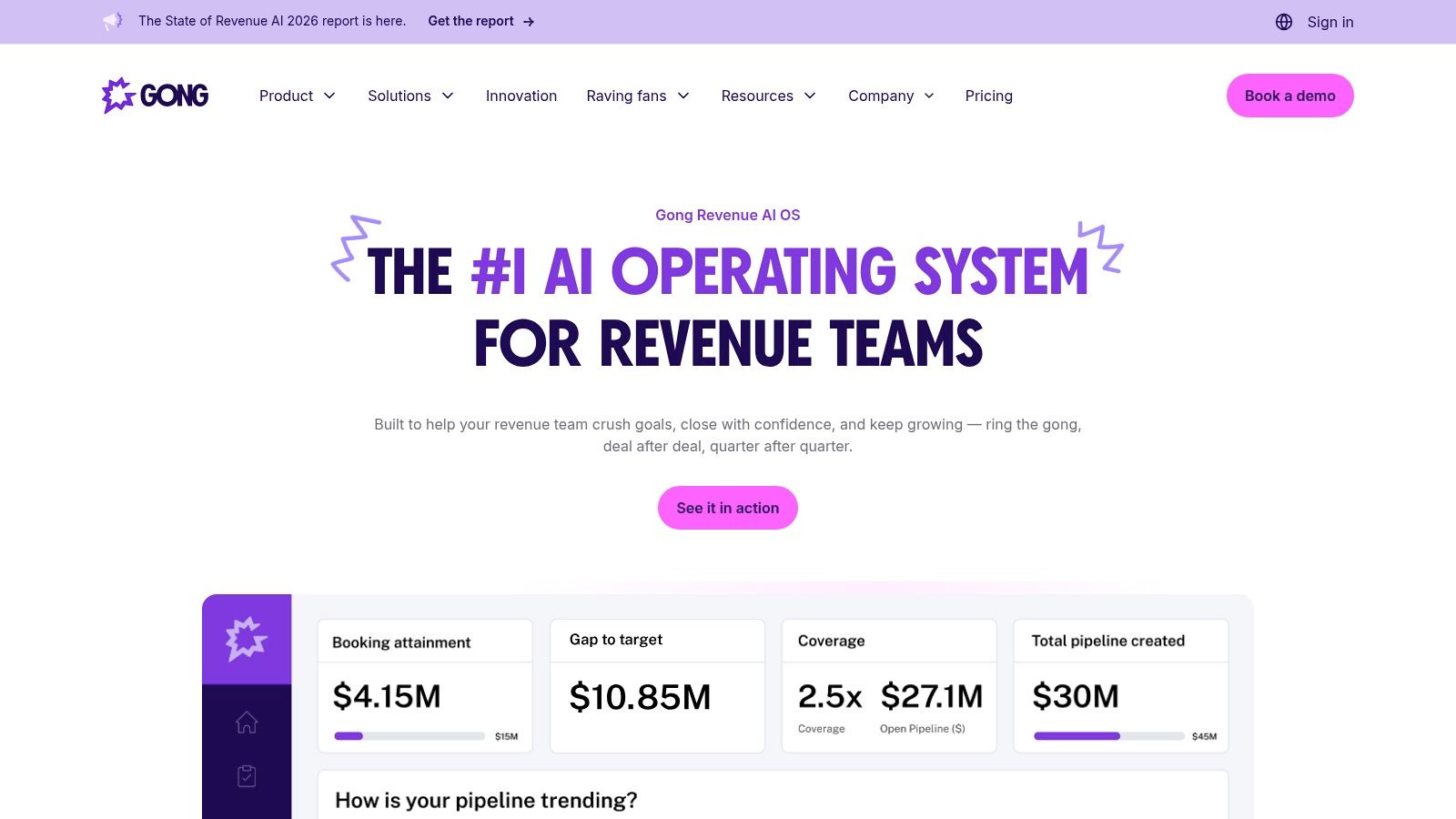
For sales leaders, Gong offers an unparalleled ability to replicate top-performer behavior across the entire team. Its AI identifies successful talk tracks and flags at-risk deals based on conversational cues, providing actionable intelligence to improve forecast accuracy. This tool is less about automating outreach and more about optimizing the human element of sales, making it one of the most strategic best ai sales tools for performance improvement.
Practical Use and Considerations
Gong is most effective for B2B sales organizations focused on improving rep performance and gaining deep pipeline visibility. Use it to build a library of best-practice call recordings for onboarding new hires and to provide targeted, data-driven coaching to seasoned reps.
Key Features:
- Conversation Intelligence: AI-driven transcription, summarization, and analysis of all sales calls and meetings.
- Pipeline & Forecast AI: Identifies deal risks and provides AI-powered next-best-action recommendations.
- CRM & Dialer Integrations: Seamlessly syncs data with platforms like Salesforce, HubSpot, and popular dialers.
- Team Coaching: Pinpoints coachable moments in conversations and tracks team performance on key topics.
A significant consideration is that Gong's value is directly tied to the volume and quality of data it can ingest. Teams that don't regularly record calls or maintain CRM hygiene will see limited benefits. Pricing is not publicly available and requires a custom quote, positioning it as a premium solution for established teams serious about revenue optimization.
Website: https://www.gong.io/
11. Outreach – AI Sales Platform and engagement
Outreach is a mature sales engagement platform that uses AI to optimize outbound cadences for SDR and AE teams. It excels at helping reps prioritize tasks, personalize messaging at scale, and automate administrative work, making it a powerful tool for complex, multi-channel prospecting sequences. The platform integrates AI across its entire workflow, from content suggestions to deal risk analysis.
The platform stands out with its deep feature set designed for established sales operations. Its AI-powered workflows guide reps on which prospects to engage with next, suggest relevant content for their emails, and even flag deals that might be at risk. This level of integrated intelligence within a single platform makes it one of the best AI sales tools for organizations looking to standardize and scale their outbound engine with data-driven precision.
Practical Use and Considerations
Outreach is best utilized by teams that need a robust, all-in-one system for managing high-volume, multi-touch sales cadences. The built-in dialer and ongoing release of new AI agents, such as those for LinkedIn personalization, make it a comprehensive solution for covering every aspect of the sales engagement process.
Key Features:
- AI Workflows: Automates task prioritization, messaging, and deal risk assessment.
- Built-in Dialer: Offers transparent, pay-as-you-go voice pricing for integrated calling.
- Content and Research Agents: Provides AI-driven suggestions for personalizing outreach.
- LinkedIn Personalization: New features leverage AI to craft messages for social selling.
While Outreach is a mature platform with extensive documentation, its core platform pricing is not public and requires a sales consultation. Be mindful that add-on costs for usage-based credits and voice minutes can become significant as your team's activity scales, so it's important to factor this into your budget.
Website: https://www.outreach.io/
12. Apollo – AI sales platform for prospecting and engagement
Apollo.io stands out as an all-in-one AI sales platform, combining a massive B2B contact database with a full suite of engagement tools. It’s built for teams that want to move quickly from prospecting to outreach within a single, unified system. The platform leverages AI not just for finding prospects but also for personalizing communication at scale, making it a powerful engine for outbound sales.
Its primary strength lies in integrating a database of over 275 million contacts with multi-step sequencing capabilities. Sales reps can build highly targeted lists using dozens of filters, enrich that data, and immediately enroll prospects into automated email and call sequences. AI-powered features assist with writing personalized emails and determining the best time to send them, streamlining the entire top-of-funnel workflow. For SMBs and mid-market companies, Apollo’s transparent, self-serve pricing model offers a fast and cost-effective path to building a scalable outbound motion.
Practical Use and Considerations
Apollo is ideal for sales teams that need to quickly source, verify, and engage leads without juggling multiple tools. Use its powerful Chrome extension to pull contact data directly from LinkedIn profiles and add prospects to sequences on the fly.
Key Features:
- Massive Prospect Database: Search and filter over 275 million contacts and 73 million companies.
- AI-Powered Sequencing: Automate outreach across email, calls, and LinkedIn with AI-assisted writing.
- Data Enrichment: Automatically enrich existing contact records with verified emails and mobile numbers.
- Integrated Dialer & Analytics: Make calls directly from the platform and track all engagement metrics in one place.
The credits-based model for data access can create budgeting complexity, as heavier usage often requires purchasing additional email and mobile credits. While the free plan is excellent for getting started, teams scaling their outreach will quickly need to upgrade to a paid tier to access sufficient credits and advanced features.
Website: https://www.apollo.io/
Top 12 AI Sales Tools: Features & Marketplace Comparison
| Product | Core features & USPs | Target audience | Price / Value | Quality & Support |
|---|---|---|---|---|
| Roger 🏆 | End-to-end outbound: lead discovery, email verification, AI‑personalized copy that mirrors your tone, multi‑channel sequences ✨ research reports per lead | 👥 B2B startups, SMBs without SDRs, agencies, sales leaders, enterprise teams | 💰 Tiered — Basic $800/mo (~800 leads), Standard $2,000, Premium $3,000 (Slack support), Enterprise custom | ★★★★☆ High deliverability; daily reporting; real‑time Slack & dedicated support on higher plans |
| G2 – AI Sales Assistant category | Aggregated reviews, live rankings, side‑by‑side comparisons ✨ verified user reviews | 👥 Buyers shortlisting vendors, procurement, evaluators | 💰 Free to browse; vendor‑driven pricing; sponsored placements possible | ★★★★ Crowdsourced sentiment; review depth varies |
| Capterra – AI Sales Assistant directory | Large directory, compare function, pricing snippets, regional pages | 👥 Buyers scanning features/pricing, smaller orgs | 💰 Free to browse; vendor pricing links; some pricing callouts | ★★★★ Easy price/feature skimming; review coverage varies |
| Product Hunt – Sales topic | Launch pages, demos, maker Q&A, community feedback ✨ early access & lifetime deals | 👥 Makers, early adopters, product scouts | 💰 Free discovery; pricing per vendor; many early‑stage deals | ★★★ Variable quality; strong community signals |
| Salesforce AgentExchange | Vetted, security‑reviewed agents integrated with Sales Cloud; native governance ✨ low‑code Agent Builder | 👥 Salesforce Enterprise customers, admins | 💰 Vendor‑priced; often quote/PO required | ★★★★ Enterprise‑grade security & integration |
| AWS Marketplace – AI agents | Procurement, consolidated AWS billing, private offers, deployment details | 👥 IT/procurement teams, AWS customers | 💰 Vendor pricing; private offers & consolidated billing | ★★★ Variable listing quality; procurement‑friendly |
| Microsoft Marketplace (Azure + AppSource) | Catalog of AI apps with Dynamics/Copilot integrations, transactable offers | 👥 Microsoft‑centric companies, Dynamics users | 💰 Vendor pricing; centralized billing & provisioning | ★★★★ Deep platform integrations; regional variations |
| HubSpot App Marketplace | Direct installs into HubSpot, workflow actions, trials, compatibility notes | 👥 HubSpot users, Sales Hub teams | 💰 Many free trials/low‑cost tiers; vendor subs may apply | ★★★★ Smooth CRM continuity; variable review depth |
| Google Workspace – AI for Sales (Gemini) | Gemini side‑panel across Gmail/Docs/Sheets, templates, agent tools | 👥 Google Workspace customers, collaboration teams | 💰 Included in Workspace tiers; 14‑day trials available | ★★★★ Integrated workflows; advanced features roll out gradually |
| Gong – Revenue Intelligence | Conversation intel, AI summarization, deal risk signals, forecasting | 👥 Revenue ops, sales leaders, enterprise teams | 💰 Quote‑based enterprise pricing | ★★★★★ Proven impact on forecast & coaching; strong enterprise support |
| Outreach – AI Sales Platform | Engagement cadences, AI prioritization, content suggestions, built‑in dialer | 👥 SDR/AE teams, outbound‑heavy orgs | 💰 Quote‑based; add‑on credits/voice costs possible | ★★★★☆ Mature platform; strong ops features |
| Apollo – AI prospecting & engagement | Large B2B contact DB, AI research & writing, Chrome extension, dialer ✨ published pricing & free plan | 👥 SMBs to mid‑market teams seeking self‑serve growth | 💰 Free‑forever plan; clear tiers; credits model for data | ★★★★ Good value for SMBs; credits can add budgeting complexity |
Making Your Final Decision: How to Choose the Right AI Sales Partner
We've explored a powerful lineup of AI sales tools, from autonomous end-to-end platforms like Roger to specialized intelligence solutions like Gong and vast ecosystems within Salesforce and HubSpot. The sheer volume of options, from established players like Outreach to comprehensive marketplaces like AWS, underscores a critical truth: the era of AI-driven sales is not on the horizon, it is here now. The 'best' tool isn't a one-size-fits-all answer; it's the one that aligns with your specific goals, team structure, and existing tech stack.
The primary takeaway from this deep dive is the shift in what's possible. Yesterday's tools automated simple tasks; today's best AI sales tools can autonomously research prospects, craft personalized outreach, manage responses, and book meetings. This moves the needle from simple efficiency gains to genuine strategic leverage, allowing human sellers to focus exclusively on high-value conversations and closing deals. Your decision-making process should reflect this new paradigm.
Here is a final framework to guide your decision-making process, ensuring you invest in a solution that delivers measurable ROI and transforms your sales motion.
Your Strategic Decision-Making Framework
Before you sign a contract, run through this checklist. Answering these questions honestly will illuminate the path to the right AI partner for your specific needs, preventing costly implementation mistakes and ensuring you select a tool that truly empowers your team.
Define Your Core Problem: What is the single biggest bottleneck in your sales process? Is it a lack of qualified leads (prospecting), low email reply rates (personalization), reps getting bogged down in administrative tasks (automation), or an inability to learn from sales calls (intelligence)?
- Prospecting & Lead Gen: Look at comprehensive platforms like Apollo or autonomous agents like Roger.
- Engagement & Follow-up: Tools like Outreach are built for this, managing multi-channel sequences.
- Conversation & Revenue Intelligence: This is the core strength of platforms like Gong.
- Ecosystem Integration: If you live in Salesforce or HubSpot, their respective marketplaces are your first stop.
Assess Your Team’s Capacity for Change: Does your team have the technical skills and time to manage a complex new platform? Or do you need a more "hands-off" solution that works in the background?
- High-Involvement Platforms: Solutions like Salesforce AgentExchange or building on AWS Marketplace require significant internal resources and technical expertise to configure and maintain.
- Low-Involvement Solutions: Autonomous platforms like Roger are designed to operate with minimal human oversight, making them ideal for SMBs or teams without dedicated sales ops.
Audit Your Existing Tech Stack: A new tool that doesn't integrate with your CRM is a non-starter. Map out your essential systems (CRM, email client, calendar) and prioritize solutions with seamless, native integrations. Check the HubSpot and Salesforce marketplaces for pre-built connections that can save you significant headaches.
Calculate the True ROI: Don't just look at the subscription price. Consider the cost of implementation, training time, and the potential value of reclaimed hours for your sales reps. How many more meetings could your top AE book per week if they spent zero time on prospecting and data entry? This calculation often proves that more comprehensive, autonomous tools offer superior long-term value.
Final Considerations Before You Commit
Beyond features and pricing, consider the vendor's vision. Are they continuously innovating, or is their product stagnant? Exploring a comprehensive directory of AI SaaS companies can help you discover the best fit for your team's unique requirements and see which providers are leading the market. The best AI sales tools are constantly evolving, so partner with a company that is committed to staying on the cutting edge.
Your final choice will ultimately shape the future of your sales organization. Whether you need a powerful co-pilot to enhance your existing team or a fully autonomous agent to build pipeline from scratch, the right tool is out there. Use this guide to make an informed, strategic decision that will not just improve your metrics, but fundamentally transform how you sell.
Ready to see how a fully autonomous AI sales agent can build your pipeline for you? Roger handles everything from ideal customer profile research and lead sourcing to personalized outreach and meeting scheduling, letting your sales team focus 100% on closing. Discover the future of outbound sales by visiting Roger today.