CRM Data Enrichment A Guide to Transforming B2B Sales Results
December 24, 2025
Think of your CRM for a moment.Is it a dynamic, strategic asset, or is it more like a digital rolodex—a long list of names and companies with little context? If you're like most B2B sales teams, it's probably somewhere in the middle. This is where CRM data enrichment comes in.
It's the process of taking the basic customer information you already have and layering it with verified, third-party data to create a complete, accurate, and incredibly useful profile. In short, it turns a simple contact list into actionable intelligence, ensuring your sales team isn't working with outdated or incomplete records.
What Is CRM Data Enrichment and Why It Matters

Let's use an analogy. Imagine your CRM is a hand-drawn treasure map. The ink is faded, and the landmarks are vague. It might point you in the general direction of a great prospect, but getting there involves a whole lot of guesswork.
CRM data enrichment is what transforms that crude map into a high-resolution, live GPS. It doesn't just pinpoint the treasure; it reveals the clearest, fastest routes to get there, highlighting potential roadblocks and opportunities along the way. It’s the art of taking what you think you know about your customers and enhancing it with what you should know.
The Constant Battle Against Data Decay
Here’s a hard truth: the moment you enter data into your CRM, it starts to go stale. People change jobs, companies get acquired, and entire tech stacks get swapped out. Industry research shows that B2B data decays at an alarming rate of over 30% per year.
Think about that. Nearly a third of your contact information could be useless within 12 months. That means bounced emails, calls to disconnected numbers, and countless wasted hours chasing dead ends.
CRM data enrichment is your defense against this decay. It works continuously to refresh and validate your records, making sure your team is always operating with the most current information possible. This includes:
- Accurate Contact Details: Verifying emails, direct-dial phone numbers, and current job titles.
- Detailed Firmographics: Confirming the latest company size, industry, revenue figures, and office locations.
- Revealing Technographics: Identifying the specific software and technology a company is using right now.
- Timely Buying Signals: Uncovering recent funding rounds, major hiring initiatives, or social media activity that signals a company is ready to buy.
From Basic Data to Enriched Intelligence A Comparison
Enrichment bridges the critical gap between knowing who your customers are and understanding how to talk to them. A standard CRM entry might just have a name, email, and company. An enriched profile, on the other hand, tells a complete story.
This table shows just how stark the difference is.
| Data Point | Before Enrichment (Standard CRM Entry) | After Enrichment (Actionable Intelligence) |
|---|---|---|
| Contact Info | jane.doe@acmecorp.com |
Verified Email, Direct-Dial Phone, LinkedIn Profile |
| Company Size | Unknown | 250 Employees, $50M in Annual Revenue |
| Industry | "Software" | SaaS - MarTech & Analytics |
| Tech Stack | Not available | HubSpot, Salesforce, AWS, Snowflake |
| Buying Signals | None | Just raised $15M Series B; hiring 10 new sales reps |
| Personalization | "Hi Jane, I see you work at Acme Corp..." | "Congrats on the $15M raise! As you scale your new sales team, I bet integrating HubSpot and Salesforce data is a priority." |
With enriched data, the conversation completely changes. You move from generic, easily ignored templates to highly relevant, personalized outreach that commands attention.
This strategic shift is fueling incredible growth. The global data enrichment market was valued at $2.5 billion in 2020 and is on track to hit $5 billion by 2025. The reason is simple: it works. For instance, marketers who use AI for data enrichment have seen a 40% increase in revenues, drawing a direct line from better data to a healthier bottom line. You can learn more by exploring the rise of AI in data enrichment market insights.
"Without enrichment, a CRM is just a digital address book. With enrichment, it becomes your team's strategic command center, guiding every interaction with precision and context."
By providing this 360-degree view of every prospect, data enrichment frees your sales reps to do what they do best: sell. They can stop spending hours on manual research and start building real relationships, tailoring their pitch to specific pain points from the very first touchpoint. This is how a standard CRM becomes a high-performance sales engine.
The Three Pillars of High-Impact Data Enrichment
Think of your CRM for a second. Is it a well-organized toolkit, or is it more like that junk drawer everyone has? Effective data enrichment isn't about just stuffing more stuff into the drawer; it’s about having the right tool for the right job, exactly when you need it.
To get there, your entire enrichment strategy needs to stand on three solid pillars: the specific types of data you’re after, the sources you trust to provide it, and an obsessive focus on quality. Nail these three, and your CRM stops being a glorified address book and becomes the engine for your sales growth.
Pillar 1: The Types of Data That Actually Drive Sales
First things first, you have to decide what information will actually help your sales team win. This is about moving past the basics—a name and an email—and building a 360-degree view of your ideal customer.
It's a journey from basic contact info to a truly strategic profile, and it usually happens in layers:
- Demographics: The absolute essentials. This is the "who" you're talking to—their job title, seniority, location, and, crucially, a verified email address and direct-dial phone number.
- Firmographics: The "what" and "where" of their company. Think industry, employee count, annual revenue, and office locations. This is how you quickly qualify an account and make sure they match your ideal customer profile (ICP).
- Technographics: The "how" of their operations. This data reveals a company's tech stack, telling you what software and tools they already use. Knowing they use a competitor's product is a huge advantage, as is knowing they use a tool that integrates perfectly with yours.
- Intent Data: This is the "when" and "why." Intent data is all about buying signals—behavioral clues that a company is actively researching solutions like yours. Are they downloading whitepapers on a specific topic? Visiting your pricing page? Spikes in online searches for keywords you care about? This is gold.
When you layer these data types together, the picture becomes incredibly clear. You don't just know a contact's name; you know their role in a company that fits your ICP, what tools they're using, and that they're actively in the market for a solution.
Pillar 2: The Sources of Your Enriched Data
Okay, so you know what data you need. Now, where do you get it? The landscape of data providers is vast, with options ranging from public records to highly curated, private databases. Knowing the pros and cons of each is key to building a data pipeline you can rely on.
Let's break down the main sources:
- Public Data Sources: We're talking about places like LinkedIn, company websites, and public business directories. The upside is that they're accessible and often free. The downside? The data is unstructured, can be wildly inconsistent, and takes a ton of manual work to scrape and verify.
- Third-Party Proprietary Databases: These are the big players—specialized data providers that do the heavy lifting for you. They collect, clean, and organize massive volumes of B2B data, which you can access through a subscription or API. For enriching CRM data at scale, this is the go-to method.
- First-Party Data: This is the data you own, collected directly from your audience. Think website forms, product sign-ups, or support tickets. It's incredibly accurate because people gave it to you themselves, but it’s limited to the contacts you already know.
A smart strategy almost always blends these sources. You might use a third-party tool to add firmographics and technographics to a new lead that just filled out your contact form (first-party data). The result is a profile far richer than what any single source could offer on its own.
Pillar 3: The Unwavering Commitment to Quality
This last pillar is, without a doubt, the most important. If your data quality is poor, the other two pillars mean nothing. Inaccurate or old information is actually worse than having no information at all because it sends your team on wild goose chases, hurts your company’s credibility, and leads to terrible decisions.
Truly high-quality data boils down to three things:
- Accuracy: Is the information correct today? A verified direct-dial number is priceless. A number that was disconnected six months ago is just a waste of a salesperson's time. Accuracy ensures your team's effort counts.
- Completeness: Are the most important fields for your ICP actually filled in? A record with a name and nothing else forces your reps right back to Google, completely defeating the purpose of enrichment.
- Timeliness: How often is the data refreshed? B2B data decays at an alarming rate. People change jobs, companies get acquired, and phone numbers change. A solid commitment to regular updates, either through real-time enrichment or frequent syncs, is non-negotiable.
When you put it all together, these three pillars—Data Types, Sources, and Quality—are the foundation of any serious CRM enrichment program. Get them right, and you’ll empower your sales team with the intelligence they need to not just hit their quota, but to crush it.
How to Implement a CRM Data Enrichment Strategy
Okay, so we've covered the "what" and the "why." Now for the "how." Moving from theory to practice with data enrichment isn't about flipping a switch and hoping for the best. It's about a methodical process that wires your data directly into your sales goals.
Think of this as a roadmap. It’s a clear path for any B2B team to take that pile of raw CRM data and turn it into a high-performance sales asset. We'll start by taking an honest look at what you’ve got before building a system that consistently feeds your team the intel they need to win.
Step 1: Audit Your Current CRM Data
Before you can add anything new, you have to know what you’re working with. This means starting with a full-blown audit of your CRM. It’s like taking inventory of a messy garage before you start organizing. You need to see what's useful, what's junk, and what’s just plain missing.
Your main goal here is to pinpoint the most critical data gaps holding your sales team back. Are reps constantly struggling to find direct-dial phone numbers? Are you missing key firmographics like employee count or annual revenue? Finding these weak spots is the first move in building a targeted and effective CRM data enrichment plan.
Step 2: Define Your Ideal Customer Profile
Once you know what’s missing, the next big question is: what data actually matters? The answer is always found in your Ideal Customer Profile (ICP). Your ICP is the blueprint for a perfect-fit customer, and every single data point you add should help you find more of them.
Don't fall into the trap of collecting data for data's sake. Instead, focus on the specific attributes that scream "high-quality lead" for your business.
- Firmographics: What's the sweet spot for company size, industry, or revenue?
- Technographics: What software or tools do your best customers use that makes your solution a no-brainer for them?
- Buying Signals: What events—like a fresh funding round, a new executive hire, or a surge in job postings—signal a company is ready to talk?
Getting crystal clear on these points ensures your enrichment efforts deliver actionable intelligence, not just more digital noise.
A well-defined ICP acts as a filter for your data enrichment strategy. It ensures you invest in enriching the specific data fields that directly correlate with higher conversion rates and larger deal sizes.
Step 3: Choose the Right Enrichment Tools and Methods
With your data gaps identified and your ICP locked in, it’s time to pick your tools. The market for these platforms is exploding, and for good reason—they're becoming essential. In fact, the data enrichment solutions market is expected to more than double, growing from USD 2.1 billion to USD 4.75 billion by 2031. This isn't just hype; it's driven by a real need for smarter, data-fueled personalization. You can find more insights on this expanding market at 6wresearch.com.
You generally have three ways to approach enriching your CRM data:
- Manual Enrichment: This is the old-school way—a sales rep manually digging through LinkedIn or company websites. It’s accurate for a handful of records but completely unscalable for a modern sales team.
- Batch Updates: Here, you export a chunk of your CRM data, send it to a third-party service to get cleaned and updated, and then re-import it. This is great for a one-time scrub, but it doesn't solve the problem of data going stale the very next day.
- Real-Time API Integration: This is the gold standard. An enrichment tool plugs directly into your CRM (like Salesforce or HubSpot) and automatically enhances records the moment they’re created or updated. It's a living, breathing solution.
This diagram breaks down the core pieces of a solid CRM data enrichment process. It shows how the data you collect, the sources you trust, and the quality you maintain all have to work together.
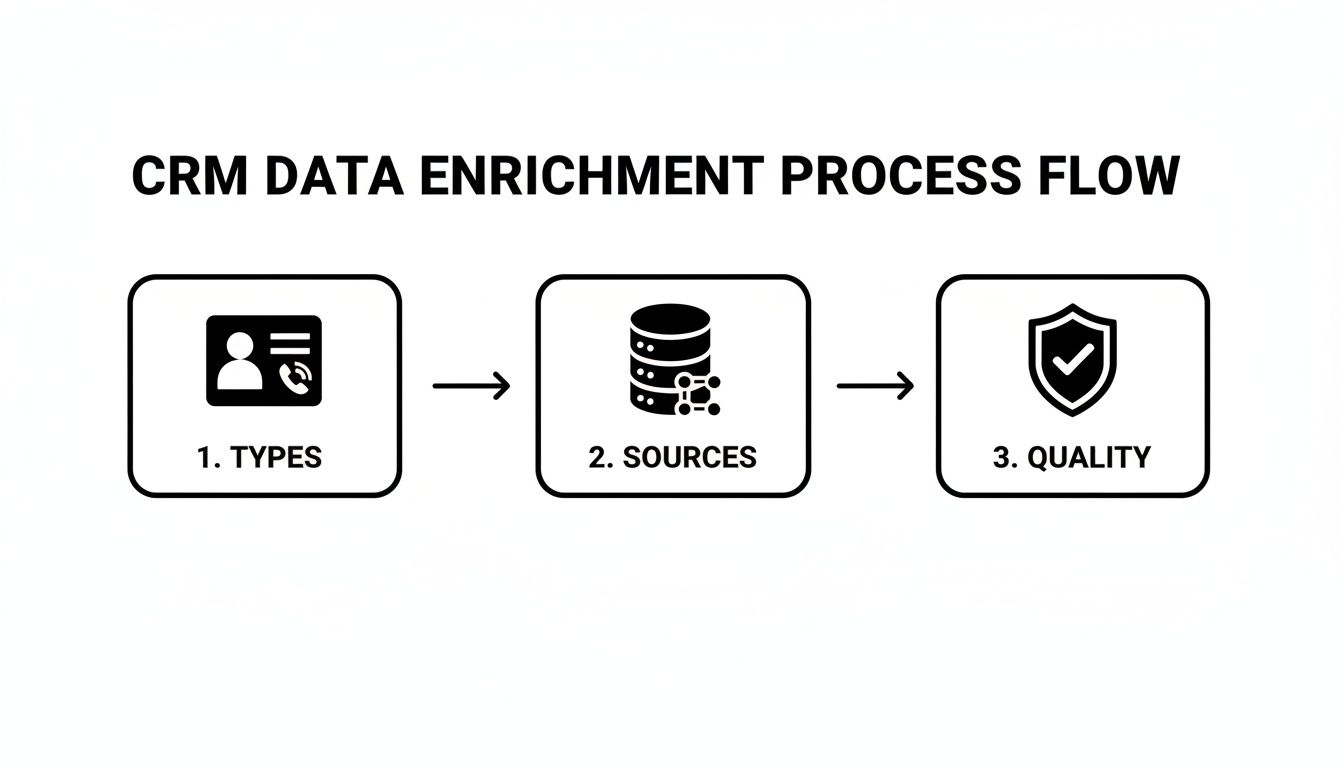
As you can see, a winning strategy is built on the seamless flow between these three pillars: having the right data types, using reliable sources, and being obsessive about quality.
Step 4: Integrate and Train Your Team
The last piece of the puzzle is putting it all into motion. This means actually integrating your chosen tool with your CRM. But just as crucial is training your sales team on how to use their newfound superpower.
Show them exactly how to use the enriched data to write better emails, nail their lead scoring, and have far more relevant conversations. Set up some clear data governance rules from the start to keep things clean over the long haul. This is how your CRM stops being a glorified rolodex and becomes the single source of truth that helps your team close deals faster.
Measuring the ROI of Your Data Enrichment Efforts
Investing in CRM data enrichment feels like the right move, but how do you actually prove it's paying off? It’s not enough to just feel like it's working; you need to show its tangible impact on your sales performance. This all starts with establishing a clear baseline before you flick the switch.
Think of it like getting in shape. You wouldn't start a new workout routine without knowing your starting weight or how many push-ups you can do. The same logic applies here. Before enriching your CRM, you have to benchmark your current key performance indicators (KPIs). This gives you that crucial "before" picture, making the "after" results impossible to ignore.
Tracking the Quantitative Gains
The most straightforward way to prove the value of data enrichment is to watch the numbers that directly affect revenue. When your data is clean, complete, and insightful, it fuels sales efficiency and effectiveness, and you’ll see the proof in your core metrics.
Start by zeroing in on these three critical areas:
- Lead Conversion Rate: Enriched data hands your reps the context they need for sharp, personalized outreach. This leads to better qualification and far more meaningful conversations, which naturally drives up the percentage of leads that convert into real opportunities.
- Sales Cycle Length: When your team has all the crucial details upfront—like a company's tech stack or recent buying signals—they can ditch the hours of manual digging. They qualify leads faster and tailor their pitch from the first call, which dramatically shortens the time from first contact to a closed deal.
- Average Deal Size: With deeper insights into a prospect’s specific needs, budget, and decision-making structure, reps get much better at spotting upsell and cross-sell opportunities. They can frame your solution as the perfect answer to a prospect’s unique problems, often leading to bigger, more strategic deals.
The impact isn't small. Businesses that get serious about using this kind of data see dramatic improvements across the board. Research shows they can achieve 25% higher lead conversion rates and generate 25% more sales-qualified leads. Not only that, enriched leads shorten sales cycles by 25% and tend to result in 30% larger deals. It’s a direct line from better data to a healthier bottom line. You can learn more about these lead enrichment trends and their impact on global sales teams.
To really get a handle on this, you need to track your KPIs consistently. Here’s a look at the most important metrics and the kind of uplift you can realistically expect.
| KPI | What It Measures | Typical Uplift with Enrichment |
|---|---|---|
| Lead Conversion Rate | The percentage of leads that become sales-qualified opportunities. | 15-25% |
| Sales Cycle Length | The average time it takes to close a deal from first contact. | 10-25% shorter |
| Average Deal Size | The average revenue generated per closed-won deal. | 10-30% larger |
| Outreach-to-Meeting Rate | The percentage of cold outreach that results in a booked meeting. | 20-40% |
| Data Accuracy | The percentage of records in your CRM that are complete and correct. | Up to 95% |
| Sales Rep Productivity | Time spent on manual research vs. active selling activities. | 20% more selling time |
Keeping a close eye on these numbers will give you the hard evidence you need to prove that your investment is generating a powerful return.
Don't Overlook the Qualitative Benefits
While the hard numbers are compelling, the qualitative benefits of data enrichment are just as vital to understanding its total value. These are the operational and cultural shifts that make your sales team more effective and motivated.
An enriched CRM removes the friction from a salesperson's day. Instead of spending hours hunting for a direct-dial number or verifying a job title, they can focus entirely on building relationships and closing deals.
This simple change creates a few powerful ripple effects:
- Higher Sales Team Morale: When reps feel equipped and empowered, they're happier and more productive. Taking away the drudgery of manual research frees them up to do what they do best: sell.
- Improved Sales and Marketing Alignment: With both teams working from the same rich, accurate dataset, collaboration becomes second nature. Marketing delivers better-qualified leads, and sales follows up with perfectly tuned messaging, creating a seamless customer journey.
By combining the quantitative KPIs with these crucial qualitative improvements, you can paint a complete and powerful picture of your ROI. It proves that CRM data enrichment isn't just another expense—it's a strategic investment that drives revenue, efficiency, and a stronger, more aligned team.
Avoiding Common Pitfalls and Compliance Challenges
A great data enrichment strategy is as much about sidestepping common mistakes as it is about following best practices. Just plugging in a new tool and hoping for magic is a surefire way to get frustrated. To really succeed, you have to navigate a few critical challenges that can stop your efforts cold.
One of the biggest blunders I see is putting all your eggs in one basket—relying on a single data source. The truth is, no single provider has a monopoly on perfect, up-to-the-minute information. A much smarter approach is to cross-validate data from multiple sources. This builds a more accurate, three-dimensional picture of your prospects and protects your team from the blind spots of any one database.
Another classic mistake is skipping data governance. If you don't set clear rules for how data enters and lives in your CRM from day one, you're just creating a new, faster-moving version of data decay. All that freshly enriched data will go stale in no time, and you'll be right back where you started.
Staying on the Right Side of Data Privacy
Beyond the operational headaches, there’s the non-negotiable world of data privacy and compliance. Getting this right isn’t just about ticking a legal box; it’s about earning trust with potential customers and protecting your company’s reputation. Ignorance isn’t an excuse, and the penalties for getting it wrong can be steep.
You absolutely have to understand how major privacy laws impact what you do. Here are the big ones:
- General Data Protection Regulation (GDPR): This EU law is the gold standard for data privacy. It demands a clear legal reason for processing personal data (like getting explicit consent) and gives people the right to see and delete their information. If you touch EU citizen data, this applies to you.
- California Consumer Privacy Act (CCPA): Much like GDPR, this law grants California residents significant control over their personal info. It forces companies to be open about the data they're collecting and gives consumers the power to opt out of their data being sold.
Choosing a data provider that is completely transparent about where their data comes from and is committed to compliance isn't just a good idea—it's essential. Your CRM data enrichment has to be both effective and ethical to succeed long-term.
Practical Steps for Ensuring Compliance
Staying compliant means being proactive, not reactive. It’s about building privacy into your processes from the ground up. This starts with picking your partners wisely and upholding internal standards that put ethical data handling first.
To build your enrichment strategy on a rock-solid foundation of compliance, take these steps:
- Vet Your Data Providers: Don’t be shy. Ask them directly where they get their data and how they stay compliant with GDPR and CCPA. A trustworthy provider will have clear, honest answers.
- Maintain an Audit Trail: Always keep a record of where your data came from and the enrichment processes it went through. This is your proof of compliance if you ever need it.
- Honor Opt-Out Requests Promptly: Make sure you have a simple, fast process for handling requests from people who want their data removed from your systems.
- Practice Data Minimization: Only enrich the data you actually need for your sales and marketing goals. Resist the urge to collect extra information just because you can.
By carefully navigating these common pitfalls and weaving compliance into the fabric of your strategy, you’ll build a data enrichment program that’s not just powerful, but also trustworthy and built to last.
The Future Is AI-Powered Enrichment

The days of manual research and clunky, once-a-quarter batch updates are numbered. The next major leap in CRM data enrichment isn’t just about getting more data; it's about getting smarter, forward-looking insights that only Artificial Intelligence can deliver. This moves enrichment from a chore you do periodically to something that happens automatically, all the time.
AI doesn’t just fill in missing fields—it connects the dots in ways humans can't. Instead of just matching records against a static database that goes stale, AI models constantly scan the web in real time. They sift through mountains of unstructured data from news articles, press releases, social media, and financial reports to find the signals that actually point to an opportunity.
From Static Data to Predictive Intelligence
Think of it this way: traditional enrichment tells you what a company was. AI-powered enrichment shows you what a company is doing right now and what it’s likely to do next. That’s the critical difference between having a simple contact list and having a real strategic advantage.
AI algorithms are built to spot patterns a person would easily miss. They can flag companies showing strong buying intent long before anyone ever clicks "request a demo." For a sales team, getting that kind of heads-up is a complete game-changer.
Here's what AI-driven enrichment really brings to the table:
- Automated Data Sourcing: AI spots the gaps in your CRM, hunts down the correct information from reliable sources, and fills in the blanks for you. No more manual copy-pasting.
- Real-Time Buying Signal Detection: It keeps an eye out for trigger events—a key executive just got hired, a new round of funding was announced, or a company is suddenly hiring a dozen new engineers. These alerts get pushed right into your CRM.
- Advanced Personalization Insights: AI tools can scan a prospect's recent LinkedIn activity or a company's latest blog post to generate genuinely relevant talking points for your outreach.
"AI transforms the CRM from a passive database into a 'living' system. Profiles are no longer static snapshots but are continuously updated and enhanced with predictive insights that guide sales strategy."
This means your CRM gets smarter the more you use it. It starts to learn which signals consistently lead to closed deals and gets better at pushing your best-fit accounts to the top of the list. Your sales reps can stop being data miners and start acting like strategic advisors.
How AI Cleans Up the Entire Workflow
Imagine your sales reps logging in each morning to a perfectly prioritized list of leads. Each lead has a pre-built briefing that explains why they're a good fit and offers a few sharp ideas on how to start the conversation. That's not a fantasy; it's what AI-powered enrichment makes possible.
Platforms like Roger automate the whole outbound process. The AI doesn't just find and enrich leads that match your Ideal Customer Profile. It then uses that fresh, rich data to write personalized outreach for you across multiple channels. It gets the nuance right, adapts to your tone, and weaves in timely research to create messages that actually get a reply.
With this kind of integrated system, sales teams are finally free from the grunt work of data entry and manual research. They can pour all that saved time and energy into what they do best: building relationships and closing deals, all while being guided by the intelligent, proactive recommendations of their AI assistant. The result is a sharper, more effective, and more motivated sales team that’s ready to jump on every real opportunity.
Frequently Asked Questions About Data Enrichment
It's natural to have questions when you're getting into data enrichment. Let's tackle some of the most common ones I hear from sales teams to help you build a smarter, more effective strategy.
How Often Should We Enrich CRM Data?
This is a big one, and it really comes down to two main schools of thought: batch updates versus real-time enrichment.
A batch update is like doing a massive spring cleaning on your house. You take everything out, scrub it down, and put it all back in order. In data terms, you export your CRM list, send it off to get cleaned up and updated, and then re-import it. It’s a great way to handle an initial, large-scale cleanup, but it has one big problem: the data starts getting stale the moment you're done.
That's where real-time enrichment comes in. Think of it as a self-cleaning house. It’s an ongoing, automated process that freshens up your data the instant a new lead hits your CRM or when an existing contact switches jobs. For any B2B sales team trying to keep up with a fast-moving market, this isn’t just a nice-to-have; it's the only way to stay accurate and jump on opportunities the second they appear.
Is Data Enrichment Only for Large Enterprises?
Not at all. This is a common myth. While big companies definitely get a lot out of it, CRM data enrichment is a game-changer for small and mid-sized businesses (SMBs). Honestly, it can be the great equalizer, helping smaller teams punch well above their weight.
Instead of spraying and praying, SMBs can use enriched data to find their perfect prospects with laser focus. This shift from quantity to quality means smaller sales teams can make every single call and email count. You get higher conversion rates and a much more efficient sales cycle, all without needing a Fortune 500 budget.
The real power of enrichment isn't about the size of your company; it's about the quality of your conversations. Better data leads to smarter outreach, and that's an advantage for everyone.
What’s the Difference Between Data Cleansing and Enrichment?
People often use these terms interchangeably, but they're two distinct—and equally important—jobs. The easiest way to think about it is to imagine your CRM data is a house.
- Data cleansing is the repair work. It’s fixing the leaky faucet, patching a hole in the wall, and replacing a broken window. You're correcting mistakes that already exist in your data—fixing typos in email addresses, standardizing job titles, and merging duplicate contacts. It makes what you already have usable.
- Data enrichment, on the other hand, is like adding a brand-new extension to the house. You're bringing in new, valuable information that wasn't there before—things like a prospect’s direct phone number, what technology their company uses, or recent news that signals they're ready to buy.
So, cleansing fixes what you have, while enrichment adds to what you have. You really need both to get a complete and actionable picture of your customers.
Ready to stop guessing and start selling with precision? Roger is an AI-powered platform that automates your entire outbound motion, from finding verified decision-makers to writing personalized outreach that gets replies. Book more meetings and let Roger handle the rest.