Define Outbound Sales A Proactive Growth Strategy
December 23, 2025
Outbound sales is all about being proactive. Instead of waiting for customers to come knocking on your door, you go out and find them. Think of it like a talent scout who actively searches for the perfect athlete, rather than just posting a "tryouts" sign and hoping for the best. You're taking control and directly targeting the exact customers you want to work with.
What Is Outbound Sales and Why It Matters

The best way to define outbound sales is to see it as an engine for intentional growth. At its core, it’s the process where your sales team identifies potential customers who haven't shown any prior interest and reaches out to them directly. The whole point is to introduce them to your company and pull them into your sales funnel using channels like cold calls, personalized emails, or social media outreach.
This approach puts your company firmly in the driver's seat of its own growth. You stop depending on passive lead generation and start actively building your pipeline by going after the specific accounts, industries, or decision-makers that are a perfect fit for what you sell. You can dive deeper into these prospecting secrets with insights from Crunchbase.
To help paint a clearer picture, here’s a quick breakdown of what makes up the outbound motion.
Outbound Sales At a Glance
| Component | Description |
|---|---|
| Initiator | The seller or business initiates the first contact. |
| Targeting | Based on a well-defined Ideal Customer Profile (ICP). |
| Awareness | The prospect is often unaware of the company or solution beforehand. |
| Control | The business has direct control over who they talk to and when. |
| Channels | Common methods include cold calling, email, and social selling. |
| Goal | To create new sales opportunities and build a predictable pipeline. |
Ultimately, these components work together to give you a powerful, direct line to your future customers.
The Strategic Advantage of Proactive Outreach
Outbound sales is a game-changer for B2B companies, especially those with high-value products or services. It gives you the power to break into new markets quickly and get in front of major accounts that would probably never find you through a Google search. Think about it: a new enterprise software company can't just wait for a Fortune 500 executive to stumble upon its blog.
An outbound motion lets you cut through the noise and deliver a specific message directly to the people who need to hear it most, creating a shortcut to real, meaningful conversations.
This proactive approach is absolutely critical for building a predictable revenue stream. When you create a repeatable system for finding, engaging, and qualifying prospects, you can forecast your sales pipeline with far greater accuracy.
Modern Outbound Is Not Old-School Cold Calling
Let's get one thing straight: the old image of a salesperson hammering a phonebook is dead. Today’s outbound sales is a sophisticated, data-driven operation. It all starts with a deep understanding of your Ideal Customer Profile (ICP), followed by highly personalized messaging and multi-touch sequences designed to build familiarity and trust over time.
It’s less about interrupting someone’s day and more about starting a relevant conversation with the right person at exactly the right moment.
Inbound vs. Outbound Sales: Understanding the Core Difference
To really get a handle on outbound sales, it helps to see it side-by-side with its counterpart, inbound. The biggest difference boils down to one simple question: who starts the conversation?
Think of it this way: inbound sales is like setting up a killer food truck in a busy town square. You use amazing smells and a great reputation (that’s your content, website, and SEO) to draw in a crowd of hungry people who are already looking for lunch. They come directly to you.
Outbound sales, on the other hand, is more like being an exclusive caterer. You research a high-profile corporate event, figure out what the VIPs love to eat, and then deliver a custom menu right to their doorstep. You don't wait for them to stumble upon you; you go to where they are. This core distinction—pulling customers in versus pushing outreach out—drives everything that follows, from the prospect's mindset to the length of the sales cycle.
The Dynamics of Engagement
With inbound, your prospect is already "warm." They've raised their hand by downloading an ebook, checking out your pricing page, or filling out a contact form. They know they have a problem and are actively looking for a fix, so they’re already familiar with your brand before a salesperson ever says hello. The conversation feels more like a consultation, guiding them based on the interest they’ve already shown.
Outbound engagement starts "cold." Your prospect probably has no idea who you are or what you do. That first touchpoint, whether it's an email, a phone call, or a LinkedIn message, has to do a lot of heavy lifting. It needs to grab their attention, create awareness, and show value almost instantly, just to earn the right to have a second conversation.
Contrasting the Sales Cycles and Intent
Because the starting points are so different, the sales cycles and prospect intent naturally diverge as well. Here’s a quick breakdown of how they usually compare:
| Factor | Inbound Sales (Pull) | Outbound Sales (Push) |
|---|---|---|
| Prospect Intent | High – Actively looking for a solution. | Low/Unknown – May not even know a problem exists. |
| Initial Contact | The prospect reaches out to the business. | The business reaches out to the prospect. |
| Sales Cycle | Often shorter and more straightforward. | Typically longer, requiring more follow-up and education. |
| Key Channels | SEO, content marketing, social media. | Cold email, cold calling, direct mail, social selling. |
The goal here isn't to pick a winner. The strongest growth strategies use both. While a whopping 78% of B2B leaders say outbound is an essential channel, the most successful companies create a hybrid model. They use inbound to capture existing demand and outbound to create new demand with hand-picked, high-value accounts.
At the end of the day, inbound sales is about efficiently converting interest that's already there. Outbound sales is about creating brand new opportunities from scratch. It gives you the power to steer your own growth by targeting the exact companies you want to work with, even if they would have never found you on their own. By mastering both, you can build a far more predictable and powerful way to bring in revenue.
Modern Outbound Sales Channels and Workflow
A winning outbound sales strategy is more than just a list of names. It’s a disciplined system built around a smart workflow and a deep understanding of the channels where your ideal customers actually live and breathe. Modern outbound isn't about carpet-bombing inboxes with generic messages; it's a precision-guided, multi-channel approach designed to build familiarity and prove your value long before you ask for a meeting.
The goal is to turn what feels like random outreach into a predictable engine for growth. It all starts with a razor-sharp Ideal Customer Profile (ICP) and a hand-picked lead list, making sure your team only talks to people who are a perfect fit. From there, you layer on a carefully choreographed sequence of touches across different channels, creating a single, compelling story.
This visual captures the core difference between inbound’s "pull" and outbound’s "push" approach.
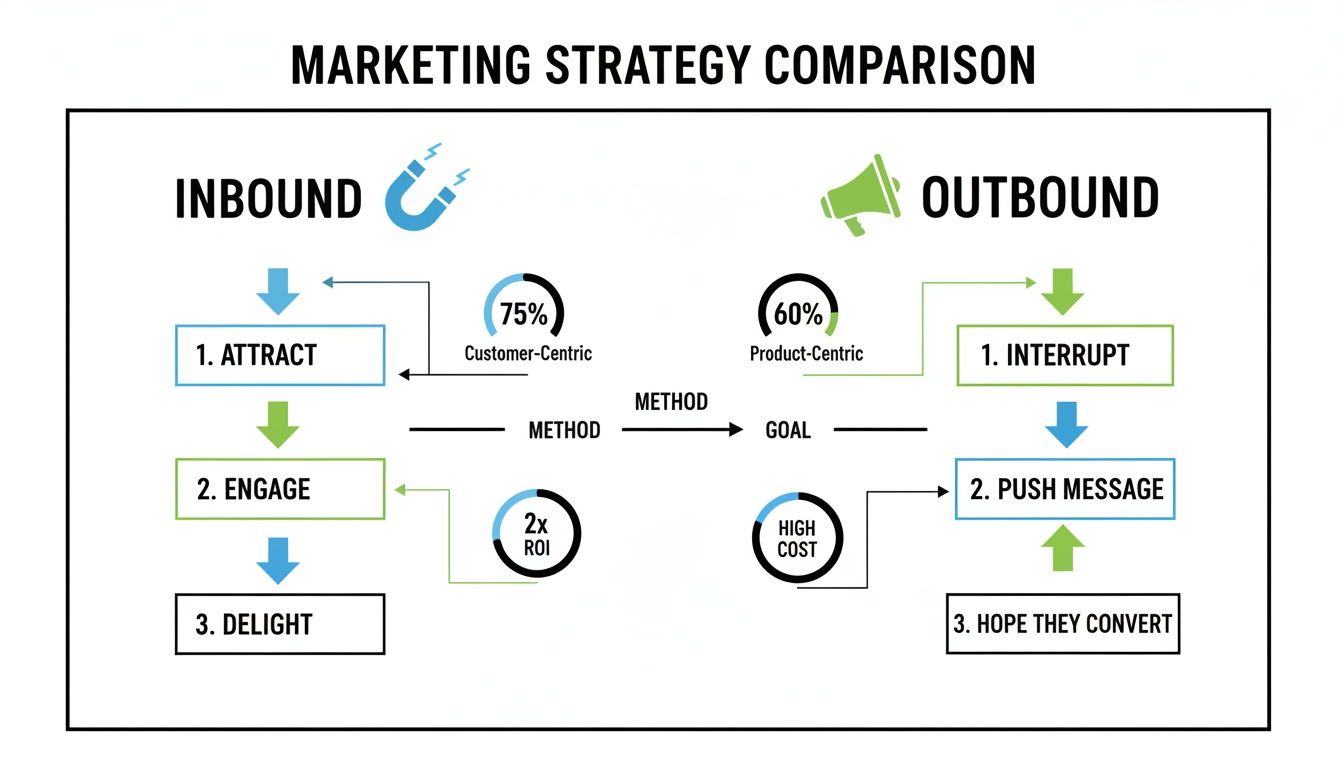
As the infographic shows, outbound sales proactively initiates contact through channels like calling and emailing, while inbound marketing works to attract potential customers with content and search engine optimization.
Key Outbound Sales Channels
Today’s sales teams have a whole toolkit of channels at their fingertips. The real magic, though, comes from using them together to create a surround-sound effect that makes your outreach feel less like a sales pitch and more like a helpful, relevant conversation.
- Hyper-Personalized Email: This is still the backbone of most outbound campaigns. But we're not talking about basic mail merges. Modern outreach involves deep research into a prospect’s company, their specific role, and recent industry news to craft messages that speak directly to their biggest headaches.
- Strategic Cold Calling: The cold call is far from dead—it just got smarter. Instead of being the first point of contact, it’s now often used to follow up on an email or a social media interaction. This simple shift turns a cold interruption into a much warmer, more contextual conversation.
- Value-Driven Social Selling: For B2B, platforms like LinkedIn are non-negotiable. Real social selling isn't about spamming InMail. It’s about building your credibility by sharing genuinely useful content, engaging with a prospect’s posts, and establishing yourself as a known entity before you ever send a connection request.
- High-Impact Direct Mail: Let's be honest, our digital lives are noisy. A physical item arriving on someone's desk can cut through that clutter like nothing else. Sending a thoughtful, personalized package to a high-value account creates a memorable experience that an email just can't match.
The best outbound strategies don't rely on a single channel. A typical sequence might start with a LinkedIn connection request, follow with a personalized email, and then use a phone call to reference both previous touchpoints, creating a multi-threaded conversation.
The Standard Outbound Workflow
To get the most out of these channels, you need a structured, repeatable workflow. This blueprint is what brings consistency and scalability to your sales efforts, allowing you to measure what works and do more of it.
- Define Your Ideal Customer Profile (ICP): Before you write a single email, you have to know exactly who you're talking to. This means digging into firmographics (company size, industry, geography) and technographics (the tools they already use), and truly understanding their day-to-day challenges.
- Build a Clean and Targeted Lead List: With your ICP locked in, the next step is to find people who match it. This involves using data providers, sifting through public sources like LinkedIn, and—crucially—verifying every contact to ensure your messages actually get delivered. Garbage in, garbage out.
- Craft Multi-Touch Sequences: This is where the action happens. You’ll build a series of 8-12 touchpoints that unfold across multiple channels (email, phone, social) over a few weeks. Each touch should build on the last, offering a little more value and gently keeping your solution top of mind.
- Execute and Personalize at Scale: Now it's time to launch your sequences. Use automation tools to handle the repetitive parts, but always leave room for a human touch. A salesperson should be adding a custom sentence or two to each email based on their research. It’s this detail that makes outreach feel one-to-one.
- Analyze, Iterate, and Optimize: Hitting "send" is just the beginning. You have to obsessively track your key metrics—open rates, reply rates, meetings booked. Use this data to A/B test your messaging, tweak your timing, and constantly refine your workflow to get better results over time.
How to Build Your High-Impact Outbound Playbook
An effective outbound sales strategy isn’t built on guesswork; it’s built on a playbook. Think of this as your team's single source of truth—a detailed guide that outlines everything from who you’re trying to reach to what you’ll say and when you’ll say it. It’s what transforms random acts of outreach into a repeatable, scalable system for generating qualified meetings.
Without a playbook, your reps are basically winging it. That leads to inconsistent messaging, unpredictable results, and a lot of wasted effort. A well-crafted playbook ensures everyone follows a proven process, making your whole outbound motion more efficient and much easier to fine-tune over time. It’s the blueprint for predictable growth.
Defining Your Ideal Customer Profile
First things first: you absolutely must have a crystal-clear Ideal Customer Profile (ICP). This isn't just a vague idea of who might buy your product. It’s a laser-focused, data-backed definition of the companies that will get the most value from your solution—and, in turn, be the most profitable for you to acquire.
The best way to build your ICP is to look at your happiest existing customers. What do they have in common?
- Firmographics: What industry are they in? How big is the company (by employee count or revenue)? Where are they located?
- Technographics: What other tools are in their tech stack? Knowing what software they already use can signal a perfect fit for your solution.
- Behavioral Traits: What was happening in their business right before they started looking for a solution like yours? Maybe they just closed a funding round, hired for a key role, or announced a new initiative. These are your triggers.
A precise ICP is your North Star. It stops your team from chasing dead-end leads and focuses all their energy on accounts with the highest chance of closing.
Crafting Resonant Messaging and Value Propositions
Once you know exactly who you're targeting, you need to figure out what to say. Let's be honest, generic pitches are dead on arrival; they get deleted in a heartbeat. Your value proposition has to cut through the noise by speaking directly to your ICP’s biggest headaches.
Your outreach shouldn't lead with what your product does. It should lead with a deep understanding of the prospect's problem and a clear, compelling glimpse of the solution.
Try creating a messaging matrix. Map your ICP’s specific pain points to your key features and the real-world results they deliver. For example, instead of saying, "Our software automates workflows," you could say, "We help operations managers like you get back the 20+ hours they lose each week to manual data entry." See the difference? You’ve reframed your solution around direct, measurable impact.
Integrating Account-Based Marketing Principles
For your absolute best-fit, highest-value accounts, a standard outreach sequence just won't cut it. This is where you bring in principles from Account-Based Marketing (ABM). The idea is to treat each of these high-value companies as a "market of one." Instead of casting a wide net, ABM focuses your sales and marketing firepower on a hand-picked group of target accounts with personalized, high-touch outreach.
This targeted approach dramatically improves the quality of your pipeline. When sales and marketing team up on an ABM strategy, it shifts the entire definition of outbound from a volume game to a precision one. In fact, a notable 61% of companies report better pipeline quality when they adopt this alignment. You can dig into more data on ABM's impact with insights from Martal Group. This strategy involves creating hyper-personalized campaigns that speak to the specific challenges and goals of each target account, ensuring your message lands perfectly with key decision-makers.
A solid playbook is the foundation of any successful outbound team. To help you get started, here’s a quick rundown of the essential components every playbook needs.
Essential Outbound Playbook Components
| Playbook Component | Key Objective |
|---|---|
| Ideal Customer Profile (ICP) | To define the exact type of company that benefits most from your solution. |
| Buyer Personas | To identify the key roles and decision-makers within your ICP accounts. |
| Value Proposition & Messaging | To craft compelling, pain-point-specific messaging for each persona. |
| Outreach Channels | To determine the most effective channels (email, phone, LinkedIn) to reach prospects. |
| Cadences / Sequences | To map out the specific touchpoints, timing, and content for outreach campaigns. |
| Objection Handling | To equip reps with proven responses to common questions and pushback. |
| Sales Enablement Content | To provide reps with case studies, one-pagers, and decks to support conversations. |
| Key Performance Indicators (KPIs) | To define the core metrics for measuring success and optimizing performance. |
Each of these elements works together to create a cohesive and powerful system that guides your team, streamlines your process, and ultimately drives predictable revenue.
How to Actually Measure Outbound Sales Success (The KPIs That Matter)

If you're running an outbound sales strategy without tracking the right numbers, you're essentially just guessing. It's like taking a road trip without a map. To build a repeatable, predictable revenue machine, you need to be obsessed with the right Key Performance Indicators (KPIs).
These numbers do more than just sit on a dashboard; they tell you a story. They show you what's clicking, what's falling flat, and exactly where you need to adjust your approach.
Ditch the Vanity Metrics
So many teams get hung up on metrics that feel good but mean very little. A classic example is the email open rate. Sure, it’s nice to know your subject line worked, but an open doesn't pay the bills. It doesn't tell you if your message actually connected with the person who read it.
To really get a pulse on your performance, you have to look past these surface-level stats and focus on the KPIs that signal genuine interest and intent.
These are the outbound metrics that truly matter:
- Reply Rate: This is your first real gut check. What percentage of people are actually hitting "reply" to your emails or messages? A low reply rate is a huge red flag that your core message or value prop isn't landing.
- Positive Response Rate: Let's be honest, not all replies are good news. This KPI is much more telling because it filters out the polite "no thank yous" and focuses only on people who show real interest—by asking a question, showing curiosity, or agreeing to chat.
- Meetings Booked: For any SDR team, this is the holy grail. How many of your conversations are turning into actual meetings on the calendar? This is the primary metric that proves your prospecting efforts are generating real, tangible opportunities for the business.
When you get right down to it, "meetings booked" is the bridge between your prospecting activity and your sales pipeline. It’s that critical handoff where potential turns into a real opportunity.
From Daily Activity to Dollars and Cents
At the end of the day, all this activity has one purpose: driving revenue. The most important KPIs are the ones that draw a straight line from your team's daily grind to the company's bottom line.
- Pipeline Generated: This is the total dollar value of all the sales opportunities your outbound team has created. It answers the big question every exec wants to know: "Are we creating qualified deals that can actually close?"
- Sales Cycle Length: How long does it take for a lead sourced from your outbound efforts to become a paying customer? Tracking this helps you forecast revenue with far greater accuracy and spot any friction points that are slowing deals down.
By zeroing in on these kinds of actionable KPIs, you stop guessing and start building a truly predictable system. You'll know exactly which levers to pull—whether that means A/B testing your email copy to improve reply rates or tightening your ICP to book more meetings with the right kind of prospects.
The Future of Outbound Sales with AI and Automation
The old playbook for outbound sales is being rewritten, and the authors are AI and automation. These tools aren't here to replace talented salespeople. Instead, they’re here to supercharge them by taking over the grinding, repetitive tasks that eat up the clock. It's a fundamental shift from a game of numbers to a game of value.
Think of AI as a dedicated research partner for every rep on your team. Modern platforms, like our own Roger, can do the heavy lifting of building hyper-targeted lead lists, making sure contact details are accurate, and even drafting personalized emails to kick off the conversation. This gives your team their time back to focus on what people do best.
Technology handles the science of prospecting—the data, the scale, the timing—so your salespeople can master the art of the conversation. They can dedicate their energy to building genuine relationships, deeply understanding customer challenges, and navigating complex deals.
This partnership between human and machine means that, for the first time, personalization and efficiency aren't at odds. Your outreach becomes smarter, not just louder.
Scaling Intelligence, Not Just Activity
Where AI and automation really shine is in their ability to scale intelligence. Imagine tools that can analyze countless data points to pinpoint the exact right moment to reach out, or suggest the messaging most likely to resonate with a specific buyer persona. This is how you build an outbound engine that’s both strategic and incredibly effective.
And this approach isn't just a "nice-to-have" anymore; it's becoming critical for growth. A recent survey of 300 senior sales and marketing leaders revealed that 78% see outbound as vital for their company's growth. What's more, 39% called it their core engine for breaking into new markets and shortening sales cycles. You can dig deeper into these findings on B2B outbound strategies at MarketingProfs.
At the end of the day, the future of outbound belongs to teams that figure out how to fuse human expertise with machine efficiency. When you let automation handle the grunt work, your team is free to operate at a higher level, forge stronger connections, and drive the kind of predictable revenue everyone is chasing.
Your Top Outbound Sales Questions, Answered
Is Outbound Sales Still Effective?
Yes, without a doubt. The old spray-and-pray tactics are dead, but modern outbound is thriving, especially in the B2B world.
Today’s approach is smart and targeted. It’s all about using data to handpick high-value accounts—the exact ones that probably wouldn’t stumble upon you otherwise. Think of it as the engine for proactive, predictable growth.
What Is the Biggest Challenge in Outbound Sales?
The biggest hurdle is simply cutting through the noise. Every decision-maker's inbox is overflowing with generic pitches and automated spam.
Winning today means doing your homework. It’s about deep personalization, showing you understand their problems, and building a real connection across multiple channels before you ever ask for a meeting.
Success in modern outbound is less about volume and more about relevance. The teams that win are those who do their homework and make every touchpoint feel personal and valuable to the prospect.
How Long Until Outbound Campaigns Show Results?
It depends on your industry and how complex your deals are, but you'll see early signs of life—like open and reply rates—within a few weeks.
But for the results that really matter, like a steady stream of booked meetings and a healthy pipeline, you need to give it 60 to 90 days. That’s typically how long it takes to build real momentum with consistent, well-tuned effort.
Ready to stop guessing and start growing? Roger is an AI-powered platform that runs your entire outbound motion, from finding perfect-fit leads to writing personalized outreach. Let Roger handle the prospecting so your team can focus on closing deals. Book more meetings with Roger today.