A Modern Guide to Outbound Lead Generation
December 19, 2025
Outbound lead generation is all about taking the initiative. Instead of waiting for customers to come to you, your team goes out and finds them. You're proactively identifying potential buyers who perfectly match your ideal customer profile and then starting the conversation through channels like personalized emails, direct outreach on LinkedIn, or even a well-timed phone call. It’s a strategy that puts you firmly in the driver's seat of your sales pipeline, making it an incredible engine for predictable B2B growth.
What Is Outbound Lead Generation Really
Let's think about it like this: you're fishing. With an inbound approach, you'd cast a big net in a popular part of the river and hope the right kind of fish swim into it. It works, but you're passively waiting for the fish to come to you. You might get some great catches, but it's largely out of your hands.
Outbound lead generation is more like spear fishing. You're not just waiting around. You've identified the exact fish you want, you know where it hangs out, and you make a direct, calculated move to catch it. It’s a proactive and highly targeted way to start conversations with specific, high-value accounts.
To make this distinction even clearer, let's look at a side-by-side comparison.
Outbound vs Inbound Lead Generation At a Glance
The table below breaks down the fundamental differences between these two powerful growth strategies. While they can and should work together, understanding their unique attributes helps you decide where to invest your resources for the best results.
| Attribute | Outbound Lead Generation | Inbound Lead Generation |
|---|---|---|
| Approach | Proactive ("push") - You initiate the conversation. | Reactive ("pull") - You attract prospects with content. |
| Targeting | Highly specific and account-based. You choose who you talk to. | Broader targeting, attracting a wider audience. |
| Speed to Results | Faster. You can see results (like booked meetings) in weeks. | Slower. Takes months to build authority and organic traffic. |
| Cost | Can have a higher initial cost per lead but often leads to larger deals. | Lower cost per lead over time, but requires significant upfront investment in content. |
| Control | High degree of control over lead volume and pipeline velocity. | Less direct control; dependent on algorithms and audience behavior. |
Ultimately, outbound gives you immediate control over your pipeline, while inbound builds a long-term, sustainable asset. The most successful companies find a way to make both work in harmony.
Taking Control of Your Pipeline
The real beauty of outbound is control. Inbound marketing is fantastic for building a brand and an audience over time, but the lead flow can feel unpredictable, especially if you're a newer company still building up your domain authority. Outbound, on the other hand, lets you turn the lead-generation faucet on or off whenever you need to.
This approach is a game-changer for businesses that:
- Target Niche Markets: When your ideal customer is a tiny slice of the market, you can't afford to wait for them to stumble upon your blog. Outbound lets you go right to them.
- Need Predictable Revenue: You can directly influence your pipeline. By controlling how much outreach you do, you get much better at forecasting how many meetings you’ll book and how many deals you'll close.
- Are Launching a New Product: Outbound is one of the fastest ways to get your new solution in front of potential buyers, gather immediate market feedback, and land those critical first customers.
The Modern Approach to Outbound Sales
Forget everything you think you know about old-school, aggressive sales tactics. The days of blasting out thousands of generic, one-size-fits-all pitches are long gone. Today, effective outbound is built on a solid foundation of deep research, genuine personalization, and delivering value from the very first touchpoint. The goal is to start a relevant conversation, not just make a quick sale.
The goal isn't just to reach out; it's to reach out with a message that makes the prospect feel understood. A well-executed outbound campaign demonstrates that you’ve done your homework and believe you can genuinely solve a problem for their business.
This shift from a volume game to a value game is everything. Top-performing sales teams now use data to find prospects who are already showing signs they're in-market, craft messages that speak directly to their pain points, and engage them across multiple channels to build familiarity. This thoughtful process is what turns a "cold" outreach into a warm, welcome introduction. It’s how you build real business relationships and, in the end, drive meaningful growth.
Building Your Outbound Foundation for Success
A killer outbound campaign doesn't just happen. It’s not about sending the first email or LinkedIn message. The real work starts way before that, with a rock-solid foundation.
Think about it like building a house. You wouldn't just start throwing up walls without a detailed blueprint and the right materials, right? That’s a recipe for disaster. Rushing the planning phase guarantees your whole structure will come crashing down.
In outbound, your Ideal Customer Profile (ICP) is that architectural blueprint. It's a meticulously detailed picture of the exact company you help. Your prospect list? That’s the high-grade steel and concrete you need to bring the plan to life. Skip this crucial groundwork, and your outreach is just noise—it might sound busy, but it accomplishes nothing.
Defining Your Ideal Customer Profile
Before you can go out and find your perfect customers, you have to know precisely who you're looking for. An ICP is much more than just basic info like industry or company size. A truly great ICP is a living document that captures the unique, subtle traits of your absolute best-fit accounts.
To get this right, you need to dig deep and answer some tough questions:
- What specific, costly pain points do we actually solve? Get granular on the problems that keep your customers up at night.
- What do our best clients have in common? Look at everything—revenue, employee count, the tech they use, even their business model.
- What events or "triggers" signal that a company needs us now? This could be a new round of funding, hiring for specific roles, or a recent expansion.
A massive part of building a smart foundation is understanding what is intent data and using it to find companies that are already in the market for a solution. This data shows you who's actively researching products like yours, giving you an incredible head start.
Building a High-Quality Prospect List
Once your ICP is crystal clear, it’s time to build your prospect list. This is where so many teams stumble. A huge list of mediocre leads is worthless compared to a smaller, hyper-targeted one. The mantra here is quality over quantity, always.
The goal is to pinpoint companies that are a perfect match for your ICP, then identify the right people inside those companies. We're talking about the decision-makers, the internal champions, and the key influencers who can actually make a purchase happen. Modern sales pros use a mix of tools like LinkedIn Sales Navigator, company databases, and industry news to find and verify these contacts.
This visual shows how this proactive, "hunting" style of outbound is fundamentally different from the more passive, "attracting" nature of inbound.
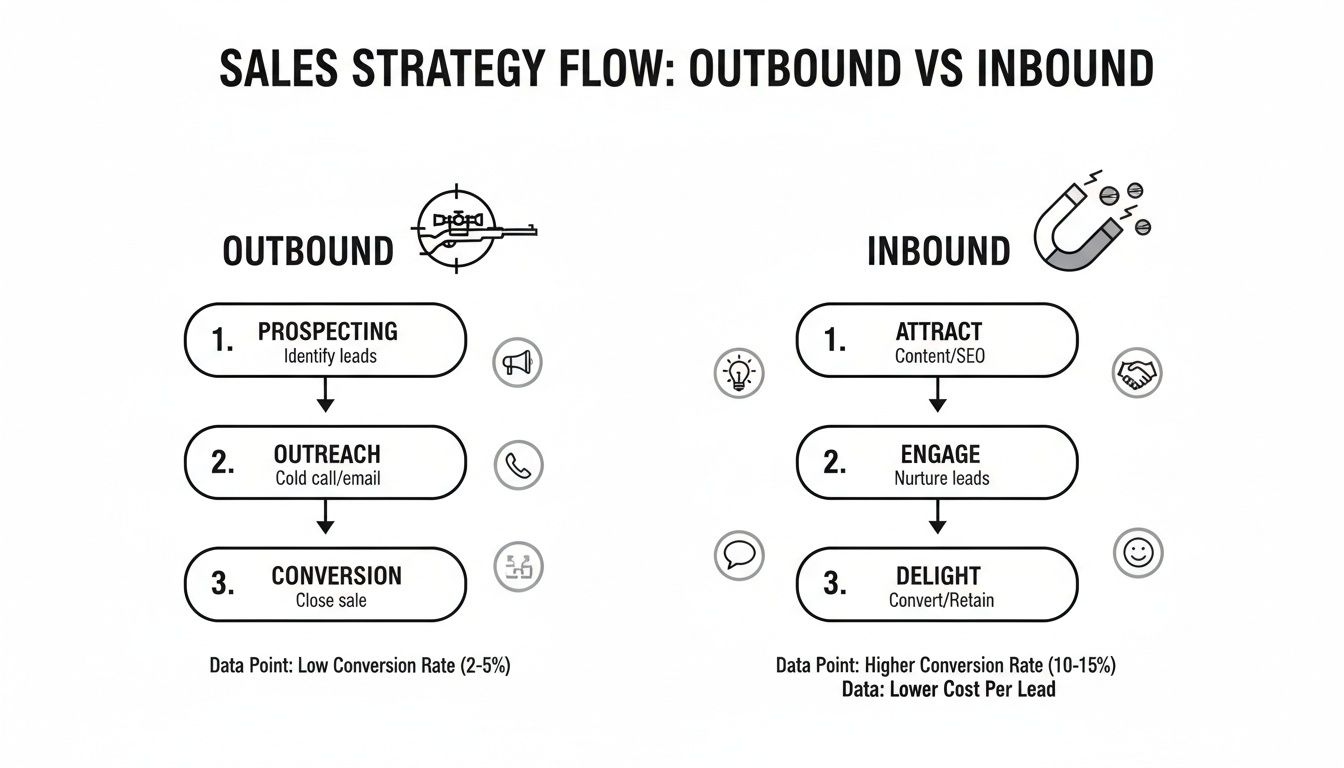
The takeaway is simple: inbound marketing casts a wide net, but outbound success hinges entirely on the precision of your initial targeting.
Crafting Messaging That Resonates
You’ve got your list. Now what do you say? It's time to write a message that actually earns a reply. Forget the generic templates and lazy personalization like [First Name] and [Company Name]. Real connection comes from proving you've done your homework and that you genuinely get your prospect's world.
Effective outbound messaging isn’t about you, your product, or your company. It's about the prospect—their challenges, their goals, and their priorities. Your message should be a mirror reflecting their reality back at them.
Your outreach needs to connect their specific situation to the problem you solve. For example, if your research shows that VPs of Operations in logistics are struggling with fleet inefficiency, don't lead with your features. Instead, reference a recent industry report on rising fuel costs or mention their company's latest expansion. This instantly signals relevance and builds credibility from the very first sentence.
Designing Intelligent Outreach Sequences
Finally, all this foundational work comes together in your outreach sequence. A sequence is just a planned series of touchpoints—across different channels like email, LinkedIn, and maybe a phone call—designed to start a conversation over a few days or weeks. Anyone can ignore a single email. It's much harder to ignore a thoughtful, multi-step approach.
Here’s what a simple but effective sequence might look like:
- Day 1 (Email): Kick things off with a highly personalized email focused on a specific pain point.
- Day 1 (LinkedIn): Follow up with a simple connection request or profile view. No pitch. Just get on their radar.
- Day 3 (Email): Circle back with a follow-up email that offers something of value, like a relevant case study or a short video.
- Day 5 (LinkedIn): Engage with their content. Like or comment on a post they shared to show you're paying attention.
- Day 7 (Email): Send a brief, final follow-up that gets straight to the point and asks for a meeting.
This multi-channel strategy dramatically increases your odds of getting noticed and shows you're persistent without being a pest. By investing real time and effort into these foundational pillars—ICP, list building, messaging, and sequencing—you're setting the stage for an outbound lead generation program that doesn’t just blast messages, but starts real business conversations.
Mastering Your Outbound Outreach Channels
Relying on just one channel for outbound lead generation is like trying to build a house with only a hammer. Sure, it's a great tool, but you won't get very far on its own. The real secret to cutting through the noise and getting noticed is a smart, multi-channel strategy.
This means weaving together different touchpoints—like email, LinkedIn, and maybe even a phone call—to create one seamless conversation with your prospect. Instead of sending a single message that’s easy to ignore, you build a subtle, professional presence that fosters familiarity and trust over time. Each channel has its own part to play in this coordinated effort.
And the data doesn't lie. A multi-channel approach consistently blows single-channel efforts out of the water. In fact, sales teams using three or more channels see 50% more prospect interactions. This isn't just a nice-to-have; it's a core driver of modern outbound success.

Weaving Together a Multi-Channel Strategy
Think about it from the perspective of a busy executive. One cold email lands in an overflowing inbox and gets archived in seconds. But what if that same executive first saw your name on a thoughtful LinkedIn comment, then received a relevant email a day later, and then saw you sent a connection request?
This multi-touch system works because it surrounds the prospect with value without being intrusive. Each interaction builds on the last, making your name and company feel familiar. The goal isn’t to bombard them; it’s to be consistently and helpfully present.
Here’s a simple breakdown of how the three main channels can work together:
- LinkedIn: This is your starting point for research and low-pressure engagement. Use it to get a feel for a prospect’s role, what they're posting about, and what's happening at their company.
- Email: This is where you deliver the detailed, personalized value. You take what you learned from your research and connect it directly to a problem you can solve for them.
- Cold Calling: Think of this as your special forces. Save it for high-value prospects who have shown some interest or when you need to accelerate the conversation and cut through the digital static.
Best Practices for Your Primary Channels
To make any of this work, you have to respect the nuances of each platform. Just copying and pasting the same message across every channel is a surefire way to get ignored. Every channel has its own etiquette and requires a unique touch.
Your outreach should feel like a natural conversation unfolding over time, not a series of disconnected sales pitches. The channel dictates the tone and format of the message.
Optimizing Your LinkedIn Outreach
LinkedIn is a professional network, first and foremost. That means your approach needs to be more about building relationships than hard-selling. To really get results here, you can dig into some proven LinkedIn lead generation strategies that go beyond the basics.
But start with these fundamentals:
- Warm Up the Connection: Before you even think about sending a request, go view their profile and engage with a recent post. It’s a small step that shows you've actually done some homework.
- Personalize Your Request: Ditch the generic connection request. Always add a short, custom note that references a mutual connection, a group you share, or something newsworthy about their company.
- Provide Value, Don't Pitch: Once you're connected, hold back on the immediate sales pitch. The best first move is to share a genuinely helpful article or offer an insight related to something they're focused on.
Crafting Emails That Get Replies
Email is still the workhorse of most outbound campaigns. Success here comes down to three things: personalization, relevance, and clarity.
- Write a Compelling Subject Line: It needs to be specific and intriguing, but not clickbait. Referencing a mutual connection or a recent company event can boost open rates by over 50%.
- Keep It Short and Scannable: No one wants to read an essay. Use short paragraphs, bullet points, and bold text to make your key points pop. Busy people don't read; they scan for value.
- End with a Clear Call to Action (CTA): Make it incredibly easy for them to respond. Instead of a high-commitment ask like, "Are you free to chat?", go for something softer, like, "Is this a priority for you right now?"
Measuring the Outbound Metrics That Matter

Running an outbound campaign without tracking the right numbers is like trying to drive across the country without a map or GPS. You’re burning gas and moving forward, but you have no clue if you’re actually getting closer to your destination. To guide your strategy, you have to separate the metrics that just look good from the ones that actually move the needle for your business.
Too many teams get lost in "activity metrics"—numbers that prove you're busy but don't prove you're effective. The real magic happens when you shift your focus to "impact metrics," which connect directly to your sales pipeline and revenue.
Activity Metrics: The Early Clues
Think of activity metrics as the leading indicators of your campaign's health. They’re the first signs that tell you whether your outreach mechanics are working at a basic level, but they don't reveal the full picture. They're like a doctor checking your vitals—important, but just the starting point for a real diagnosis.
Key activity metrics to watch include:
- Open Rate: The percentage of prospects who opened your email. A healthy open rate, ideally above 40%, tells you that your subject lines are compelling and your emails are actually landing in the inbox.
- Reply Rate: The percentage of people who responded to your message. This is a far more telling sign of whether your message is hitting home than opens alone.
- Click-Through Rate (CTR): The percentage of recipients who clicked a link you included. This signals they’re interested enough to check out a resource or your website.
These numbers are fantastic for troubleshooting problems at the very top of your funnel. For instance, if you have a great open rate but a terrible reply rate, you’ve pinpointed a classic disconnect. Your subject line got them in the door, but the email body completely failed to connect with their needs.
Impact Metrics: The Numbers That Drive the Business
While activity metrics help you diagnose issues, impact metrics are what the business truly runs on: qualified opportunities and cold, hard revenue. These are the KPIs that make it into the board deck and prove the real return on your outbound investment.
The goal of outbound isn't just to get opens or replies. It's to start meaningful conversations that lead to new customers. Your most critical metrics should always reflect that bottom-line objective.
This is where you need to focus your reporting and your team's energy:
- Positive Reply Rate: This is a crucial metric that filters out all the noise—the "unsubscribe" messages and out-of-office replies—to show you how many prospects are genuinely interested in talking.
- Meetings Booked: The total number of qualified demos or discovery calls set on the calendar. For most SDR teams, this is their north-star metric.
- Sales Qualified Leads (SQLs): This tracks how many of those booked meetings are accepted by the sales team as legitimate, high-potential opportunities.
- Pipeline Generated: The total dollar value of all the opportunities created from your outbound efforts. This is the ultimate measure of success and ROI.
By focusing on these, you graduate from measuring how busy you are to measuring the actual business impact you’re making.
Key Outbound KPI Benchmarks by Channel
To give you a better sense of what "good" looks like, it helps to compare your numbers against industry averages. Keep in mind that these are just starting points—your specific industry, audience, and messaging will cause them to vary.
| Metric | Cold Email Benchmark | LinkedIn Outreach Benchmark | Cold Calling Benchmark |
|---|---|---|---|
| Open/Connection Rate | 40%-60%+ | 20%-30% | N/A |
| Reply/Acceptance Rate | 5%-12% | 15%-25% | N/A |
| Positive Reply Rate | 1%-3% | 2%-5% | N/A |
| Meetings Booked | 0.5%-2% (of total sent) | 1%-3% (of total sent) | 1%-3% (of dials) |
| Call-to-Conversation | N/A | N/A | 5%-10% |
These benchmarks help you spot weaknesses. If your email reply rates are well below 5%, it’s time to rethink your messaging or targeting. If your call-to-conversation rate is under 5%, your team might need more training on their opening scripts.
Putting It All Together to Tell a Story
When you look at your metrics together, they tell a story. A consistently low open rate points to a deliverability problem or stale subject lines. A high positive reply rate that doesn’t lead to many booked meetings might signal a weak call-to-action or that SDRs are struggling to convert interest into a scheduled call.
By constantly analyzing this data, you can stop guessing and start making informed decisions. You can confidently A/B test a new subject line, refine your ideal customer profile, or tweak your outreach sequence, knowing exactly which lever to pull to get better results and prove the undeniable value of your outbound engine.
Deciding How to Scale Your Outbound Engine
So, your outbound lead generation machine is finally humming. You've proven the model works, and meetings are starting to fill the calendar. That’s a huge win. But now you're facing a new, much better problem: how do you scale this thing without it all falling apart?
This is a critical fork in the road. You essentially have two choices. Do you build out a dedicated team of Sales Development Representatives (SDRs) yourself? Or do you bring in a specialized outbound agency to do it for you? There’s no single right answer here—the best path forward really depends on your company's stage, budget, timeline, and what you're trying to achieve long-term. Let's break down the pros and cons of each.
The Case for an In-House SDR Team
Building your own SDR team is a bit like growing your own garden. It takes a lot more work upfront—you have to prepare the soil, plant the seeds, and water them constantly. But the upside is you get complete control over the final harvest. You hand-pick the team, immerse them in your company culture, and train them on every last detail of your product and market.
Going this route has some clear advantages:
- Total Control: Your team lives and breathes your brand every single day. You call the shots on strategy, messaging, and daily priorities, which means you can pivot on a dime as you learn what's working.
- Deep Product Knowledge: When your SDRs sit next to the product and marketing teams, they absorb knowledge by osmosis. They’ll develop a much deeper understanding of your solution and be able to handle tougher, more technical questions from prospects.
- Cultural Integration: An internal team is woven into the fabric of your company. It also becomes a fantastic talent pipeline for grooming future Account Executives and even sales leaders.
Of course, this level of control doesn't come cheap. The overhead for salaries, benefits, training, and the sales tech stack adds up quickly. Plus, finding, hiring, and onboarding a new SDR until they're fully productive can easily take a few months, creating a lag in your pipeline growth just when you want to accelerate.
The Case for an External Agency
Hiring an outbound agency is more like calling in a professional landscaping crew. They show up with their own top-of-the-line tools, a team of seasoned experts, and a playbook that’s been refined over hundreds of jobs. You trade some of that direct, day-to-day control for immediate speed and specialized expertise.
This path is often the perfect fit for companies that need to get results fast without the massive upfront investment. And the data backs this up. Some studies show that outsourcing can produce 43% better results than going it alone, completely changing how B2B companies build their sales pipelines. You can dig into more of these lead generation statistics and their impact on growth.
The key benefits of partnering with an agency really boil down to this:
- Speed to Market: A good agency can get a campaign launched and start booking meetings in weeks, not months. They already have the people, the tech, and the proven processes ready to go.
- Access to Expertise: You instantly tap into a team of specialists who do nothing but outbound sales, all day, every day. They bring a wealth of knowledge from other industries and are constantly testing new tactics.
- Cost Efficiency: While you'll pay a monthly retainer, you get to skip the hefty costs of salaries, benefits, software licenses, and recruiter fees that come with building your own team.
The main trade-off, naturally, is giving up some control. You set the high-level strategy, but the agency handles the day-to-day execution. This makes it absolutely critical to find a partner who feels like a true extension of your team and who nails your brand's voice and approach.
The decision to build or buy isn't just about cost; it's a strategic choice between control and speed. Do you need a perfectly customized engine built from scratch, or a high-performance one you can rent and deploy tomorrow?
Ultimately, the right choice hinges on your most pressing needs. If you have the capital and the patience to invest in a long-term, internal asset, building your own team is a powerful move. But if your number one priority is growing your pipeline right now and getting immediate access to proven experts, a specialized agency is often the smarter, faster path forward.
Your Top Outbound Lead Generation Questions, Answered
Even with the best game plan, it's natural to have questions when you're getting started with outbound. Let's tackle some of the most common ones I hear from teams diving in for the first time. Think of this as your cheat sheet for sidestepping common hurdles and building confidence.
Is Outbound Lead Generation Actually Still a Thing?
Absolutely. But let's be clear: the old way of doing outbound is dead. Blasting out thousands of generic, self-serving emails? That's a one-way ticket to the spam folder.
Modern outbound is a different beast entirely. It’s a surgical, value-first approach. It’s about using data to pinpoint the exact companies that need your help and then crafting a message that speaks directly to their problems. Done right, it lets you start conversations with high-value decision-makers who would have never stumbled across your website on their own.
How Long Until I Actually See Results?
This is where outbound really shines. While inbound marketing is a long game—often taking 6-12 months to gain traction with SEO and content—outbound can deliver a much quicker payoff. If you have a solid list and a compelling message, you can see the first sparks of interest in just a few weeks.
But "results" can mean a few different things, so let's break it down:
- Initial Engagement: You could see positive replies hitting your inbox within the first 1-2 weeks.
- Booked Meetings: A steady stream of qualified meetings usually starts to build within the first 30-60 days.
- Closed Deals: This one depends entirely on your typical sales cycle. It could be a few weeks or several months from that first meeting to a signed contract.
Inbound vs. Outbound: Which One Wins?
It’s the wrong question. It's never about "versus." The smartest growth strategies don't pick a side; they use both to create a powerful, balanced engine.
Here’s an analogy I like to use:
Inbound is like setting up a beautiful storefront on a busy street. You make your shop look amazing and hope the right customers wander in. Outbound is like having a personal shopper who goes out and hand-delivers invitations to your ideal clients for a private viewing.
Inbound is fantastic for building your brand and casting a wide net over time. Outbound gives you control and predictability right now, letting you go straight to the accounts you want most. You need both.
What are the Most Common Ways People Mess This Up?
It's rarely the channel's fault when a campaign fails. It's usually one of a few classic, avoidable mistakes. If you can steer clear of these, you’re already ahead of 90% of the pack.
Here are the top four campaign killers:
- Garbage In, Garbage Out: Starting with a bad list is the #1 reason for failure. If your contact data is inaccurate or your targeting is off, the most brilliant email in the world won't save you.
- Generic, "Me-First" Messaging: Nothing gets an email deleted faster than a generic template that screams "I'm sending this to 500 other people." Real personalization, based on actual research, isn't optional.
- Giving Up After One Email: Did you know most positive replies come after the third or fourth touchpoint? Quitting after one or two attempts is leaving a ton of opportunity on the table. Persistence is part of the formula.
- Flying Blind: If you aren't tracking your open rates, reply rates, and meeting booked rates, you have no idea what's working. You can't fix what you don't measure.
How Much Should We Budget for This?
The cost can swing pretty dramatically depending on your model. If you go the in-house route, you're looking at salaries, benefits, and software for each SDR—easily a six-figure investment per person, per year.
For many small businesses and startups, that's a heavy lift. That’s where partnering with a specialized agency or using an automation platform comes in. These options give you access to the expertise and tech stack without the massive overhead and ramp-up time of hiring. Ultimately, it’s not about the upfront cost, but the return. The real question is: for every dollar you put in, how much pipeline are you getting out?
Ready to scale your outbound lead generation without the heavy lifting? Roger automates the entire process—from finding verified decision-makers to sending hyper-personalized, multi-channel outreach. Let our AI-powered platform fill your calendar with qualified meetings while you focus on what you do best: closing deals. Book a demo with Roger today!