Sales Outbound Definition A Guide to Modern B2B Prospecting
December 28, 2025
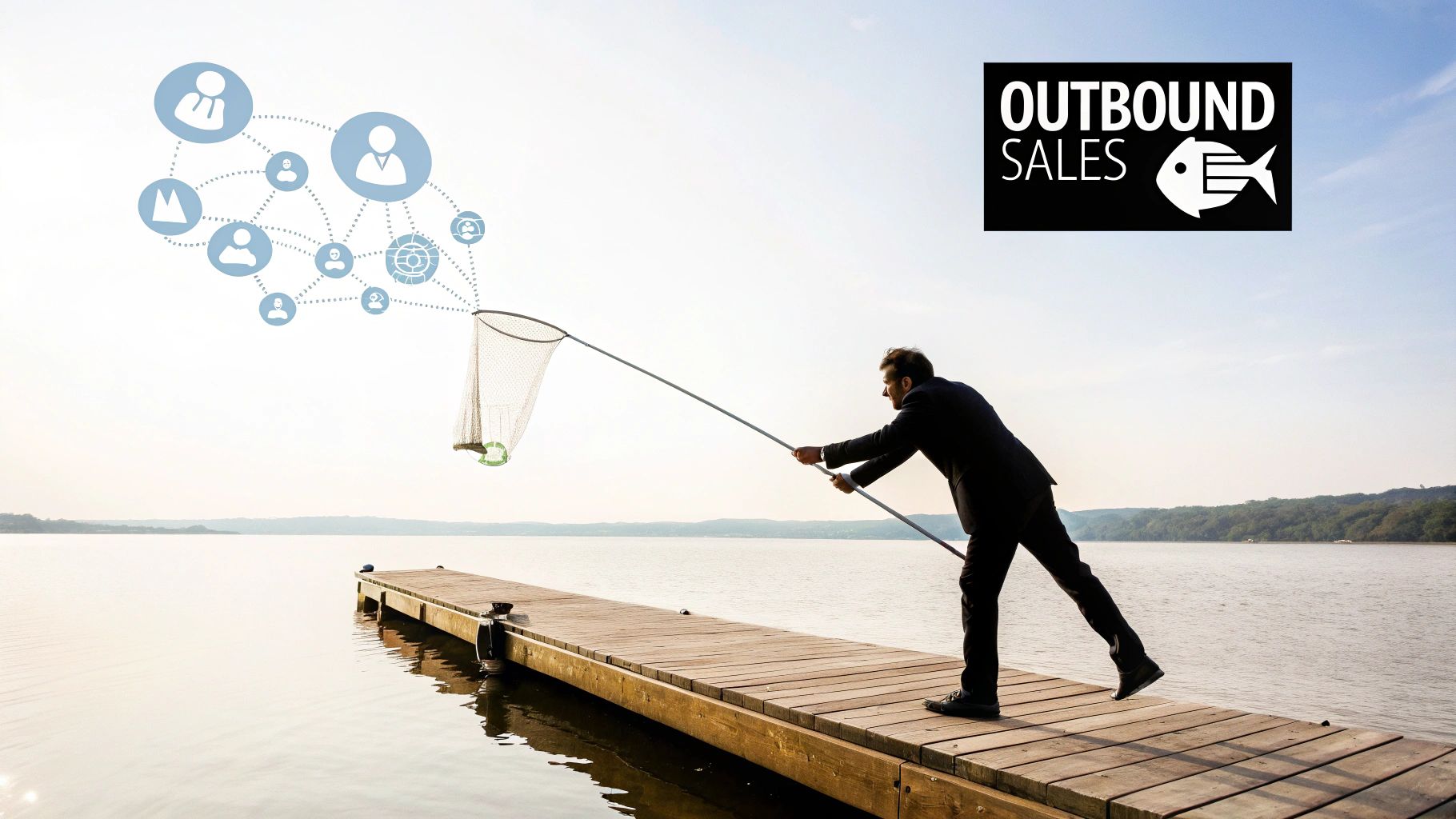
Let's cut right to the chase: sales outbound is the art of proactively hunting for your future customers. Instead of waiting for them to come to you, your sales team goes out and starts the conversation with people who haven't yet raised their hand to show interest.
What Is Sales Outbound?
Think of it this way: inbound sales is like setting up a shop and waiting for customers to walk in the door. Outbound sales is like being a skilled hunter who knows exactly what they're looking for, tracks it down, and makes a direct, personal approach. You're not waiting for business to happen; you're making it happen.
This isn't your grandfather's cold calling. Modern outbound isn't about dialing random numbers from a phone book. It’s a sophisticated, data-backed process designed to build a predictable sales pipeline. The real power here is control—you get to decide precisely who you engage with, making sure every ounce of effort is spent on prospects that fit your Ideal Customer Profile (ICP).
Core Components of Modern Outbound Sales
A strong outbound strategy isn't just one thing; it's a machine with several interconnected parts. Get these right, and you transform random outreach into a consistent way to book qualified meetings.
This table breaks down the fundamental pillars of a successful outbound sales strategy.
| Component | Purpose | Key Activities |
|---|---|---|
| Ideal Customer Profile (ICP) | To define the perfect company for your solution. | Analyzing firmographics (industry, size, revenue) and technographics. |
| Targeted Prospecting | To build a high-quality list of the right people at those companies. | Identifying decision-makers and influencers on platforms like LinkedIn. |
| Personalized Messaging | To craft compelling messages that stand out and resonate. | Researching individual pain points, company news, and industry trends. |
| Multi-Channel Sequencing | To engage prospects across different platforms for maximum impact. | Creating a structured series of touchpoints via email, LinkedIn, and calls. |
When these components work in harmony, your outbound engine really starts to hum. It's the difference between shouting into the void and having a meaningful conversation with someone who can actually buy from you.
Despite the buzz around inbound marketing, don't let anyone tell you outbound is dead. It’s a massive driver for B2B growth. In fact, research shows that more than 60% of B2B appointment setting still comes directly from cold outreach, proving just how crucial it is for tapping into specific, high-value market segments.
For anyone serious about building a robust sales pipeline, mastering outbound lead generation is non-negotiable. It's about shifting from a passive, hopeful mindset to actively creating opportunities with the exact customers you want to win. This proactive stance gives you direct control over your growth.
Outbound vs. Inbound: Understanding the Difference
To really get a feel for what sales outbound is all about, it’s helpful to put it side-by-side with its more famous counterpart, inbound sales. The easiest way to think about them is like a hunter versus a farmer.
Outbound sales is pure hunting. Your sales team acts like a skilled tracker, actively going after specific, high-value targets. They aren't waiting around for leads to show up; they're out there creating conversations with prospects who perfectly match their Ideal Customer Profile.
Inbound sales, on the other hand, is all about farming. This approach is about planting seeds—think blog posts, SEO, and social media content—and carefully nurturing them. The goal is to attract potential customers to you, growing their interest until they're ready to reach out.
The Fundamental Split
The biggest difference comes down to one simple question: who starts the conversation? Outbound is proactive, where the seller makes the first move. Inbound is reactive, where the buyer initiates contact. This single distinction changes everything, from your cost structure to how long it takes to close a deal.
With inbound, you're building assets that slowly attract an audience over time. It can take months, sometimes even years, to see a real return. The leads you get are usually "warm" because they’ve already engaged with your content and have some idea of who you are.
Outbound gives you immediate control and quick feedback. You can design and launch a campaign today and, if you do it right, start booking meetings within the week. You have total say over who you contact, giving you a level of precision that’s hard to match with inbound alone.
Outbound is all about precision targeting and making the first move. Inbound is about attracting an audience and letting them come to you. The smartest strategies don't pick one—they use both to build a predictable and resilient revenue engine.
Outbound vs. Inbound Sales: A Direct Comparison
While both outbound and inbound share the same ultimate goal—generating revenue—the way they get there couldn't be more different. Their mechanics, costs, and timelines are worlds apart. Understanding this helps you put your resources in the right place and set realistic goals for your team.
This table breaks down the two methodologies side-by-side.
| Attribute | Outbound Sales | Inbound Sales |
|---|---|---|
| Lead Source | Seller-initiated outreach (email, calls, social). | Buyer-initiated contact (content, SEO, ads). |
| Targeting | Highly specific and controlled by the seller. | Broad attraction based on content and keywords. |
| Scalability | Predictable; add more reps to increase activity. | Less predictable; depends on content velocity and SEO. |
| Cost Per Acquisition | Often higher initially but predictable over time. | Can be lower long-term but requires upfront investment. |
| Sales Cycle | Can be shorter as you target decision-makers directly. | Often longer as leads require more nurturing. |
| Feedback Loop | Immediate; you know quickly if messaging resonates. | Delayed; requires analyzing content performance data. |
Finding Your Strategic Mix
It’s easy to get caught up in the "either/or" debate, but the reality is that a hybrid approach almost always wins. While a solid inbound strategy can generate a significant 59% share of top-quality leads, outbound is essential for filling the gaps, driving over 60% of B2B appointments.
This is exactly why 43% of high-performing teams blend both. They use outbound's laser focus to land high-value accounts that a broad inbound net would likely miss. You can discover more about how modern sales teams build their strategies and see why a pure inbound model often leaves money on the table.
In the end, outbound gives you the power to go after the exact customers you want, right now. Inbound builds a valuable, long-term asset that draws customers to you over time. The most successful companies don't choose one; they get really good at both.
The Core Channels for Winning at Outbound
Once you’ve got your outbound strategy mapped out, it's time to bring it to life. In today's B2B world, you can't just pick one channel and hope for the best. The real magic happens when you orchestrate a smart sequence of touchpoints across different platforms, meeting your prospects where they already are.
The big three channels that form the backbone of almost any successful outbound plan are cold email, LinkedIn prospecting, and strategic cold calling. Each has a specific job to do. When you weave them together, you create a professional and persistent presence that’s hard for your ideal customers to ignore. Using them in isolation just doesn't cut it anymore.
The image below breaks down the fundamental difference between the proactive "hunter" style of outbound and the more reactive "farmer" approach of inbound.
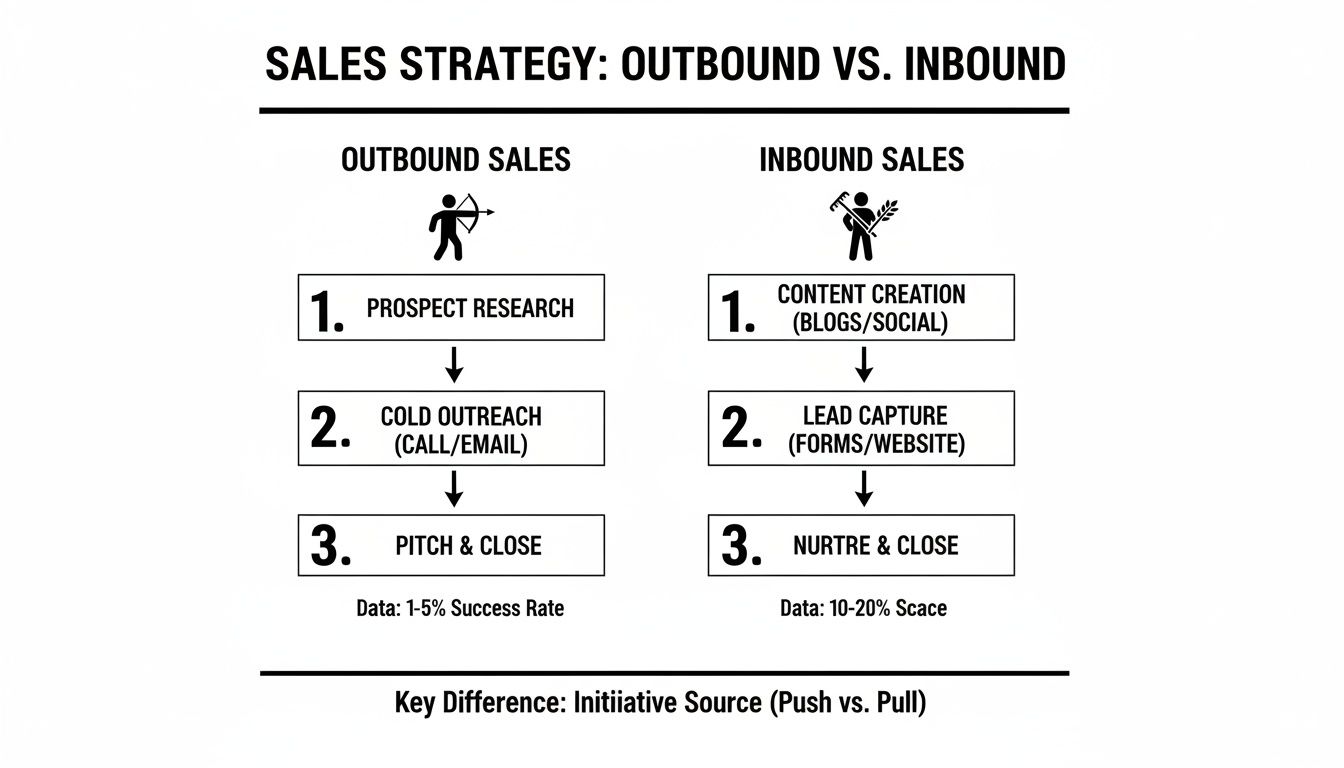
As you can see, outbound puts you firmly in control of starting the conversation, while inbound is all about attracting prospects who come looking for you.
Getting Cold Email Right
Cold email is still the workhorse of outbound sales. Why? Because it’s easy to scale, test, and personalize. But let's be clear: the days of blasting out generic, cookie-cutter templates are over. A great cold email in 2024 feels like a one-to-one message, even when it’s part of a larger campaign.
It all starts with the subject line. Your mission is to be intriguing and credible, not clickbaity. Simple, direct subject lines often work best because they feel human. Think "Quick question about [Company Name]" or "Idea for [Their Goal]."
In the body of the email, you have to get to the point—fast. Make your value proposition crystal clear within the first couple of sentences. The entire focus should be on a problem you can solve for companies just like theirs. Mention something you found on their LinkedIn profile or a recent company announcement to prove you've done your homework.
Here’s how to write emails that actually get a response:
- Keep it short and sweet. Aim for under 125 words. Busy people scan, they don't read novels.
- Make it about them, not you. Flip "We provide X" to "You can achieve Y."
- End with a simple, low-friction question. Instead of a demanding "Got 30 minutes for a demo?" try something like, "Is improving [Specific Area] a priority for you right now?"
Using LinkedIn for Smart Prospecting
LinkedIn isn't just a digital Rolodex anymore; it's a critical channel for building B2B relationships. It gives you the context you need to warm up a cold outreach and establish your credibility long before you ever ask for a meeting.
The biggest mistake people make is sending a connection request immediately followed by a sales pitch. That’s a one-way ticket to being ignored. The real goal is to provide value and build a little familiarity first.
Start by engaging with your prospect's content. Leave a thoughtful comment on their post. Share an article you think they'd find interesting. When you finally send that connection request, personalize it. Reference a shared connection, a recent post they made, or something you genuinely admire about their work.
A Simple Multi-Touch Sequence:
- Day 1: View the prospect's LinkedIn profile. Like one of their recent posts.
- Day 3: Send a personalized connection request that mentions the post.
- Day 5: Now, send a concise, value-focused cold email.
- Day 7: Follow up with a quick LinkedIn message: "Hi [Name], just sent an email with an idea for [Their Goal]. Did you happen to see it?"
The Place for Strategic Cold Calling
A lot of sales reps dread the cold call, but it’s far from dead—it has just evolved. When used strategically as part of a multi-channel sequence, a cold call can be your most powerful tool. It’s no longer about mindlessly dialing for dollars; it’s about making targeted, timely calls to people who have already shown a flicker of interest, like opening your email or connecting on LinkedIn.
The goal of a modern cold call isn’t to sell your product right then and there. It's to confirm their interest, ask a couple of sharp qualifying questions, and book a proper discovery call. Your opener needs to be direct and respectful of their time.
Try this: "Hi [Name], this is [Your Name] from [Your Company]. I know I'm calling you out of the blue, but do you have 27 seconds for me to tell you why I called?" This pattern disrupts their automatic "no" and buys you just enough time to state your case.
How AI Is Redefining Outbound Sales
The old playbook for outbound sales—based on pure hustle and volume—is officially a thing of the past. Artificial intelligence is completely overhauling the process, shifting it from a numbers game to a strategy of precision. AI isn't just another tool in the stack; it’s changing the very DNA of how teams find, personalize, and connect with potential customers.
Think of it this way: AI gives every sales rep a team of tireless researchers working around the clock. It takes on the soul-crushing, repetitive tasks that eat up most of a rep's day, freeing them to do what people do best: have meaningful conversations and close deals.
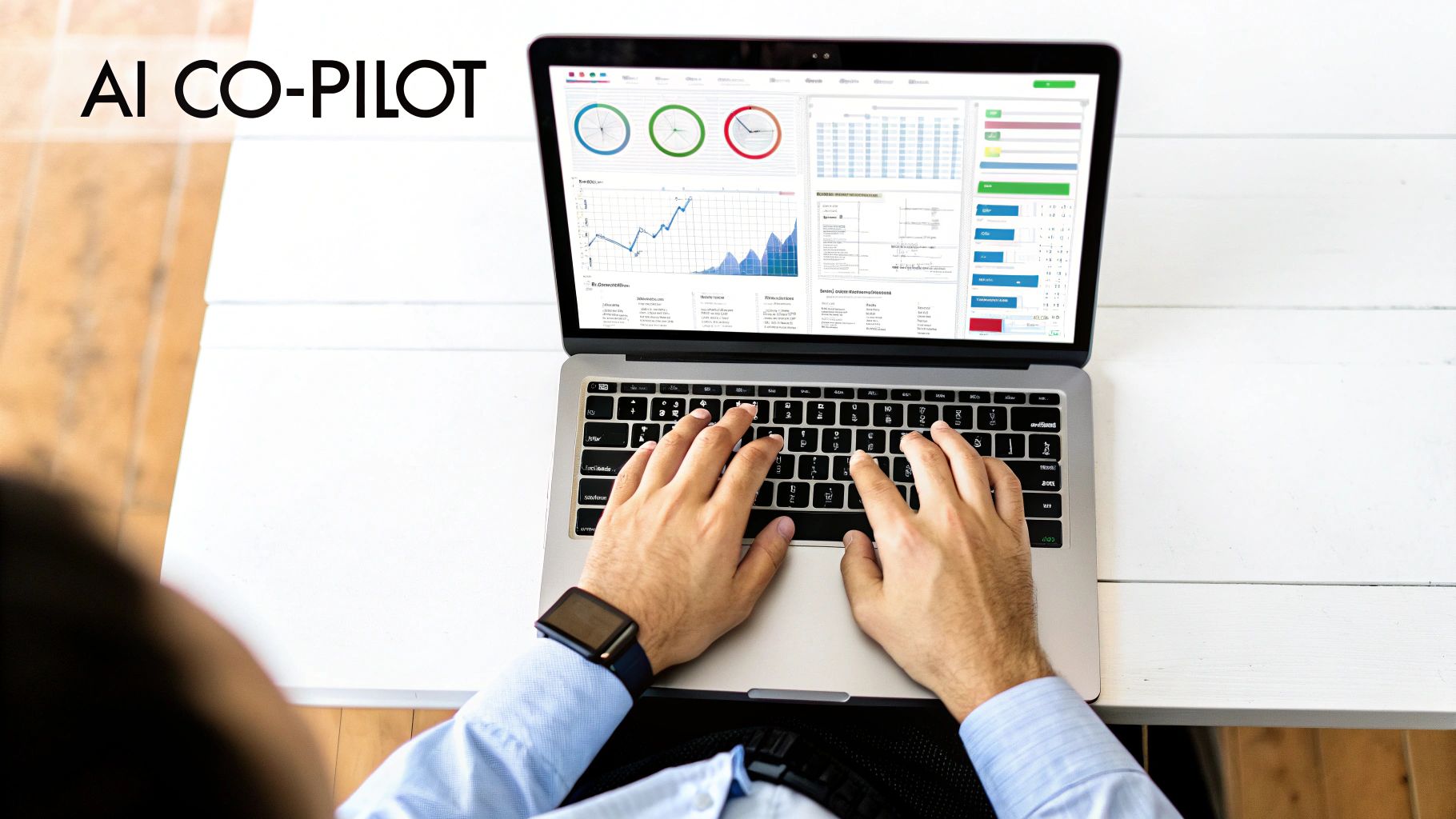
I like to think of modern AI platforms like Roger as an expert co-pilot for your sales team. Your rep is the pilot, focused on navigating the conversation and landing the deal. Meanwhile, the AI co-pilot handles all the critical prep work—charting the flight path (finding prospects), managing the comms (sending emails), and feeding the pilot real-time intelligence.
Automating Prospect Discovery and Verification
Let’s be honest, the biggest bottleneck in any outbound campaign is building a clean list of ideal customers. Historically, this meant reps spent countless hours scraping LinkedIn, guessing email formats, and then dealing with the frustration of bounced messages. It was slow, wildly inefficient, and frankly, a huge morale killer.
AI flips this entire script. Platforms like Roger constantly scan millions of data points across the web—company announcements, social profiles, news articles, job postings—to pinpoint decision-makers who are a perfect fit for your Ideal Customer Profile.
Even better, the AI doesn't just give you a name. It validates their contact info in real time, so you know your messages are actually hitting the right inbox. This keeps your deliverability high and your domain reputation safe. The result? Your team starts every morning with a fresh, verified list of high-value prospects, ready to go.
By automating discovery and verification, AI gives back thousands of hours. Your sales team can finally stop acting like data miners and start being the strategic sellers they were hired to be.
Achieving Personalization at Scale
Everyone knows personalization is what cuts through the noise. But doing it manually just doesn't scale. A single rep can't possibly research hundreds of prospects a day and write a genuinely custom message for each one. This is where AI has its biggest "wow" moment.
AI agents become research assistants, automatically digging up key insights for every single person on your list.
- Recent LinkedIn Activity: It can pull a quote from a recent post they shared.
- Company News: It might reference a recent funding round or a new product launch.
- Shared Connections: It can spot a mutual contact to help build instant rapport.
- Pain Points: It analyzes online conversations to find clues about their current struggles.
All this intel is then used to generate hyper-personalized lines—or even full email drafts—that feel authentic and relevant to that one individual. The shift is already happening. Recent data shows that 54% of sales teams now use AI for personalized outbound emails and 45% for account research. For teams that have adopted it, over half report a 10-25% lift in their sales pipeline. You can learn more about AI's effect on modern prospecting to see the tangible results for yourself.
Intelligent Sequencing and Optimization
Finally, AI plays the role of an intelligent campaign manager. Forget manually tracking follow-ups in spreadsheets. AI-powered platforms can run sophisticated, multi-channel sequences on autopilot. They know the best time to send an email, when to follow up with a LinkedIn request, and crucially, when to back off if a prospect seems disengaged.
This smart automation keeps your team persistent without being annoying, ensuring no qualified lead ever slips through the cracks. The AI can even A/B test different subject lines, CTAs, and value props on the fly, constantly learning and fine-tuning your outreach for better results. It creates a self-improving system that turns your outbound motion into a predictable engine for growth.
Key Metrics for Measuring Outbound Performance
You can't improve what you don't measure. An outbound strategy without data is just a series of hopeful guesses. To really master outbound, you have to get serious about tracking the right metrics. They’re the vital signs of your sales engine, telling you exactly what’s working, what’s broken, and where you need to focus.
This isn't just about counting wins at the end of the quarter. It's about understanding the entire journey, from that first cold email to a signed contract. Each metric tells a piece of the story, helping you diagnose problems in your process before they sink your entire campaign.
Leading Indicators of Campaign Health
Before you ever see pipeline or revenue, you need to know if your outreach is even getting noticed. These are your leading indicators—the early signals that tell you if your messaging is hitting the mark or falling flat.
Think of these as the top of your sales funnel. If you have a problem here, nothing else matters.
Email Open Rate: What percentage of people actually opened your email? A strong open rate, ideally above 50%, means your subject lines are grabbing attention and you're not getting flagged as spam. If this number is low, your subject line is the first thing to fix.
Reply Rate: This is where the rubber meets the road. How many people replied? A high open rate with a low reply rate is a huge red flag—it means your subject line worked, but the body of your email failed to connect. This metric shows true engagement.
Positive Reply Rate: Let's get more specific. This metric filters out the "not interested" and "unsubscribe" responses to focus only on replies that show actual interest, like "Tell me more" or "When can we connect?". This gives you a much clearer picture of who is genuinely intrigued by your offer.
Lagging Indicators of Business Impact
Leading indicators track activity, but lagging indicators measure results. These are the metrics that tie your outbound efforts directly to what the business really cares about: meetings, pipeline, and revenue. For a deep dive into this, check out A Practical Guide to Sales Reporting and Metrics.
These are the KPIs that prove your outbound strategy is actually making money.
The ultimate goal of any outbound sales definition is to create predictable revenue. Tracking conversion rates at each stage of the funnel—from reply to meeting, and meeting to opportunity—is the only way to build a reliable forecasting model for your business.
A healthy outbound machine moves prospects smoothly from one stage to the next.
Meetings Booked: This is the big one for most sales development reps (SDRs). It’s the raw number of qualified meetings your team sets from their outreach. It's a direct measure of your team's productivity and the campaign's immediate success.
Meeting-to-Opportunity Conversion Rate: Of all the meetings that happened, what percentage turned into a real, qualified sales opportunity in your CRM? This metric is crucial for judging meeting quality. A low conversion rate here suggests your team is booking meetings with the wrong people or the handoff to the account executive needs work.
Common Outbound Mistakes to Avoid
Even the sharpest, most well-planned outbound strategies can fizzle out. What separates a campaign that floods your calendar with qualified meetings from one that gets completely ignored? It usually comes down to dodging a few common, yet critical, mistakes.
I've seen so many teams get excited about outbound, invest in all the shiny new tools, and build massive contact lists, only to end up with nothing but a sky-high unsubscribe rate. The problem almost always boils down to a fundamental failure: they don't respect the prospect's time and inbox.
Let's walk through the three biggest blunders and how you can sidestep them.
Mistake 1: Neglecting Your ICP
The single biggest mistake in outbound is not having a crystal-clear Ideal Customer Profile (ICP). Seriously. If you don't know exactly who you're trying to reach, you’re just shouting into the wind. This inevitably leads to vague, generic messaging that tries to speak to everyone and ends up resonating with no one.
What Not to Do: Buying a huge, generic list of "VPs of Sales in tech" and blasting them all with the same email. This is a surefire way to get abysmal engagement and, even worse, damage your domain reputation.
What to Do Instead: Get surgical. Define your ICP with a sharp focus on firmographics (like company size, industry, or revenue) and technographics (the specific tools they already use). A focused ICP like "Series B SaaS companies with 50-200 employees using Salesforce" lets you craft a message that hits on their specific challenges.
Mistake 2: Relying on Generic Templates
In a world where everyone is drowning in content, generic outreach is the fastest ticket to the spam folder. Your prospects are smart—they can spot a copy-and-paste template from a mile away. If you're using the same tired lines as everyone else, you'll be ignored just like everyone else.
What Not to Do: Firing off an email that starts with "I hope this email finds you well" and is packed with self-serving "we provide" statements about your features.
What to Do Instead: Personalize with a purpose. I'm a big fan of the "one-to-few" approach. You create a solid core template for a specific persona, but you add 1-2 completely unique sentences for each person. Mention a recent LinkedIn post they wrote, a company announcement, or a shared connection. It shows you actually did your homework.
A great outbound email shouldn't feel like marketing. It should feel like a relevant, one-to-one message from a helpful expert who understands a specific problem the recipient is likely facing right now.
Mistake 3: Giving Up Too Soon
This one is painful to watch. So many reps send one or two emails, hear crickets, and immediately mark the lead as dead. That’s a massive waste of potential pipeline. The data doesn't lie: most positive replies come after the fourth touchpoint, yet most reps give up after just two.
What Not to Do: Sending two emails a week apart and then abandoning the prospect forever. You are leaving a significant amount of revenue on the table with this approach.
What to Do Instead: Build a persistent, multi-channel sequence. A great starting point is 8-12 touches spread over 3-4 weeks, blending email, LinkedIn engagement, and a few strategic calls. This shows you’re serious and professional without being a pest, and it dramatically increases your odds of starting a real conversation. It’s all about being professionally persistent, not pushy.
Common Questions About Outbound Sales
Even with a solid grasp of the basics, putting an outbound sales strategy into practice brings up a lot of questions. Let's tackle some of the most common ones that teams face when getting started.
Is Cold Calling Dead?
Not at all—but the old way of doing it definitely is. Gone are the days of mindlessly dialing down a list. A modern cold call is a strategic touchpoint, often part of a bigger plan that includes emails and LinkedIn messages.
Think of it less as a cold pitch and more as a way to start a real conversation. When you've done a bit of homework on the person and their company, you can get straight to the point with a relevant idea. It’s a powerful way to cut through the noise and book a meeting.
How Much Personalization Do I Really Need?
This is all about balancing relevance with your time. You don’t need to craft a completely unique email for every single person. The most effective approach is what you might call a "one-to-few" model, where you customize just a small piece of an already strong template.
Start with a message tailored to a specific type of customer and their biggest headache. Then, just add a sentence or two about something you noticed—like a recent company announcement or a post they shared on LinkedIn. This shows you've paid attention without taking up your entire day. AI tools are getting incredibly good at doing this part for you.
The point of personalization isn't to show you know how to use Google. It's to prove you understand their world enough to be worth their time right now.
What’s the Ideal Length for an Outbound Sequence?
There’s no single right answer here, but the sweet spot for most successful sequences is somewhere between 8 and 12 touches. You'll want to spread these out over three or four weeks. The goal is to be persistent without being a pest.
A good sequence also mixes it up. You should be using a combination of email, LinkedIn, and phone calls, and each message should offer something a little different. And, of course, the whole thing should stop the second someone replies. The best advice is to experiment with different lengths and timing to see what clicks with your audience.
Ready to build an outbound engine that practically runs itself? Roger uses AI to handle everything from finding the right customers to personalizing your outreach and booking meetings. This frees up your team to do what they do best: close deals. See how it works at hireroger.com.